Court ratifies minimum sentence for leader of the Beltrán Leyva cartel

The Mexican justice system closes the case with a controversial sentence, while the capo faces his fate in the United States.

The decline of a titan of crime: the sentence that shakes Mexico

In a twist that left the country in suspense, a College Court confirmed the sentence of just ten months in prison and a ridiculous fine of 84 pesos against Jesús Ricardo Patrón Sánchez, alias “El H3”, former lord of terror of the Beltrán Leyva Cartel. The Mexican justice system, in an act that many consider insufficient, found him guilty of simple possession of methamphetamine, a crime that pales in comparison to his history of blood and power.

The final escape: the shadow of extradition

But fate, capricious and cruel, had already written another episode. In February of this year, the claws of US law snatched him from the national territory to face monumental charges: international drug trafficking, possession of weapons and leadership of a criminal organization. While Mexico debated his sentence, the northern empire prepared its own trial, one that could bury him behind bars for decades.

RelatedThey arrest a drug trafficker linked to the Beltrán Leyva in Sinaloa

The defense of “El H3”, desperate as a cornered animal, alleged defects in the process: they accused the Jalisco judge of omitting key testimonies from the Federal Ministerial Police, those who participated in the search where he was captured. However, the judges of the Second Court of Appeals dismissed his arguments with the coldness of an executioner, thus sealing his fate on Mexican soil.

The fall of the heir: from Nayarit to infamy

The operation that took him down was worthy of a movie: agents from the FGR and the Army broke into a building in Tlajomulco de Zúñiga, Jalisco, finding not only the feared Beltrán Leyva plaza boss in Tepic, but also an arsenal of drugs that revealed his empire. His alias, “H3”, was no coincidence: he was the designated successor of Héctor Beltrán-Leyva, the legendary “H”, and brother of “El H2”, killed by the Navy in 2017 in an epic confrontation.

The organization he commanded, baptized with the same sinister name as his fallen brother, extended its tentacles from Nayarit and Sinaloa to American cities such as Los Angeles, Las Vegas and New York. Today, his legacy of violence and addiction crumbles between courts and cells.

Did this story impact you? Share it and discover more about the dark ins and outs of organized crime in our special section. The drama, we promise, is not over.
One year after the discovery in a crematorium, families march for justice

One year after the discovery of 386 bodies, families demand justice and an end to corruption.

March for justice one year later

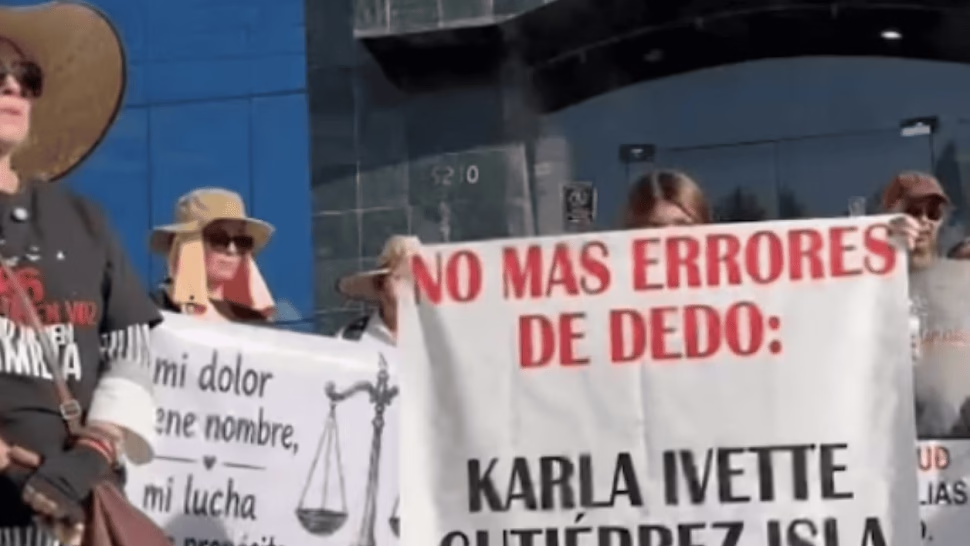
On Saturday afternoon, groups of families affected by the Plenitude crematorium case demonstrated. The discovery of 386 bodies turns one year old, and the bereaved demand answers.

The protest began at the Latinoamericana funeral home, one of those identified by family members. From there, the protesters walked towards the State Attorney General’s Office (FGE).

Dora Elena Delgado, spokesperson for the Justicia para Nuestros Deudos collective, reported that at least 1,500 families were affected. The central demand: no more impunity, no more corruption and full justice.

Actions pending by the authority

The protesters carried blankets with messages of justice. They demand action against Coespris officials involved in the case, as well as the recapture of José Luis A. C., owner of the crematorium. He was released by a federal judge, and a red card from Interpol is expected to arrest him again.

So far, of the 386 bodies found, the FGE reports that 135 remain to be identified. The identification process continues.

The collective Memory, Dignity and Justice joined the mobilization. They placed a permanent memorial in the shape of a cross outside the Prosecutor’s Office, as a reminder of the victims.

Continue reading

Sheinbaum asks to preserve native corn for national sovereignty

Sheinbaum highlights that native corn is key to food sovereignty and national identity.

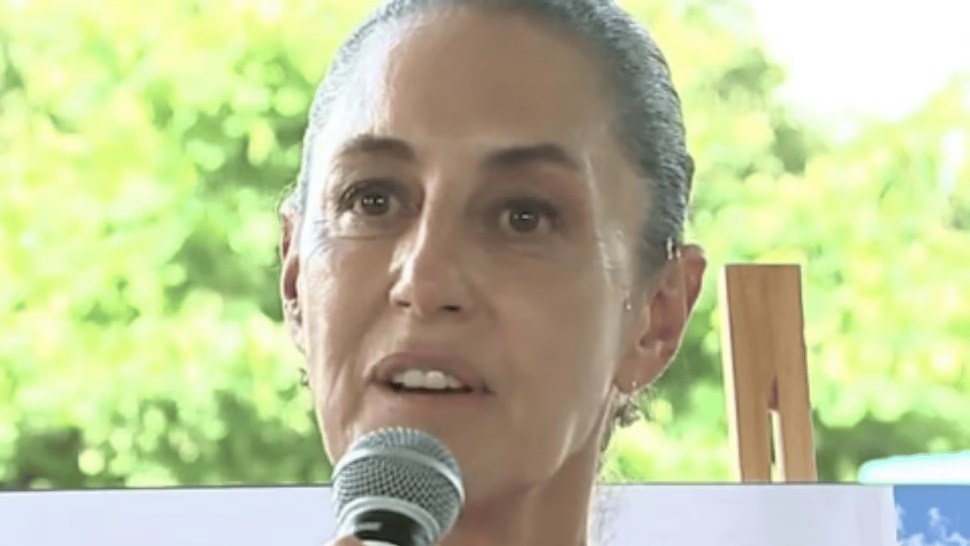
President Claudia Sheinbaum Pardo reaffirmed that the governments of the Fourth Transformation defend national sovereignty in all areas. During a meeting with farmers in Pijijiapan, Chiapas, he highlighted the importance of native corn as a pillar of Mexican identity and self-sufficiency.

Defense of sovereignty through native corn

Sheinbaum presented the “Corn is the Root” program, whose objective is to improve the conditions of producers and reduce dependence on seeds controlled by large corporations.

“Conserving native corn also means defending sovereignty,” he stated.

The president warned about the risks of hybrid seeds:

“If we continue with pure hybrid corn, people will depend on buying seeds and those who sell the seeds will be a few companies.”

He stressed that preserving native varieties is essential to avoid this economic dependence.

“If we did not have native corn, we would lose a good part of food sovereignty, of what we are as Mexicans,” he said.

In addition, it extended the defense of sovereignty to the energy, cultural and food fields. She assured that the Fourth Transformation drives her “in every possible way.”

The program seeks to strengthen small farmers and conserve the genetic diversity of corn, a central element in the country’s diet and culture.

Continue reading

Mexico sends rescue team to Venezuela after earthquakes

25 specialists and 5 canine pairs travel to support search efforts in Venezuela.

Solidarity in action

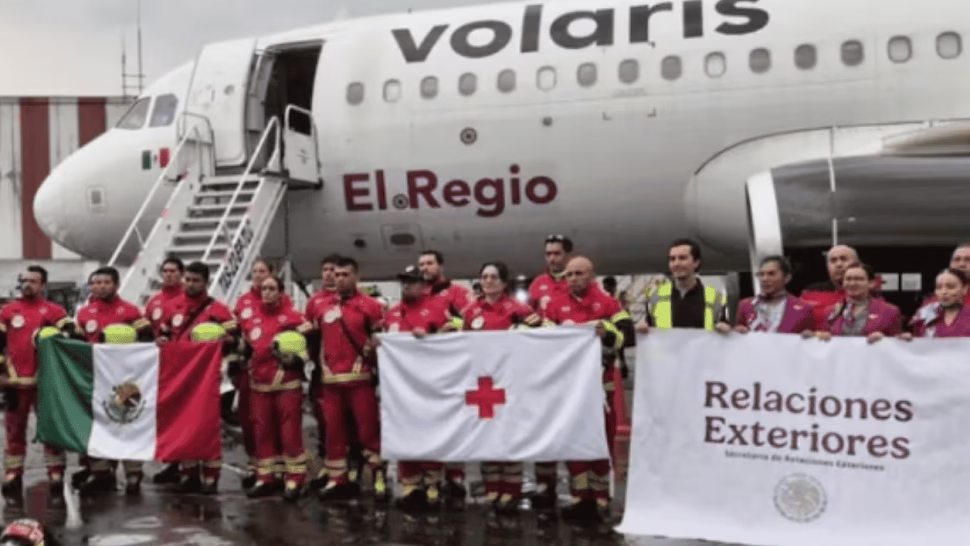
After the earthquakes of magnitude 7.2 and 7.5 registered in Venezuela on June 24, which left 1,430 dead and 3,328 injured, Mexico reinforced its humanitarian support. The Ministry of Foreign Affairs (SRE) coordinated the sending of a rescue mission with the Mexican Red Cross and the Volaris airline.

“This afternoon a support team made up of 25 specialists from the Urban Search and Rescue Unit (USAR) of the Red Cross and the Cancun International Rescue Brigade (USAR BRIC) left for Venezuela, as well as a brigade element from the Azteca Topos,” the agency indicated.

Equipment and logistics

The mission includes five canine pairs and 3.5 tons of specialized equipment for search and rescue tasks in the rubble. The shipment was transported on a Volaris flight.

“With this, Mexico reaffirms its solidarity and commitment to the Venezuelan people in these difficult times,” the SRE said in a statement. Foreign Minister Roberto Velasco heads the coordination of this aid.

Continue reading