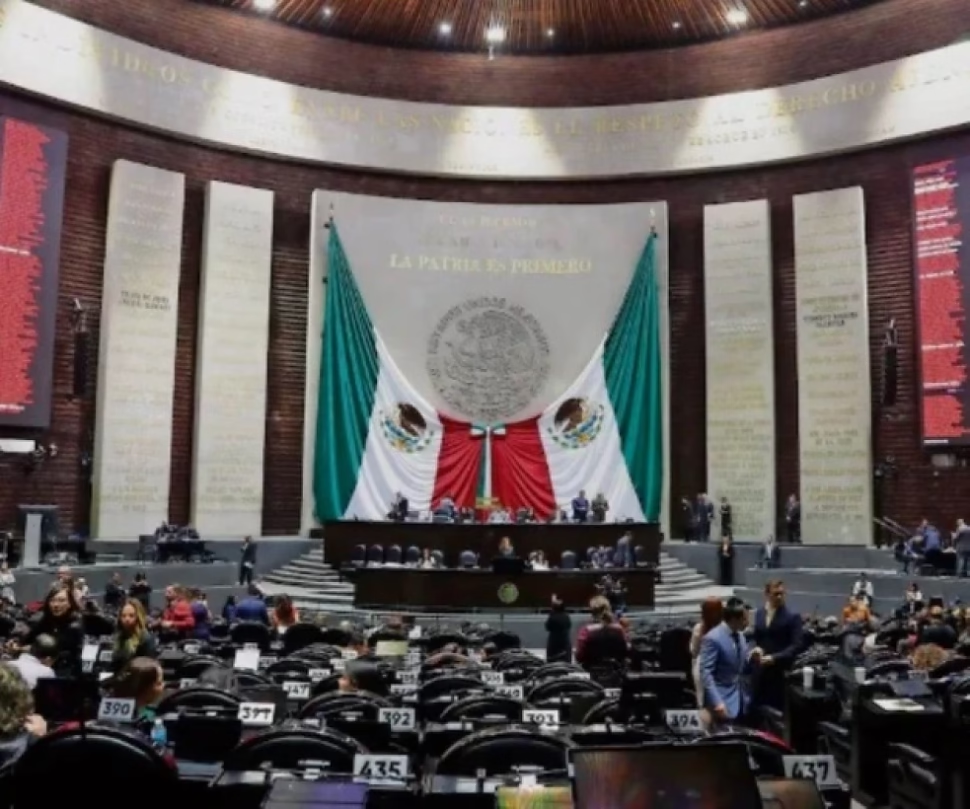
Congress installs Bicameral National Security Commission

Legislative week begins with the installation of a key commission and debates on justice and gender.

Legislative work of the week

The Permanent Commission of the Congress and the Senate launched an agenda with key activities for this week. The installation of the Bicameral National Security Commission stands out, in addition to meetings focused on justice and gender.

Laura Itzel Castillo Juárez, president of the Board of Directors, detailed on social networks that the work will start this Monday with sessions in both chambers. The meeting of the Justice Commission will analyze initiatives on the General Law on Itinerant Civic Justice.

RelatedPermanent Commission of Congress meets for less than an hour without political debate

The Bicameral National Security Commission will be headed by Morena legislators. Its installation represents a step in the coordination between cameras for security issues.

Adjustments for soccer and indigenous participation

Castillo Juárez announced that the session of the Permanent Commission will be moved to Tuesday, June 23, due to the Mexican team’s match. The young indigenous woman Reina Juliette de la Cruz de la Cruz, originally from Veracruz, will participate in that session.

The Senate will also commemorate International LGBTTTIQA+ Pride Day, while work continues in commissions on gender equality, justice and national security.

The agenda reflects legislative priorities on security, human rights, and civic justice issues, with a focus on the inclusion and participation of historically marginalized groups.


Sheinbaum demands justice for the death of a young man at the Tamaulipas academy

Sheinbaum asks to investigate the death of a young man in a militarized academy in Tamaulipas; mother demands federal action.

President Claudia Sheinbaum spoke about the death of Dafne Quintos, which occurred last week at the Doenitz Academy, in Ciudad Madero, Tamaulipas. He demanded that justice be done and recalled that the campus does not depend on Sedena, but on the state government.

“Justice has to be done, obviously, in this case,” he said during the Morning.

Sheinbaum explained that they are state education centers with military training and strict discipline. It is up to the government of Tamaulipas to investigate and the state Attorney General’s Office to clarify the facts.

Mother’s reaction

Alejandra Quintos, the teenager’s mother, regretted that the president delegated the case to local authorities. He asked for support “from woman to woman” to solve the crime.

“It is a femicide. It is a human life, it is not an animal. She died tortured, with her lungs filled with water up to the trachea. She died from asphyxiation due to submersion,” he declared.

She questioned the lack of federal action: “Aren’t they going to capture them? Isn’t it her responsibility? Isn’t she there to safeguard the entire Republic? Since the day she lost her life, there have been no detainees.”

Investigation in progress

The prosecutor of Tamaulipas, Jesús Eduardo Govea Orozco, reported that the investigations were extended to all the academy staff, including its director and owner. The campus was closed to facilitate the proceedings.

He confirmed that forensic studies established that the cause of death was asphyxia due to submersion. The folder remains open under two figures: feminicide and intentional homicide.

The case continues under the femicide protocol, while the family demands justice and that those responsible be captured.

Continue reading

AT&T Mexico loses a million prepaid users due to mandatory registration

One million prepaid users unsubscribed from AT&T Mexico due to mandatory registration.

Mandatory registration of mobile lines hits AT&T Mexico

The mandatory cell line registration process had a strong impact on AT&T Mexico’s prepaid customer base. During the second quarter of 2026, the company lost one million users in that segment. At the end of June, it had 15 million 829 thousand prepaid customers, according to its financial results.

In contrast, the postpaid service reported significant growth. The company added 369 thousand new clients, an increase of 20.7% compared to the same period of the previous year. Thus, it reached a total of 7 million 457 thousand users at the end of the semester.

Since January, telecommunications companies began registering mobile lines in the national registry. However, only 43% of the lines had been registered to date. Given this, the federal government extended the deadline to complete the process. The suspension of service for those who do not comply will begin in stages between August 15 and December 31.

The general director of AT&T Mexico, Mónica Aspe, indicated that the company will concentrate its efforts on successfully concluding the linkage process during the second half of the year. For its part, the consulting firm The Competitive Intelligence Unit (CIU) attributed the reduction in prepaid lines to the mandatory registration.

Despite the decrease in prepaid users, AT&T reported total revenue of $1,224 million in the second quarter. This represented annual growth of 16.1%, driven primarily by a favorable exchange rate. In addition, the company highlighted the strengthening of its network and the deployment of 5G infrastructure in stadiums and Fan Fest areas during the World Cup tournament, as part of its growth strategy.

Continue reading

US plans 10% tariff on Mexico for forced labor

A new 10% levy would replace temporary US tariffs linked to labor compliance.

The United States is evaluating replacing the temporary tariffs that expire this week with a regional scheme focused on combating forced and child labor. The measure would impose a 10% tax on Mexican products, according to international trade specialists.

New tariff scheme

The tax would be linked to compliance with labor legislation and the prohibition of importing goods made with forced or child labor. It would also apply to inputs from third countries where these practices exist. Sanctions could hit entire regions, not just specific companies.

Adrián Castillo, partner at Von Wobeser y Sierra, pointed out that if US authorities detect signs of forced labor in a company in a certain area, trade restrictions would be extended to the entire region. He recalled that the T-MEC already includes provisions against goods produced under these conditions, and that Mexico implemented certification mechanisms since 2025.

Regional impact

Jorge Molina, a foreign trade specialist, indicated that the new tax will replace the temporary tariff established by Washington and responds to President Donald Trump’s strategy. He added that the measure seeks to prevent products manufactured with Chinese inputs from entering the US market through Mexico.

The precise details of the scheme will be known in the coming days, but experts warn that it will especially affect sectors with high exposure to the regional supply chain.

Continue reading