Commercial gentrification transforms neighborhoods and displaces businesses

A tsunami of boutique cafes and gourmet restaurants destroys traditional businesses, rewriting the commercial map of cities.

The Invisible Siege: When Traditional Commerce Fades

In the beating heart of the Mexican metropolises, a silent and epic battle is being fought that is redefining the very soul of its streets. It is not a conflict with weapons, but with leases and lifestyles. A perfect storm of shortage of supply and a demand that knows no limits has unleashed an unprecedented escalation, raising the rental price of commercial premises up to a terrifying 18 percent in just three years. This is not a simple market adjustment; It is a revolution that is erasing the familiar face of the neighborhoods forever.

The neighborhoods that are crowned as the new epicenters of fashion become magnets for a legion of tenants with superior purchasing power, bearers of radically different consumption habits. This army of new residents, eager for exclusive experiences, is not looking for the usual fonda or the traditional tortería. Its arrival marks the beginning of a forced exodus for emblematic businesses, which are disappearing like tears in the rain, leaving behind a void that is quickly occupied by signature restaurants, international chain cafes, art galleries, gourmet markets and urban experience spaces. This phenomenon, a tsunami of commercial transformation, is not limited to Mexico City; Its shadow extends voraciously over Mérida, Monterrey and Guadalajara.

RelatedThird anti-gentrification march paralyzes the center with closures and surveillance

The Great Commercial Migration and the Change of Directions

Cuauhtémoc Rivera, president of the National Alliance of Small Merchants (Anpec), stands as a chronicler of this urban drama. With a warning voice, he reveals that this phenomenon of repopulation and rising prices is not an anecdote, but the new reality. “Not only do the rents of the premises become more expensive, but there is also a change in the business because people arrive with other types of consumption,” he says. The landscape is now painted with specialty coffees with exotic menus, fine pastries, artisan pastries and organic or vegan food proposals. Each new opening is a nail in the coffin of tradition.

But in this great theater of gentrification, the plot has an unexpected twist. Rivera introduces a glimmer of hope in the midst of tragedy: “Demand does not disappear, it simply transforms. Clients change on one side, but they appear on another. The art is knowing how to relocate with a certain speed and a certain degree of skill.” Displaced businesses, those anonymous heroes like convenience stores, do not become extinct; They undertake a migration to other neighborhoods, carrying with them the legacy of a more authentic commerce. However, the new territory conquered by the elite demands boutiques with designer clothing, artisanal pieces and a luxury that was previously foreign.

Alba Rodríguez, specialist in real estate trends, provides the blood-curdling analysis. He describes this displacement of traditional businesses as one of the most controversial and painful consequences of gentrification. Those businesses that for decades were the heart and meeting point of communities, which saw entire generations grow up, are now forced to close the shutters permanently, crushed by the lethal combination of stratospheric rents and vanishing local demand. It is not just an economic change; It is the loss of the cultural identity and collective memory of a neighborhood.

This story of urban transformation is more than news; It is the chapter of a novel where the characters fight for their economic and cultural survival. The future of our cities is decided in these streets, in this struggle between overwhelming modernity and resistant tradition. Are you witnessing this transformation in your own neighborhood?Share this story on your social networks and help us explore the changing faces of our urban landscape. Visit our site to discover more analysis on the impact of gentrification in your city.

Sheinbaum reinforces security and housing in Cuautla

The president presented a package of social and security actions in Cuautla, Morelos.

President Claudia Sheinbaum visited Cuautla, Morelos, to announce a set of social and security measures. Among them, the construction of 10 new schools of the “Margarita Maza” National High School, house-to-house visits, more jobs through Young People Building the Future and a greater presence of the National Guard.

“We are going to build together, because this is a job for everyone, for families to care for their children, for the state government and for the federal government,” the president highlighted.

The visit occurred after the arrest of the mayor of Cuautla. Sheinbaum instructed strengthening the federal presence with attention to the causes, as part of the National Security Strategy. Next week they will begin house-to-house tours and outreach to merchants. He promised to return in three months to monitor progress.

Housing for Wellbeing

At the event, 128 Infonavit homes and 207 Insus deeds were also delivered. Sheinbaum recalled the four components of the program: build 1.8 million new houses for people with incomes of one to two minimum wages; deliver the same number of credits for improvement; grant a million deeds; and restructure unpayable loans for 5 million families.

Octavio Romero Oropeza, director of Infonavit, reported that of the goal of 1.2 million homes, there are already 440 approved complexes that total 514 thousand houses (43% progress). In Morelos, the goal is 13 thousand new homes with an investment of 8,150 million pesos.

Edna Elena Vega Rangel, head of Sedatu, explained that 128 homes and 207 deeds were delivered. Governor Margarita González Saravia thanked the expansion of the state goal to 24 thousand houses in the six-year term, in addition to other works such as modernization of the countryside, a Convention Center in Cuernavaca and the “Circuito Tierra y Libertad” highway program.

The beneficiary Kendra Ramírez Orozco expressed her gratitude for access to housing. Sheinbaum reiterated his commitment to return in three months to follow up.

Continue reading

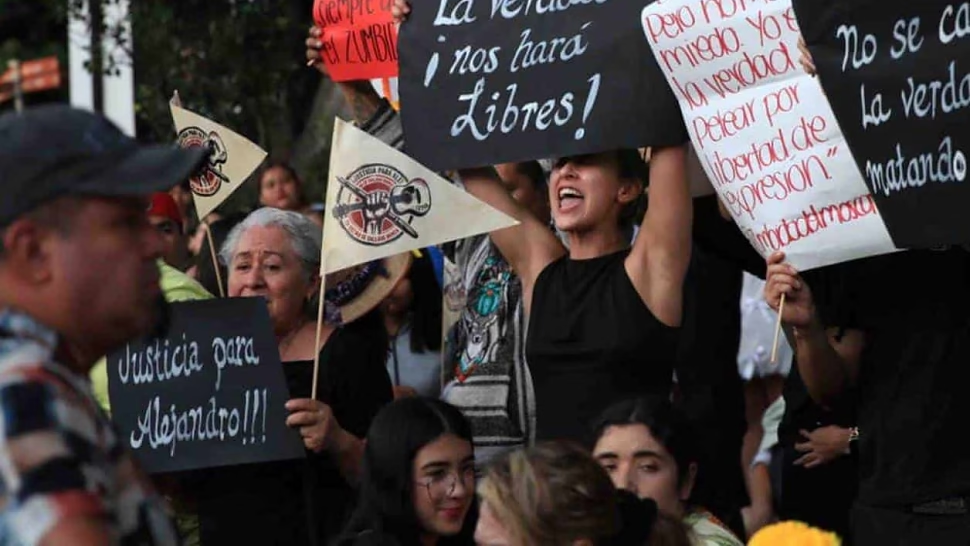
They demand justice for a journalist in Oaxaca; colleague receives threats

Threats against journalist in Oaxaca after the murder of Alejandro Leyva; protest in the Guelaguetza.

Threats against correspondent

After the murder of Francisco Alejandro Leyva Aguilar, Proceso‘s correspondent in Oaxaca, Pedro Matías Arrazola, was intimidated through social networks. They warned him that he would be next.

Organizations such as Reporters Without Borders and the UN demanded that the threats be investigated and security guarantees granted. The Oaxaca Prosecutor’s Office deployed two agents to protect him, and the state police carry out patrols near his home.

“I didn’t find out until they told me about Reporters Without Borders and then the UN, but I didn’t pay much attention to it (…). Better to keep a low profile,” declared Matías.

The journalist explained that he avoided spreading the threats so as not to divert attention from Leyva’s case. However, colleagues advised him not to minimize the risk, in a context of growing attacks against the press.

Two years ago, individuals threw Molotov cocktails with nails at his home, without causing any injuries. That attack forced him to leave the country for six months. Sixteen years earlier he was kidnapped and tortured.

“I am not afraid. I am a believer. I have a mission in this life and it will be until God decides,” he stated.

Matías filed a complaint for threats with the State Prosecutor’s Office. Its incorporation into the federal protection mechanism began.

“If we remain silent, they will have achieved their purpose. In recognition of Alejandro Leyva, I will continue along the same critical line,” he said.

Protest in Guelaguetza

Relatives and friends of Alejandro Leyva protested during the Guelaguetza delegation parade. With tarps, banners on the roof of a house and dressed in black, they demanded justice.

“We are Alejandro’s family and we ask for justice for my uncle. We know the situation in the country. It is not just Oaxaca, it is the entire country. Please join our cause,” expressed the protesters.

Continue reading

Sheinbaum announces border reopening for Mexican cattle

Gradual reopening of the US border to Mexican cattle at the end of August.

New stage for national livestock farming

President Claudia Sheinbaum confirmed that the United States border will gradually reopen at the end of August for the export of Mexican livestock. The measure represents economic relief for the country and for thousands of families dedicated to livestock farming.

Both nations suffered losses during the shutdown, caused by the presence of the screwworm. Sheinbaum acknowledged that the coordinated work between governments and producers for more than a year made it possible to contain the pest.

“You know that we have been working on the issue, both with all the livestock organizations and with the governors, to contain the screwworm,” said the president from Cuautla, Morelos.

As part of the strategy, a plant to produce sterile flies is already operating in Chiapas. In addition, Cofepris is analyzing a new strain that would make the process more efficient.

Sheinbaum explained that the effort is carried out in conjunction with the governments of Mexico, the United States and Panama. This articulation created the conditions for the US authority to authorize the opening of the border.

Continue reading