The Scenario of Incendiary Criticism
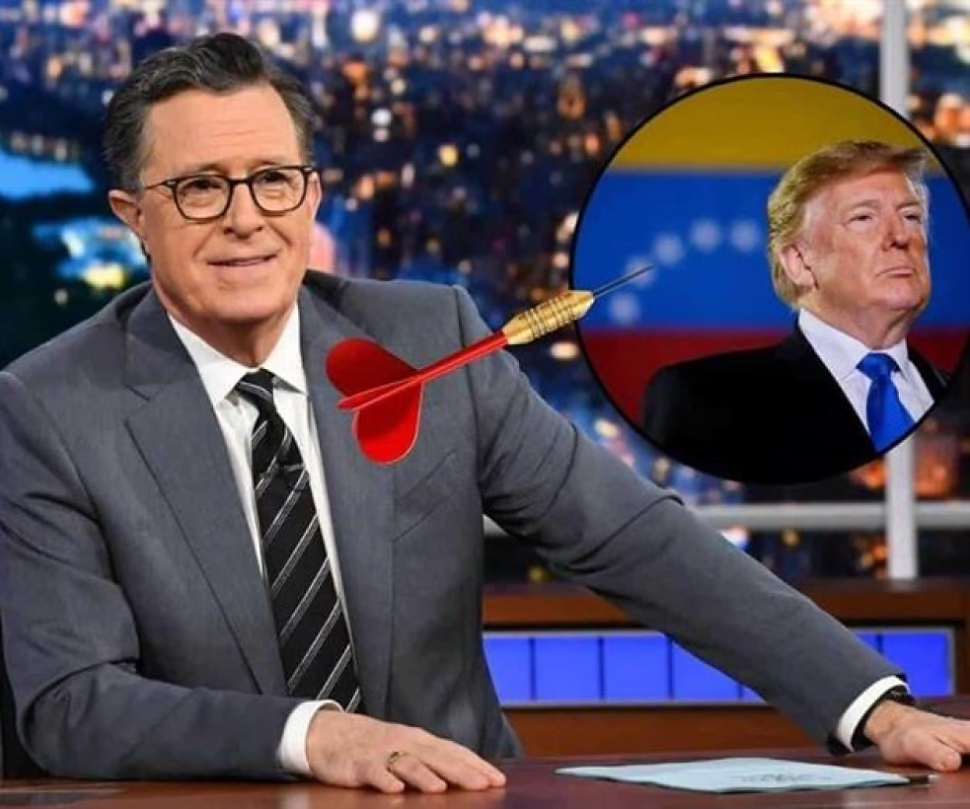
In a world on the brink of the abyss, where geopolitical tension wove its darkest web after the capture of the Venezuelan president, Nicolás Maduro, a voice rose from the screens to challenge the official narrative. It was not that of a statesman, but that of a modern jester loaded with truth. Stephen Colbert, in the first 2026 broadcast of his late-night reign on “The Late Show,” unleashed a torrent of satire and questioning that resounded like thunder in the complicit silence. Before an audience filled with laughter and shouts, the comedian transformed his studio into a court of public opinion, where the accused was none other than the government of Donald Trump and his audacious military intervention.
With a smile full of lethal irony, Colbert began his monologue evoking the ghosts that haunt power. “Do you know what this means?” he asked the universe, dropping the name that is an echo of conspiracies: the Epstein files. “They must be crazy,” he stated, weaving with that thread the shadow of unspeakable secrets behind state actions. Each word was a poisoned dart, thrown with the precision of a master who knows that comedy is the last refuge of criticism in times of delirium.
Deconstructing an Epic Operation
With the skill of a narrator of Greek tragedies, Colbert recapitulated the events of this global drama. The historical image of Maduro was revived before the eyes of millions, being transported like a war trophy to New York. He unearthed the snapshot of President Trump, watching the broadcast of the bombings over Caracas with the coldness of a director watching his work. And, with sharp sarcasm, he cited the conference at Mar-a-Lago where the Republican leader described the operation as “very well organized“.
It was then that he asked the question that millions asked in a whisper, but that he shouted with the megaphone of satire: “Why do you suddenly decide to kidnap your president in what appears to be a violation of American and international law?“. A question that pierced like a sword through the justifying heart of the administration, exposing the abrupt escalation of threats to executive action with unpredictable consequences.
The Absurdity of a Double Mandate and an Oily Background
The climax of this narrative came with Trump’s statements about governing Venezuela until a “safe transition” was achieved. Colbert, his eyes shining with theatrical disbelief, deciphered the slogan “America First” with devastating logic: “Evidently when he says ‘America First’ he means alphabetically.” And then, he released the sentence that encapsulated the absurdity of the moment: “It’s crazy. You can’t govern two countries at the same time, you can’t even govern one.” A line that, laughing, was a devastating political judgment.
Finally, like an oracle who sees beyond the immediate chaos, the presenter turned his gaze to the economic background of the commotion. He framed the operation not only as an act of power, but of greed, pointing out the strategic interest in Venezuelan oil. His final reflection was a warning wrapped in hope, a call to historical memory: “I hope the American people do not fall into this a second time.” A closing that transformed the comic monologue into an urgent plea for citizen conscience.
In this story where humor was the weapon and the screen was the battlefield, Stephen Colbert showed that, sometimes, the crudest truth must be said between laughs in order to be digested. His criticism was not just an entertainment segment; It was a crucial chapter in the chronicle of our time, where satire stands as the last bastion of reason.
Do you agree with this scathing look at global events?Share this analysis on your social networks and explore more content on the intersection between politics, media and satire on our site.