CNTE blames the government for the death of a teacher in protest

After a teacher's heart attack during a mobilization, the teachers point to the federal government as indirectly responsible.

Members of the National Coordinator of Education Workers (CNTE) pointed to the federal government as indirectly responsible for the death of a teacher that occurred after Monday’s mobilizations. The teacher died after trying to enter the capital’s Zócalo.

During a conference next to El Caballito, prior to a dialogue table at the Ministry of the Interior, the general secretary of Section 22 of Oaxaca, Yenny López, explained that the teacher suffered a heart attack. He attributed the outcome to the stress generated by the clashes and the tension of the protest.

“The stress derived from the confrontations influenced the outcome,” said López.

Requirements of the teaching profession

The CNTE maintains its local and national demands. Among the main ones: hiring teachers to cover retirement vacancies, paying teachers who work additional hours and regularizing passwords for management and teaching staff. They also reported delays in the delivery of resources for school uniforms and irregularities in the distribution of educational furniture.

RelatedThe CNTE announces massive mobilization to demand labor rights

Likewise, they pointed out deficiencies in ISSSTE clinics and hospitals in Oaxaca, despite new infrastructure. They reiterated their demand to repeal the ISSSTE Law of 2007, return to a solidarity pension system and eliminate the educational reform.

The union representatives reported that this Tuesday they will hold a tripartite table focused on the demands of Section 22. They announced that they are evaluating new protest actions, including an eventual entry into the capital’s Zócalo. More contingents could arrive in Mexico City to strengthen the national sit-in. They affirmed that they will remain mobilized until they obtain favorable responses.
More than eight million apocryphal cigarettes seized in Manzanillo

Joint operation in Manzanillo detected shipment of counterfeit cigarettes.

Operational in the port of Manzanillo

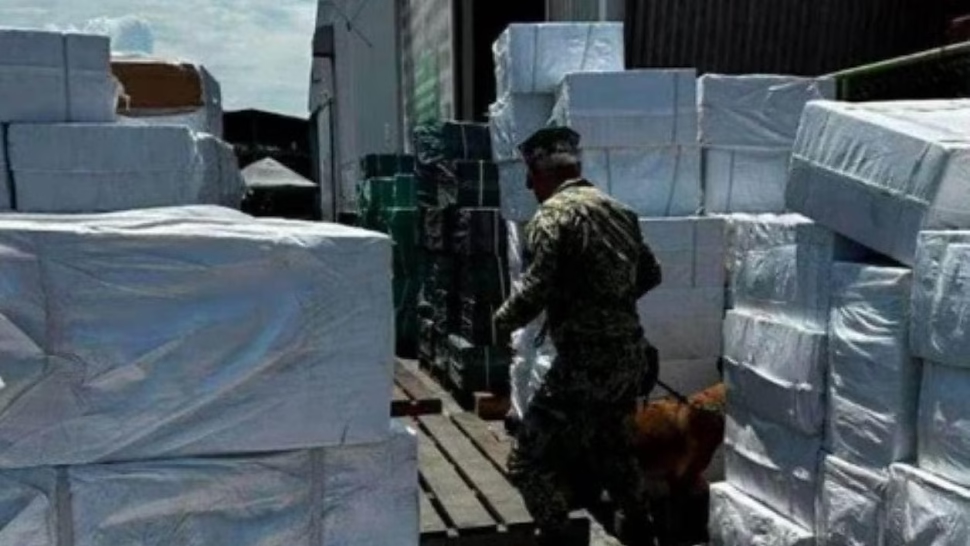
Federal authorities seized more than eight million allegedly apocryphal cigarettes in the port of Manzanillo, Colima. The operation was coordinated by agencies of the security cabinet and the National Customs Agency of Mexico (ANAM).

Personnel from the ANAM and the Administrative Unit of the Manzanillo Customs detected inconsistencies in an operation to import cigarettes from abroad. This led to a specialized review.

As a result of the inspections, the authorities located 8 million 436 presumably counterfeit cigarettes. The merchandise was insured with the support of the Secretary of the Navy (Semar).

The ANAM reported that this type of operations are part of the permanent mechanisms of operational intelligence, risk management and strategic analysis. The objective is to strengthen security in foreign trade operations and detect documentary irregularities or goods of illicit origin.

The comprehensive analysis of the operation made it possible to reinforce documentary traceability, operational review and validation of commercial profiles. The authorities maintain surveillance at entry points into the country to combat illegal trade.

Continue reading

Perception of insecurity drops to 59.8%: Sheinbaum

Perception of insecurity in Mexico drops to 59.8%, the lowest figure since 2018.

ENSU results

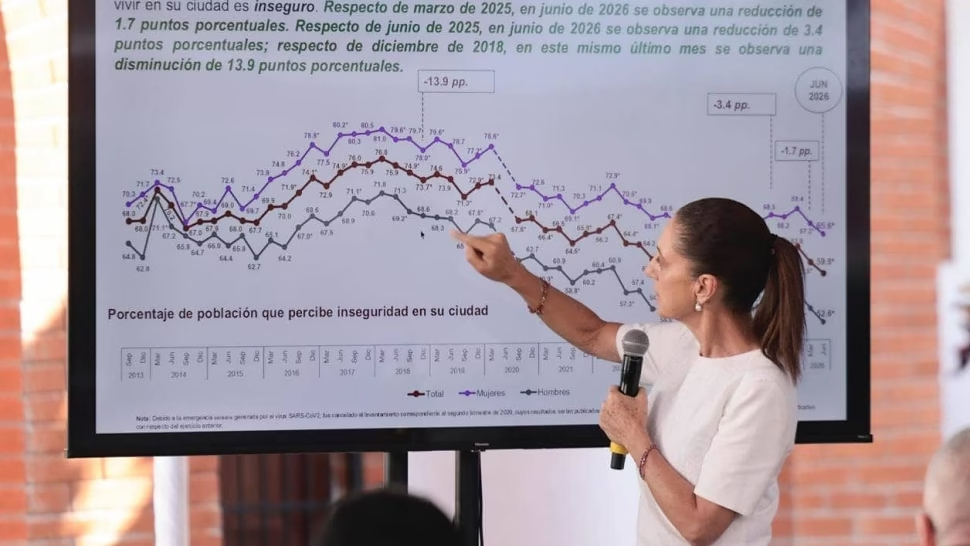
President Claudia Sheinbaum reported that the perception of insecurity in urban areas fell to 59.8% in June 2026, according to the National Urban Public Security Survey (ENSU) of the INEGI. In December 2025 it was 63.8%, which represents six consecutive months of decline.

“The important thing here is that we are giving results in the security indicators and people are beginning to notice this decrease,” he said during the morning conference in Cuernavaca, Morelos.

Historical comparison

Sheinbaum recalled that in December 2018, under the government of Andrés Manuel López Obrador, the perception of insecurity was 73.7%. The previous lowest point was reached in September 2024 at 58.6%. The president attributed the improvement to the National Security Strategy.

The ENSU measures citizens’ feeling of insecurity in their environment. Recent data reflects a positive trend, although the challenge remains to maintain the reduction in crime. The authorities continue to implement actions to consolidate these results.

Continue reading

Sheinbaum delivers 43 homes in Morelos through the Housing Plan

President delivers homes, settlements and deeds in Xoxocotla, Morelos.

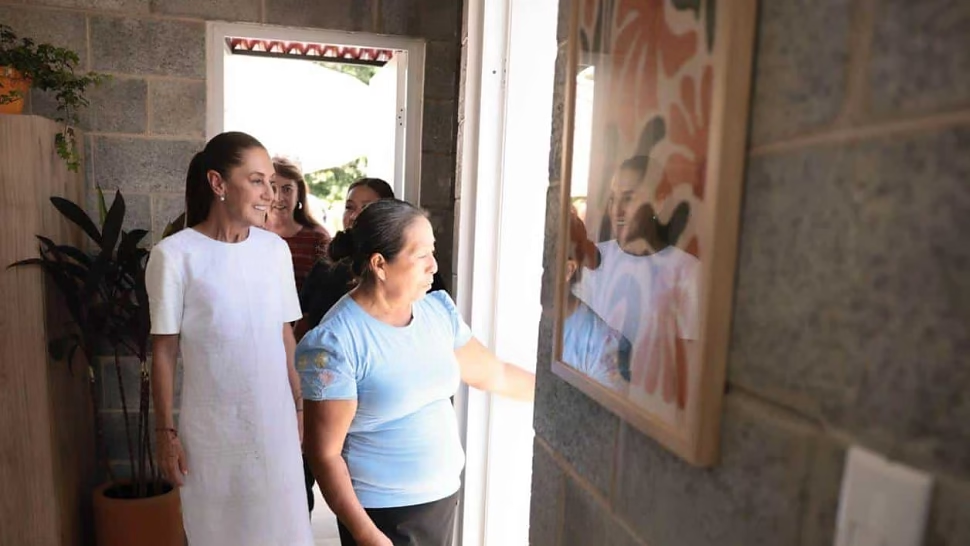
President Claudia Sheinbaum led in Xoxocotla, Morelos, the delivery of 43 new homes from Conavi, 348 settlement certificates from Fovissste and 79 deeds from INSUS. It’s all part of the Housing for Wellbeing Program.

“Previous governments took from the people, we increased the minimum wage, we are providing homes with accessible loans and we are removing debt from families,” said the president.

“Those from before governed for a few, the governments of the Transformation govern by the people and for the people of Mexico,” he added.

Plan details

Sheinbaum recalled that the program contemplates the construction of 1.8 million new homes in the country; the forgiveness and restructuring of unpayable loans for 5 million families; and the delivery of one million deeds to guarantee legal certainty.

The homes are aimed at people with incomes of one to two minimum wages. The land for new houses is already available throughout the national territory.

The Secretary of Agrarian Development, Edna Elena Vega Rangel, explained that in Morelos the goal was expanded from 10 thousand to 24 thousand new homes. Of these, 3,893 are already hired. In addition, 8 thousand families will receive deeds and more than 35 thousand will improve unpayable loans. Nationally, the program will benefit more than 10 million families.

The director of Conavi, Rodrigo Chávez Contreras, reported that of the 500 thousand homes under his charge there are already 320 projects to build 150 thousand houses. Of them, 75 thousand have already been assigned in 119 municipalities. In Morelos, 2,000 homes are being built in seven municipalities; 90 of them for Xoxocotla, of which 43 were delivered today.

Governor Margarita González Saravia thanked the president and confirmed that the state already has land for the 24 thousand houses in eleven municipalities.

One beneficiary, Araceli Pacheco López, thanked the delivery of her home, which she described as “very nice.”

Continue reading