Citizens demand cancellation of water agreement with Israel

Thousands called to demonstrate on August 1 in several cities due to alleged opacity.

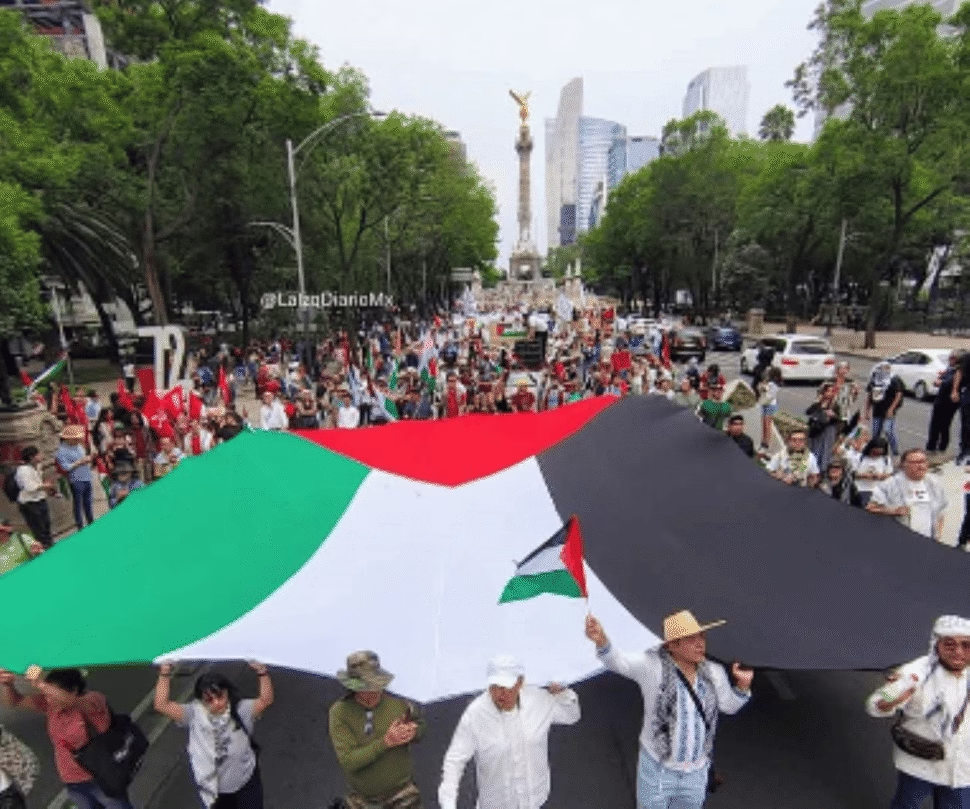
Civil unrest around the water cooperation agreement between the Chihuahua Central Water and Sanitation Board (JCAS) and the Israeli Mashav Agency has escalated to the national level. The mobilization, promoted on TikTok by the user @amigamagica, will take place on Saturday, August 1 at 9:30 a.m. in various cities across the country.

Meeting points include from the Estela de Luz towards the Zócalo in Mexico City, to concentrations in Tabasco, Pachuca, Ciudad Juárez and Jalisco. The agreement, signed in 2023 under the government of María Eugenia Campos Galván, is the center of the debate.

RelatedGiant freshwater aquifer discovered under the Atlantic Ocean

The legal vacuum of the agreement

According to Luis Andrés Rivera Levario, spokesperson for Save the Hills of Chihuahua, the Ministry of Foreign Affairs (SRE) confirmed that there are no legal instruments in force between Israel and Chihuahua. This, according to activists, violates the Law on the Conclusion of Treaties, which requires any inter-institutional agreement to be registered with the Foreign Ministry.

“It was left in a situation in limbo where it is impossible to request accounts, since it does not legally exist,” said Rivera Levario in an interview with IMER.

The civil organization maintains that the agreement operates in total opacity as it lacks registration with the Mexican Agency for International Development Cooperation (Amexcid).

Technical concern

Beyond the legal, protesters criticize the proposed technological model. Reverse osmosis, they explain, is not viable for Chihuahua due to the absence of the sea. They point out that aquifer wells are already becoming salinized due to poor management, and the technology would only aggravate soil salinization.

“They are coming to offer us a high-risk solution,” added the spokesperson.

The real solution, they insist, is to protect water recharge areas and carry out agricultural and industrial reconversion. The community demands that the authorities terminate the agreement, which they consider non-existent.
More than eight million apocryphal cigarettes seized in Manzanillo

Joint operation in Manzanillo detected shipment of counterfeit cigarettes.

Operational in the port of Manzanillo

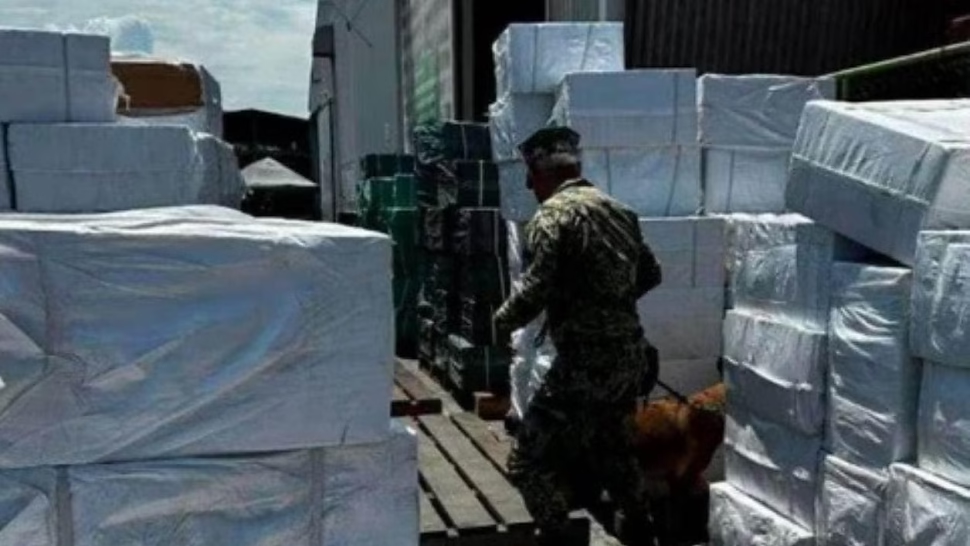
Federal authorities seized more than eight million allegedly apocryphal cigarettes in the port of Manzanillo, Colima. The operation was coordinated by agencies of the security cabinet and the National Customs Agency of Mexico (ANAM).

Personnel from the ANAM and the Administrative Unit of the Manzanillo Customs detected inconsistencies in an operation to import cigarettes from abroad. This led to a specialized review.

As a result of the inspections, the authorities located 8 million 436 presumably counterfeit cigarettes. The merchandise was insured with the support of the Secretary of the Navy (Semar).

The ANAM reported that this type of operations are part of the permanent mechanisms of operational intelligence, risk management and strategic analysis. The objective is to strengthen security in foreign trade operations and detect documentary irregularities or goods of illicit origin.

The comprehensive analysis of the operation made it possible to reinforce documentary traceability, operational review and validation of commercial profiles. The authorities maintain surveillance at entry points into the country to combat illegal trade.

Continue reading

Perception of insecurity drops to 59.8%: Sheinbaum

Perception of insecurity in Mexico drops to 59.8%, the lowest figure since 2018.

ENSU results

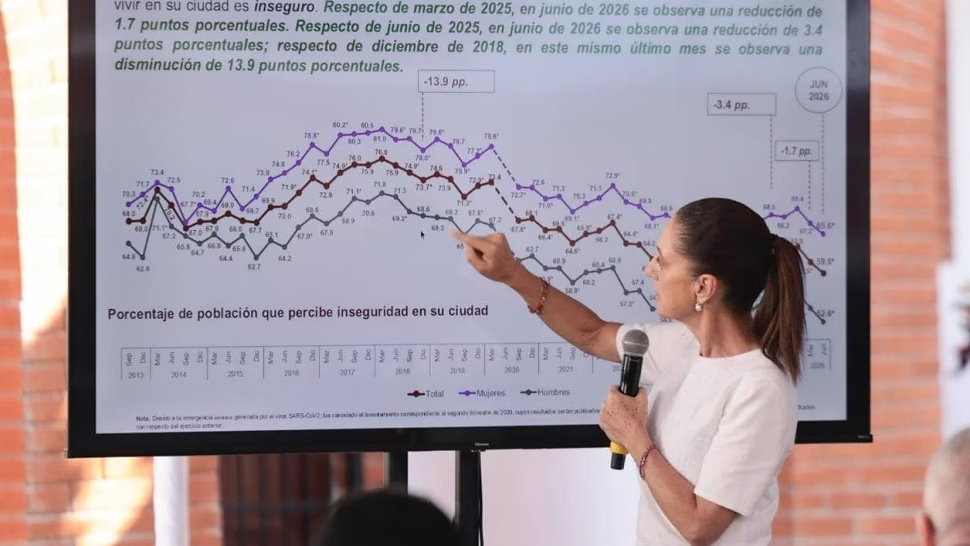
President Claudia Sheinbaum reported that the perception of insecurity in urban areas fell to 59.8% in June 2026, according to the National Urban Public Security Survey (ENSU) of the INEGI. In December 2025 it was 63.8%, which represents six consecutive months of decline.

“The important thing here is that we are giving results in the security indicators and people are beginning to notice this decrease,” he said during the morning conference in Cuernavaca, Morelos.

Historical comparison

Sheinbaum recalled that in December 2018, under the government of Andrés Manuel López Obrador, the perception of insecurity was 73.7%. The previous lowest point was reached in September 2024 at 58.6%. The president attributed the improvement to the National Security Strategy.

The ENSU measures citizens’ feeling of insecurity in their environment. Recent data reflects a positive trend, although the challenge remains to maintain the reduction in crime. The authorities continue to implement actions to consolidate these results.

Continue reading

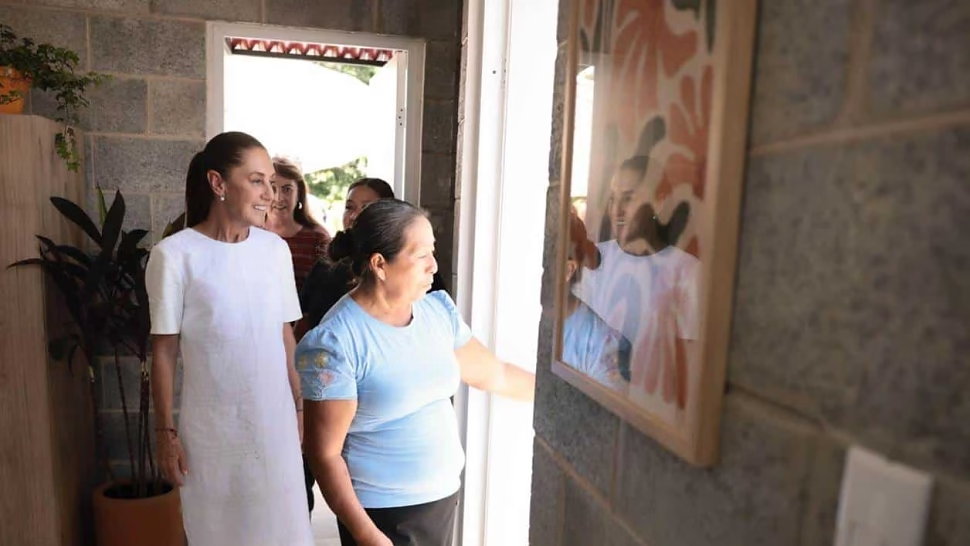
Sheinbaum delivers 43 homes in Morelos through the Housing Plan

President delivers homes, settlements and deeds in Xoxocotla, Morelos.

President Claudia Sheinbaum led in Xoxocotla, Morelos, the delivery of 43 new homes from Conavi, 348 settlement certificates from Fovissste and 79 deeds from INSUS. It’s all part of the Housing for Wellbeing Program.

“Previous governments took from the people, we increased the minimum wage, we are providing homes with accessible loans and we are removing debt from families,” said the president.

“Those from before governed for a few, the governments of the Transformation govern by the people and for the people of Mexico,” he added.

Plan details

Sheinbaum recalled that the program contemplates the construction of 1.8 million new homes in the country; the forgiveness and restructuring of unpayable loans for 5 million families; and the delivery of one million deeds to guarantee legal certainty.

The homes are aimed at people with incomes of one to two minimum wages. The land for new houses is already available throughout the national territory.

The Secretary of Agrarian Development, Edna Elena Vega Rangel, explained that in Morelos the goal was expanded from 10 thousand to 24 thousand new homes. Of these, 3,893 are already hired. In addition, 8 thousand families will receive deeds and more than 35 thousand will improve unpayable loans. Nationally, the program will benefit more than 10 million families.

The director of Conavi, Rodrigo Chávez Contreras, reported that of the 500 thousand homes under his charge there are already 320 projects to build 150 thousand houses. Of them, 75 thousand have already been assigned in 119 municipalities. In Morelos, 2,000 homes are being built in seven municipalities; 90 of them for Xoxocotla, of which 43 were delivered today.

Governor Margarita González Saravia thanked the president and confirmed that the state already has land for the 24 thousand houses in eleven municipalities.

One beneficiary, Araceli Pacheco López, thanked the delivery of her home, which she described as “very nice.”

Continue reading