Mexico City expands drinking water network with six new plants

The capital expands its purified water distribution network to benefit hundreds of thousands of people with an essential service.

A Wave of Wellbeing Floods Mexico City

Hello, transforming family! Ready to celebrate news that is changing lives and filling every corner of our wonderful Mexico City with hope? Today is a day to vibrate positively, because the incredible Clara Brugada has shared with us an update that fills our hearts. The engines of six new purification plants have just been turned on within the extraordinary Atlitic Wellbeing Water program. Imagine the energy: these six new jewels join the five that were already operating, creating a powerful team of eleven plants working in synergy to bring well-being to your home. And the goal is even bigger! By the end of this year, there will be thirteen purification centers radiating health. This is not just a project; It is an unstoppable movement towards a higher quality of life.

Visualize the impact: with this expansion, production capacity skyrockets to twelve thousand jugs of crystal clear water every day. Think of every drop, of every family that will now have access to this vital liquid of the highest quality. It is a powerful reminder that when we come together with a clear purpose, there is no limit to what we can achieve. The head of Government announced it from the vibrant Ciudad Deportiva 1 purification plant, in Venustiano Carranza, an epicenter of change and progress. And best of all, the reach is multiplying. The program, which currently reaches 130 neighborhoods, is expanding dramatically to embrace 400 neighborhoods. That’s exponential growth! He is living proof that every step, no matter how small, contributes to a monumental transformation.

RelatedThe cheap jug program now promises to double every week

Multiplying the Impact: More Days, More Trucks, More Connected Communities

But wait, the good energy doesn’t stop there. The enthusiastic José Mario Esparza, secretary of Comprehensive Water Management (Segiagua), has given us details that make us jump with excitement. We are not only adding infrastructure, we are optimizing each process to serve you better. The production of these valuable jugs, which previously ran from Monday to Friday, now extends from Monday to Saturday. One more day of production means more smiling families, more health, more life! And to bring all this abundance to every door, the delivery fleet is getting stronger. We will go from eight to twenty delivery trucks, each with the capacity to transport 600 jugs. It is like a network of guardian angels bringing well-being directly to communities. Each truck is a symbol of commitment and that your access to clean water is a top priority.

Let’s meet these new pillars of well-being, the six plants of Segiagua that have joined this mission. Each one with their own strength and capacity, working as a team for a greater good. We have the Tanque Cerro plant, in Iztapalapa, with an impressive capacity of 2,500 jugs per day. The Xaltepec plant, in Xochimilco, generating 2,000 jugs every day. The Miguel Alemán plant, in the Miguel Hidalgo mayor’s office, providing 1,500 jugs daily. Today’s host, Ciudad Deportiva 1 in Venustiano Carranza, also with a capacity of 1,500 jugs per day. The Xotepingo 6 C plant, in Coyoacán, adding another 1,500 jugs. And the San Luis 5 plant, in Xochimilco, completing the team with its 1,500 purified jugs per day. Together, they are a symphony of progress, each doing its part to create a powerful and effective whole.

And now, take a deep breath and feel the magnitude of what has already been achieved. Since this dream began to roll, from January to September of this year, 252,475 bottles of Agua Bienestar have been produced! Behind each number is a story, a family, a child, an older adult who now has reliable access to pure water. This figure means that more than 900,000 people have been positively touched by this initiative. Do they realize the power of consistent action and teamwork? This shows us that challenges, like access to water, are just opportunities in disguise to innovate, to grow, and to serve with love. Each jug represents a fulfilled commitment, a promise of health and a brighter future for all.

Friends, this is the kind of news that inspires us to continue believing in the power of collective transformation. It is a testament that with clear vision, passion and tireless work, we can turn obstacles into stepping stones to success. This drinking water project is much more than infrastructure; It is a message of hope, a community embrace and a lighthouse that guides us towards a tomorrow where the essentials are within everyone’s reach. Let’s celebrate each achievement, no matter how small, because it is these that, added together, create an unstoppable tsunami of well-being.

It’s your time to be part of this positive wave! Share this incredible news on your social networks and let’s make the message of progress and well-being reach every corner. Do you know someone who lives in the benefited neighborhoods? Tag them! And be sure to explore more inspiring content about how together we are building a stronger, healthier city for everyone.
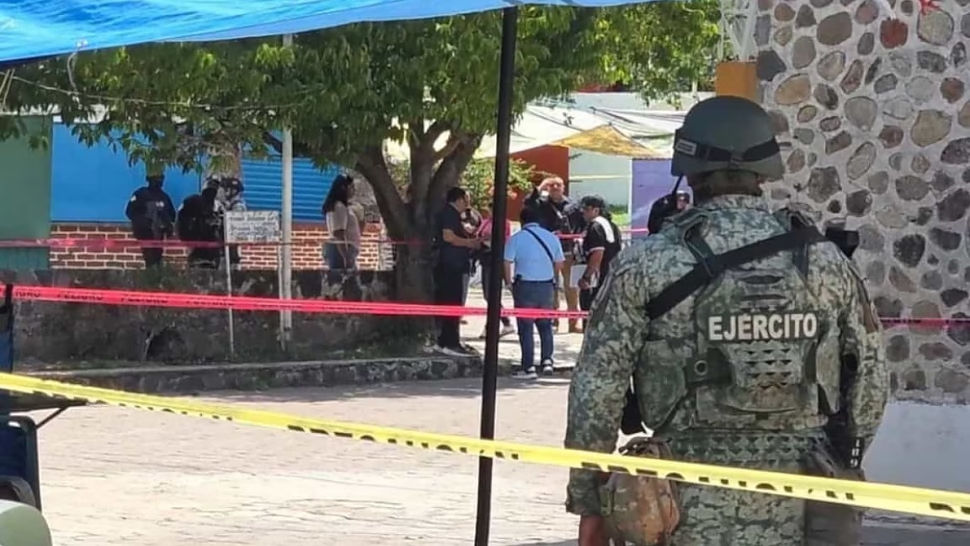
14 mayors deprived of their lives during Sheinbaum’s six-year term

The attack on the mayor of Temoac raises the number to 14; Oaxaca and Michoacán concentrate the cases.

The armed attack against Valentín Lavín Romero, mayor of Temoac, Morelos, which occurred inside the City Hall, raised to 14 the number of municipal presidents deprived of their lives during the current government. Specialists warn that this reflects the advance of organized crime in local governments.

A crisis that is growing in small municipalities

According to records from civil organizations and local media, Oaxaca tops the list with five councilors who were victims of homicide in the last year and a half, followed by Michoacán with four. The attacks against municipal authorities show, according to experts, a dispute between criminal groups for territorial control and political influence in communities.

  • Alejandro Arcos Catalán, from Chilpancingo, Guerrero (October 6)
  • Román Ruiz Bohórquez, from Candelaria Loxicha, Oaxaca (October 15)
  • Jesús Franco Lárraga, from Tancanhuitz, San Luis Potosí (December 15)
  • Mario Hernández García, from Santiago Amoltepec, Oaxaca (May 15)
  • Isaías Rojas Ramírez, from Metlatónoc, Guerrero (June 2)
  • Yolanda Sánchez Figueroa, from Cotija, Michoacán (June 3)
  • Salvador Bastida García, from Tacámbaro, Michoacán (June 5)
  • Lilia Gema García Soto, from San Mateo Piñas, Oaxaca (June 15)
  • Martha Laura Mendoza Mendoza, from Tepalcatepec, Michoacán (June 17)
  • Miguel Bahena Solórzano, from Pisaflores, Hidalgo (October 20)
  • Carlos Alberto Manzo Rodríguez, from Uruapan, Michoacán (November 1)
  • Joel Ángel Bravo Martínez, from San Miguel Amatitlán, Oaxaca (June 13)
  • Eduardo Saavedra López, from San Miguel Yogovana, Oaxaca (July 12)
  • Valentín Lavín Romero, from Temoac, Morelos (July 22)

Security specialists point out that small municipalities are the most vulnerable due to their limited institutional and security capacities. Víctor Sánchez, academic at the Autonomous University of Coahuila, explained:

The attacks against mayors represent a symptom of municipal capture by criminal organizations, which seek to influence local police, political decisions and territorial control.

The PAN senator, Mario Vázquez, stated that these homicides reflect the abandonment of municipal governments in the face of organized crime and accused a lack of federal support. Meanwhile, federal authorities have noted a reduction in high-impact crimes, although experts consider that the security strategy has not been able to uniformly strengthen local governments.

Continue reading

Fox and former PAN governors defend Ruffo Appel

Fox and former PAN governors demand a fair process for Ruffo Appel indicated by the FGR.

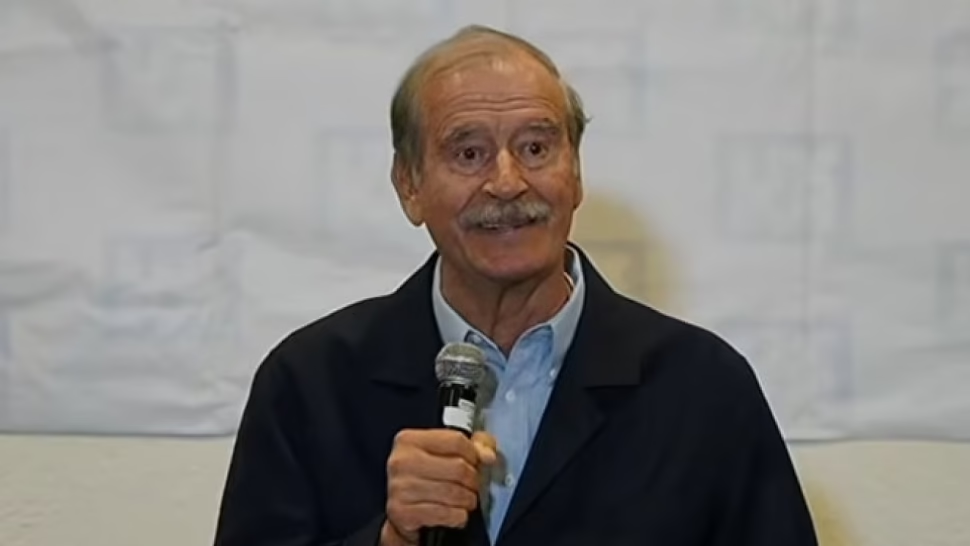
Former president Vicente Fox Quesada and four former governors of the National Action Party (PAN) formed a defense front for Ernesto Ruffo Appel, after the Attorney General’s Office (FGR) accused him of alleged crimes of organized crime and tax fraud.

At a press conference, Fox was accompanied by former governors Francisco Javier Ramírez Acuña and Alberto Cárdenas Jiménez, from Jalisco, as well as Juan Carlos Romero Hicks and Miguel Márquez Márquez, from Guanajuato. They demanded that the judicial process be carried out with transparency and adherence to the rule of law.

Fox stated that he “puts his hands in the fire” for who was the first opposition governor in the modern history of Mexico. He assured that the defense is not seeking privileges, but rather to guarantee that his constitutional rights are respected during the process.

The former president questioned the initial hearing against Ruffo Appel and pointed out that there are doubts about the impartiality of the procedure. He maintained that the accusations have a political background and recalled that large-scale fuel smuggling networks and tax fraud were previously reported.

Fox criticized the new Judiciary, which emerged from a popular election, which he described as a body without independence to guarantee fair processes. The former PAN governors insisted that the case must be resolved based on evidence and under the principles of legality and due process.

Continue reading

FDA false positive affects Mexican lettuce producers

The FDA withdrew its warning against Mexican lettuce after confirming an analysis error.

FDA Reporting and Correction

The United States Food and Drug Administration (FDA) initially linked a sample of lettuce from Taylor Fresh Foods, a company with operations in Guanajuato, with a gastrointestinal outbreak in that country. Days later, the authority retracted it: the result was a false positive. The case generated uncertainty in the export sector.

Reaction of Mexican producers and authorities

Given the accusation, the National Agri-Food Health, Safety and Quality Service (Senasica) analyzed 14 samples of lettuce and water from the producing areas. The results ruled out the presence of the Cyclospora cayetanensis parasite. The most affected entities were Guanajuato, Zacatecas, Puebla, Aguascalientes and Sonora, which concentrate a large part of lettuce exports to the United States.

Representatives of the agri-food sector requested to strengthen the budget for health and safety. They argue that more resources are required to ensure the safety of export products and prevent future incidents that damage buyers’ confidence.

The case exposes the fragility of the control processes and the dependence on external certifications. Producers are confident that the FDA’s rectification will help restore trade without further losses.

Continue reading