CIA in Mexico: historical espionage and collaboration networks

Files reveal CIA espionage in Mexico since 1934.

The shadow of the CIA in Mexico: from 1934 to the Cold War

The declassified files don’t lie. The Agency has been operating in Mexico for decades, at least since 1934. The jewel in the crown? Operation LIENVOY, which spied on figures such as Lázaro Cárdenas and David Alfaro Siqueiros. Of course, during the Cold War, anyone with leftist ideas was a strategic target.

“Among those under surveillance was former President Lázaro Cárdenas, as well as the muralist David Alfaro Siqueiros”

But it doesn’t stop there. The LITEMPO network in the 1960s already involved high-ranking Mexican officials, including Gustavo Díaz Ordaz and Luis Echeverría. All from the US Embassy, ​​with the Federal Security Directorate as an accomplice. The context? The surveillance of the student movement of ’68. Ironies of power.

RelatedYuri relives five musical decades in Texas with his Icónica Tour

Collaboration that never stops

Today, cooperation is more transparent: in 2021, Deputy Director David S. Cohen visited Mexico, and AMLO recognized the collaboration with the CIA, FBI and DEA. But one can’t help but wonder: what really changed? Institutions learn to disguise their methods, but the modus operandi remains the same: information is power, and power never sleeps.

Sheinbaum meets with US trade envoy over tariffs

Sheinbaum will receive the US trade representative amid tariff tensions.

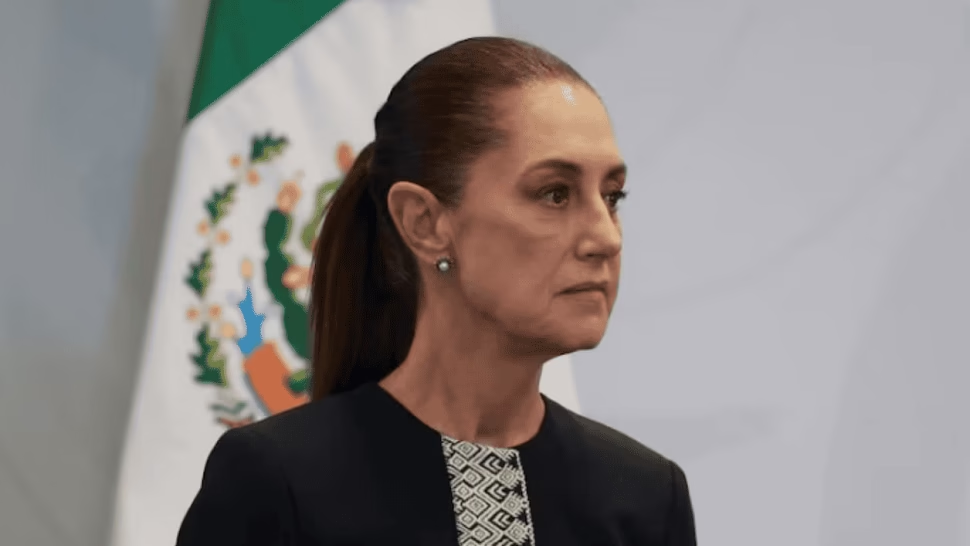
President Claudia Sheinbaum reported that this Thursday she will receive Jamieson Greer, United States Trade Representative (USTR), at the National Palace. The meeting will address the bilateral economic relationship, in a context of expectation for possible new tariffs from the US government.

Key meeting at the National Palace

Regarding Greer’s statements about the preparation of tariffs for approximately 60 countries, Sheinbaum called to wait for Washington’s definition. He explained that the scheme is linked to a new application of trade sanctions.

“We are going to wait, but this application of tariffs has to do with a new form that they call 301; it is a sanction scheme that has to do with tariffs that President Trump imposed at the time,” he said.

The president recalled that, during the implementation of the so-called reciprocal tariffs, Mexico was left out of these measures thanks to the Treaty between Mexico, the United States and Canada (T-MEC). The levies applied to products not covered by the trade agreement.

Arguments from Mexico to avoid tariffs

Sheinbaum reported that the Ministry of Economy already presented the Mexican government’s arguments to the US authorities last week to avoid the imposition of new tariffs.

“The Ministry of Economy, last week, if I remember correctly, went to give all the arguments why there should not be higher tariffs on Mexico, but we are going to wait,” he stated.

From her morning conference in Toluca, State of Mexico, the president indicated that the meeting will be held in the morning, although she did not specify the exact time. “I am going to receive Ambassador Greer at the National Palace. In the morning, I still don’t have the time, but in the morning,” he concluded.

Continue reading

Semarnat prohibits mining in natural areas without environmental permit

Without an environmental permit, there is no mining exploitation in protected areas, even if there was already a concession.

The Ministry of Environment and Natural Resources (Semarnat) published an agreement that stops mining in Protected Natural Areas (ANP). The measure, already in force in the Official Gazette of the Federation (DOF), prohibits individuals from carrying out exploration and exploitation if they do not have the corresponding environmental impact authorization.

Restriction on mining concessions

The agreement establishes that environmental permits are an independent procedure from mining concessions. The prohibition applies even to concessions granted before the reform to the Mining Law of May 8, 2023. Previously, the concessions covered all minerals and water; now they are limited to a specific mineral and with water controls.

“Having a concession does not grant an automatic right to exploit, the owner is obliged to obtain an environmental authorization,” explained Semarnat.

Conanp binding evaluation

When Semarnat receives an environmental impact request related to mining, it must inform the National Commission of Protected Natural Areas (Conanp). This body will prepare a binding technical report to determine if the work affects federal protected areas. The measure is aligned with a ruling by the Supreme Court of Justice of the Nation (SCJN) that endorsed the mining reform and established that concessions do not grant automatic exploitation rights.

The agreement also obliges environmental officials to supervise that concessionaires implement environmental restoration programs from 2024. Semarnat will not be able to grant permits in sites protected by their ecosystem, nor authorize the disposal of mining waste in wetlands, channels or federal water zones, due to the risk to health and the environment.

Continue reading

FGR would analyze extradition of ‘El Mayo’ Zambada

There are no assets in the name of the criminal leader, García Harfuch reported.

Possible extradition of “El Mayo” Zambada

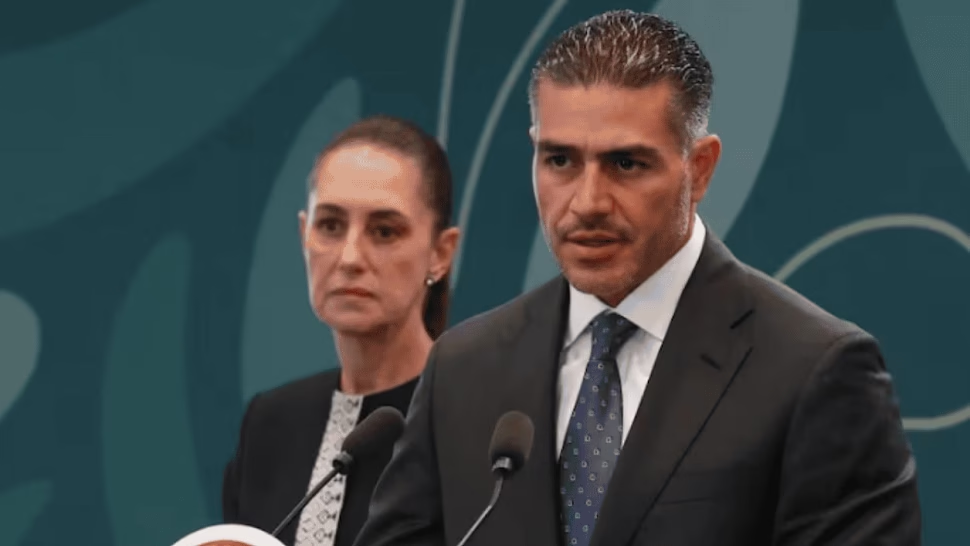
The Secretary of Security and Citizen Protection, Omar García Harfuch, reported that the Attorney General’s Office (FGR) could analyze the extradition of Ismael “El Mayo” Zambada. The leader of organized crime expressed his desire to serve his sentence in Mexico.

During President Claudia Sheinbaum’s morning conference in Toluca, García Harfuch declared:

“It would have to be determined by the Attorney General’s Office if extradition is requested.”

The official also clarified that so far no assets have been secured directly in Zambada’s name. “A large number of accounts, properties, especially frozen UIF accounts have been secured, but not directly in his name,” he explained.

Regarding the assets of the criminal organizations, he added: “Not specifically in his name, yes, a considerable amount of accounts and properties have belonged to the criminal organizations.”

The statement occurs within the framework of the legal process of Zambada, who was detained in the United States and is now seeking to be tried in Mexico. The final decision will rest with the FGR.

Continue reading