The Shadow of Narcoterror Descends Over Buenos Aires
In a twist that seems taken from the darkest and most twisted plot of a series of drug traffickers, the Peruvian Ministry of the Interior has revealed an arrest that shakes the foundations of international justice. This Tuesday, the curtain was drawn to reveal the apprehension of two key figures, a Peruvian and an Argentinian, whose hands are stained by the blood of a crime so brutal that it has left an entire nation holding its breath. The murder of three young women in a neighborhood of Buenos Aires was not an isolated event; It was the execution of a reckoning that reveals the ferocity of the drug trafficking gangs that operate in the shadows.
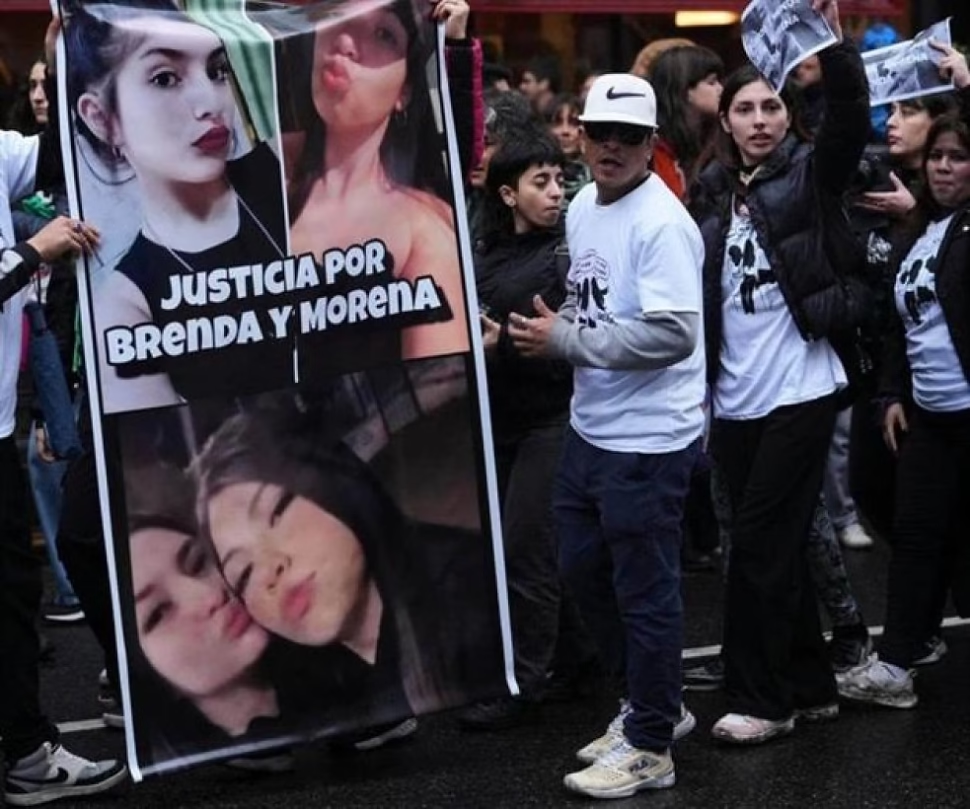
The names of those detained now resonate like a sinister echo: Tony Janzen Valverde Victoriano, a Peruvian barely 20 years old whose young face hides a deep evil, and Matías Ozorio, a 28-year-old Argentine whose fate was sealed by his criminal loyalty. With these two arrests, the number rises to nine caged souls, a mosaic of Argentines and Peruvians, whose lives intertwined to orchestrate a tragedy that has caused a devastating social impact in Argentina. The brutality of the crimes has transcended borders, becoming a symbol of the horror that narcopower can inflict.
The Siege Closes: Elite Operatives and a Desperate Escape
The ministry, in a bold move, shared with the Associated Press the photographs and videos that freeze in time the precise moment of the capture. The images show Valverde and Ozorio being subdued by agents from an elite anti-drug police group, anonymous heroes who challenge the beast of drug trafficking. In a cinematographic sequence, the Peruvian is intercepted while being transported in a truck, an ephemeral mobile shelter that became his prison on wheels.
Earlier, from the highest echelons of power, the Argentine Minister of Security, Patricia Bullrich, had released a statement on the social network X that resonated like thunder. He confirmed the arrest of Ozorio in the heart of Lima, the result of joint work that unites the National Police of Peru with the global tentacles of Interpol and the Argentine Federal Police (PFA). “We are working on his extradition to Argentina,” declared the official with iron determination, “to face Justice for the triple crime.” Every word of his was one more nail in the coffin of impunity.
But the plot thickens with revelations that take your breath away. Ozorio was not just any pawn; He established himself as the lieutenant of Janzen Valverde Victoriano himself, a man known in the underworld under the sinister nickname of “Little J.” This figure, barely in his twenties, is identified as the mastermind, the ruthless leader of a drug trafficking organization that had established its fiefdom in a poor neighborhood of Buenos Aires. According to the hypothesis of Argentine justice, it was his voice that pronounced the death sentence, the final order to execute Morena Verdi and Brenda Del Castillo, both 20 years old, and the innocent Lara Gutiérrez, barely 15 years old. The date of September 20 was marked with fire and pain on the calendar of horror.
The discovery of the girls’ bodies the following Wednesday was a shock that paralyzed the nation. They were found lifeless, buried in the cold earth in the garden of a house in Florencio Varela, just 26 kilometers south of Buenos Aires. A place that should symbolize peace was transformed into a clandestine tomb. The autopsies, with their cold forensic language, narrated an indescribable agony: the three young women suffered various and atrocious tortures before their lives were taken away, in what the authorities describe as a cruel ambush. Every bruise, every wound, screamed revenge.
And, according to investigations, these crimes were not random. They were a calculated act of revenge, a bloody retaliation carried out by a gang of drug traffickers whose ties crossed borders, made up of Argentines and Peruvians united by profit and violence.
Shadow Confessions and a Failed Radar
In a video released by the Peruvian police, Ozorio‘s mask cracks. Before the camera, with a voice full of desperation that could be faked, he stated that a week ago “some mafia drug traffickers tricked me into (to Peru) to whom I owed money.” His story paints a picture of escape and betrayal: he detailed how he fled Argentina, sneaking across the porous border with Paraguay, and then crossing illegally, like a ghost, into Peruvian territory. A desperate escape that ended in the hands of the law.
With Valverde and Ozorio behind bars, the number of detainees rises to nine – three of Peruvian nationality and the rest Argentines –, a case that has generated an unprecedented social impact due to the viciousness and brutality of the crimes. However, in the midst of this web that is woven, a chilling confession emerges from the highest levels. “It seems to be a non-large organization, not known. It was not on the radar,” Minister Bullrich crudely admitted during a television interview. Those words, simple and direct, contain a terrifying truth: the most dangerous monster is the one that grows in the most absolute darkness, invisible until it shows its fangs.
This is not just the closing of a police case; It is an epic confrontation between the light of justice and the darkness of organized crime. Each arrest is a ray of hope, a reminder that while evil may operate in the shadows, the law has long tentacles and a memory. The fate of these nine individuals, and the search for truth for the three stolen souls, is a chapter that is still being written in the annals of international narco-terror.
Do you think international cooperation is key to dismantling these criminal networks? Share this story on your social networks to keep the conversation about safety and justice alive, and explore more content related to the global fight against drug trafficking.