Canada formalizes the recognition of the Palestinian State
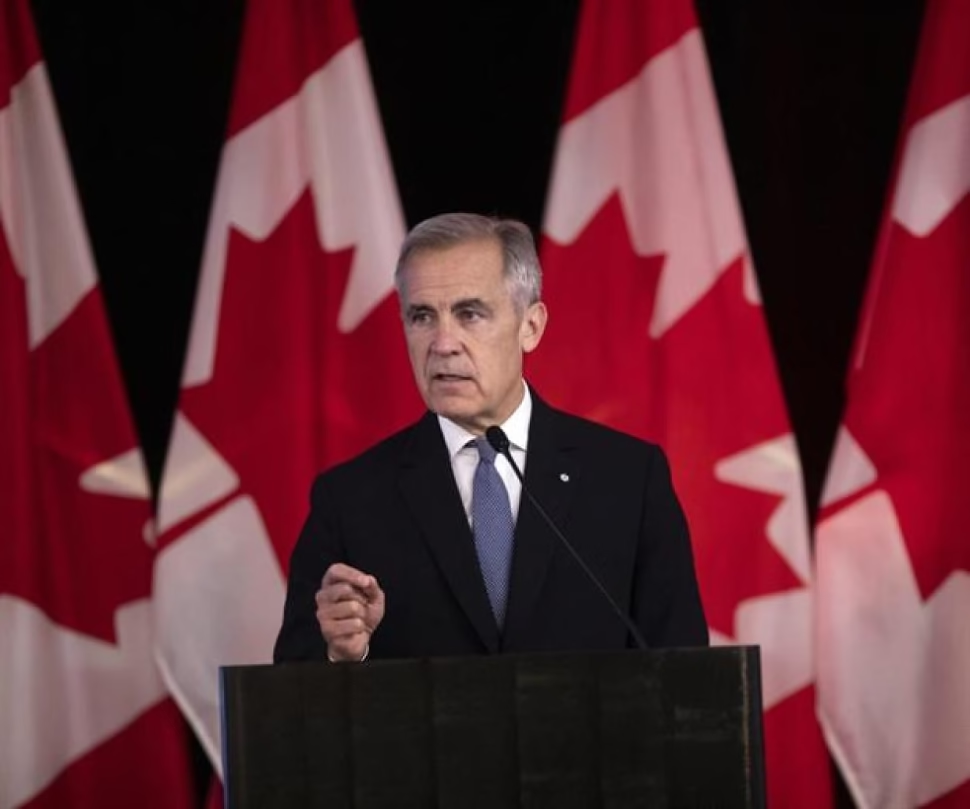
The Canadian government, led by Prime Minister Mark Carney, proceeded with the formal recognition of a Palestinian state this Sunday. This foreign policy decision is being carried out despite the open opposition of the United States government. The measure is part of a diplomatic strategy aimed at preserving the viability of a two-state solution as a path to peace in the region, a perspective that, according to Ottawa, is systematically undermined by the actions of the current Israeli government.
The announcement was made through the social platform X, where Carney explained the foundations of this historic resolution. Almost simultaneously, United Kingdom and Australia communicated similar decisions, marking a coordinated and significant shift in the position of several Commonwealth nations. This collective movement represents growing international pressure on Israel and reflects the dismay of a part of the Western community at the escalation of the conflict and humanitarian crisis in Gaza.
Basics and immediate reactions
In an official statement, Prime Minister Carney was forceful in pointing out that “the current Israeli government is methodically working to prevent the possibility of the establishment of a Palestinian state”. As evidence of this claim, he cited the policy of settlement expansion in the West Bank, which he described as illegal under international law. Likewise, he referred to the Israeli offensive in Gaza, highlighting the human cost of tens of thousands of dead civilians, more than a million displaced people and a devastating famine that he considers avoidable.
The response was immediate. Israeli Prime Minister Benjamin Netanyahu stated categorically that the establishment of a Palestinian state “will not happen.” For its part, the Hamas group urged the international community to isolate Israel, interpreting the recognitions as support for its cause. The US administration, through President Donald Trump, reacted with an economic warning, stating that this announcement “will make it very difficult” for a new trade agreement between the United States and Canada to be finalized.
A movement in the global context
These diplomatic actions take place on the eve of the UN General Assembly meeting, where the conflict is expected to occupy a central place on the agenda. France, under the leadership of President Emmanuel Macron, is expected to join this bloc of nations and make its own recognition announcement at a conference co-chaired with Saudi Arabia. Macron had previously announced his intention to make France the first major Western power to take this step during the month of September.
With these new accessions, the number of countries that recognize the Palestinian State exceeds 145, including more than a dozen European nations. This formal recognition by Western powers is interpreted in diametrically opposite ways. For Canada and its allies, it is a mechanism to safeguard a negotiated solution. For Israel and the United States, it constitutes a measure that, in their view, emboldens extremists and rewards the actions of Hamas after the attacks of October 7, 2023.
The Canadian position and the humanitarian panorama
Canada has historically been in favor of an independent Palestinian state that coexists peacefully with Israel, although it traditionally conditioned its recognition on it being the final result of a successful negotiation process. The change in position responds to the assessment that the facts on the ground—the settlements, the expropriations, and the high cost in lives—are making that possibility unfeasible. Carney was emphatic in clarifying that this recognition “in no way legitimizes terrorism, nor is it a reward for it,” and reiterated Canada’s unwavering support for Israel’s security, which, he argues, can only be fully guaranteed through a comprehensive two-state solution.
The context in which this decision is made is extremely serious. According to data from the Gaza Ministry of Health, the prolonged Israeli bombardment has resulted in the deaths of more than 65,100 people in the territory. Infrastructure has been devastated, vast areas are destroyed and approximately 90% of the population has been displaced. Gaza City faces severe famine, according to independent experts. Additionally, 48 hostages still remain captive in Gaza, with less than half estimated to be alive, a reminder of the initial Hamas attack that sparked the current conflict, where around 1,200 people were killed and 251 kidnapped.
Did you find this analysis of a crucial moment in international politics interesting?Share this article on your social networks to contribute to the informed debate and explore more content related to geopolitics and international relations on our portal.