Welfare Pension payment schedule for September 2025

Find out the dates and criteria to receive financial support from the federal government this month.

Distribución Programada del Quinto Depósito Anual

El Gobierno de México, a través de la Secretaría del Bienestar, ha iniciado formalmente el proceso de dispersión correspondiente al quinto pago del año 2025 del programa Pensión Bienestar. Este desembolso, que cubre el período bimestral de septiembre y octubre, se efectuará de manera escalonada y estructurada entre el 1 y el 25 de septiembre, siguiendo un calendario predefinido diseñado para agilizar la operación y garantizar el orden en la entrega de los recursos.

La metodología de distribución se basa en el primer apellido de los beneficiarios registrados en la base de datos oficial. Este sistema alfabético permite una gestión eficiente y evita la saturación de los sistemas de pago. Para esta jornada del 5 de septiembre, el depósito está asignado de manera exclusiva a los ciudadanos cuyos apellidos paternos inicien con las letras D, E y F. Cada beneficiario perteneciente a este grupo recibirá la cantidad establecida de 6,200 pesos mexicanos, un subsidio directo que forma parte de la política de bienestar social federal.

RelatedWelfare Pension payment schedule for September 2025

Marco Conceptual y Población Objetivo de la Pensión Bienestar

La Pensión para el Bienestar de las Personas Adultas Mayores se instituyó como un pilar fundamental de la política social de la administración del expresidente Andrés Manuel López Obrador. Su objetivo primordial es proporcionar un apoyo económico permanente a un sector de la población históricamente vulnerable. Los criterios de elegibilidad son específicos y están claramente delineados: deben ser ciudadanos mexicanos, tener 65 años de edad o más y contar con un domicilio registrado dentro del territorio nacional. Este programa no es contributivo, lo que significa que funciona como una transferencia monetaria directa sin requerir un historial laboral formal o cotizaciones previas por parte del beneficiario.

Ampliación de la Coberbertura: Otros Programas Sociales con Desembolsos Simultáneos

Es crucial destacar que el calendario de dispersión del quinto pago no se limita exclusivamente a la Pensión para Adultos Mayores. El mismo cronograma alfabético rige para otros tres programas sociales clave administrados por la misma secretaría, aunque los montos asignados varían según la población objetivo y la naturaleza del apoyo.

El Programa de Pensión para el Bienestar de las Personas con Discapacidad está dirigido a mexicanos de hasta 29 años de edad que acrediten una condición de discapacidad permanente. El monto designado para este grupo es de 3,200 pesos bimestrales, un recurso destinado a auxiliar en los gastos derivados de su condición.

Por su parte, la Pensión para el Bienestar de las Mujeres está orientada específicamente a mujeres de entre 60 y 64 años de edad. Este apoyo, de 3,000 pesos por bimestre, busca brindar un sustento económico a aquellas que se encuentran en el lapso previo a integrarse al programa general de adultos mayores.

Finalmente, el Programa de Apoyo para Madres Trabajadoras ofrece un subsidio diferenciado. Las madres con hijos entre 0 y 4 años de edad reciben un apoyo de 1,600 pesos. Existe una variante para aquellas madres con niños de 0 a 6 años que vivan con alguna discapacidad, quienes reciben un monto mayor de 3,600 pesos, reconociciendo los costos adicionales asociados a su cuidado.

Este enfoque integral demuestra una estrategia social estratificada, donde los recursos se asignan con base en necesidades específicas, buscando maximizar el impacto positivo de la ayuda gubernamental en la economía familiar de los sectores más desprotegidos. La ejecución metódica y el calendario público refuerzan la transparencia del proceso, permitiendo a los millones de beneficiarios planificar con anticipación la recepción de estos vitales recursos.

¿Este análisis te fue de utilidad para comprender el calendario de pagos?Comparte esta información crucial en tus redes sociales para que más personas conozcan las fechas y detalles de estos programas de apoyo. Te invitamos a explorar más contenido relacionado con las políticas sociales y programas de gobierno en nuestro sitio web para mantenerte informado.

Sheinbaum highlights record in clean energy and economic rebound

Sheinbaum reports historic growth in renewables and low inflation at 3.55%.

Economy and energy: the president’s announcements

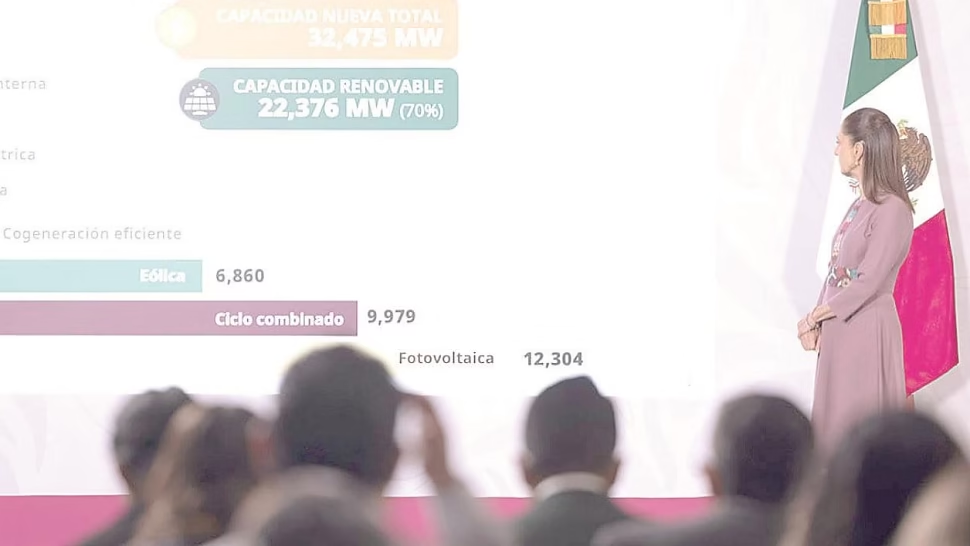
President Claudia Sheinbaum reported that, for the first time, Mexico has projects for 32 thousand megawatts of additional electrical capacity, of which 70% are renewable. “When we leave the government, natural gas consumption will decrease and energy generated by renewable resources will increase,” he stated.

Sheinbaum also highlighted economic growth. According to Inegi, the Global Indicator of Economic Activity (IGAE) rose 1.2% in April compared to March, the best advance since 2021. The annual rate reached 2.2%. The president attributed this to the boost in construction, especially the housing program.

Regarding inflation, the president pointed out that it fell to 3.55% annually in the first half of June, its lowest level since October 2025. This is due, she said, to agreements with gas stations to set maximum fuel prices and the Package Against Inflation and Scarcity (Pacic) to control the basic basket.

Energy transition with 32 thousand megawatts

The Secretary of Energy, Luz Elena González, explained that by 2030 32 thousand megawatts will be added; 22 thousand will be renewable. The goal is for at least 38% of generation to be clean to meet climate commitments. He assured that the CFE will maintain its majority participation, providing 61% of the electricity at the end of the six-year term.

The director of CFE, Emilia Calleja, explained the projects. In Baja California Sur, the Oasis System will combine solar energy, batteries and green hydrogen to supply Mulegé and 40 thousand homes. It includes a 72 megawatt plant, 20 megawatt storage and will produce 120 cubic meters of water per year, avoiding 94 thousand tons of CO2.

In Sonora, the “Rafael Galván” photovoltaic plant in Puerto Peñasco will reach one thousand megawatts of capacity and 246 megawatts of storage. It currently provides 400 megawatts. The investment exceeds 1.4 billion dollars. “They are environmental benefits that strengthen energy sovereignty,” concluded Secretary González.

Continue reading

Controversy over an interview with Monsiváis reaches the Senate and the Palace

The republication of a 1999 interview unleashes accusations between the Executive and legislators.

The republication of an old interview attributed to Carlos Monsiváis climbed to the center of the Mexican political debate this Wednesday. The issue was discussed both in the Senate and in President Claudia Sheinbaum’s morning conference.

The original text was written by journalist Edmundo Cázares in 1999 and recently republished by El Universal. It contains statements about the then head of Government Andrés Manuel López Obrador. Its veracity and context have been questioned, generating conflicting positions.

Sheinbaum describes the content as “grotesque”

During her conference, the president harshly criticized the publication. He described the content as “grotesque” and accused the medium of generating a controversy that distorts the tribute to the Mexican intellectual.

Reactions in the Senate

The issue also reached Congress. Senator Lilly Téllez read fragments of the text on the platform. In response, Gerardo Fernández Noroña rejected its use and maintained that it was a false publication with the intention of political attack.

The exchange reflects the polarization around the figure of López Obrador and the use of historical documents as partisan weapons.

Continue reading

PRI demands urgent action against violence in Guerrero

They denounce an incursion of armed civilians in Coyuca de Catalán; party calls for state intervention.

The national leadership of the PRI demanded that the Mexican State intervene urgently in response to the complaint by inhabitants of the Guajes de Ayala ejido, in Coyuca de Catalán, Guerrero. The residents reported the incursion of armed civilians into their community in the Sierra.

Call for safety

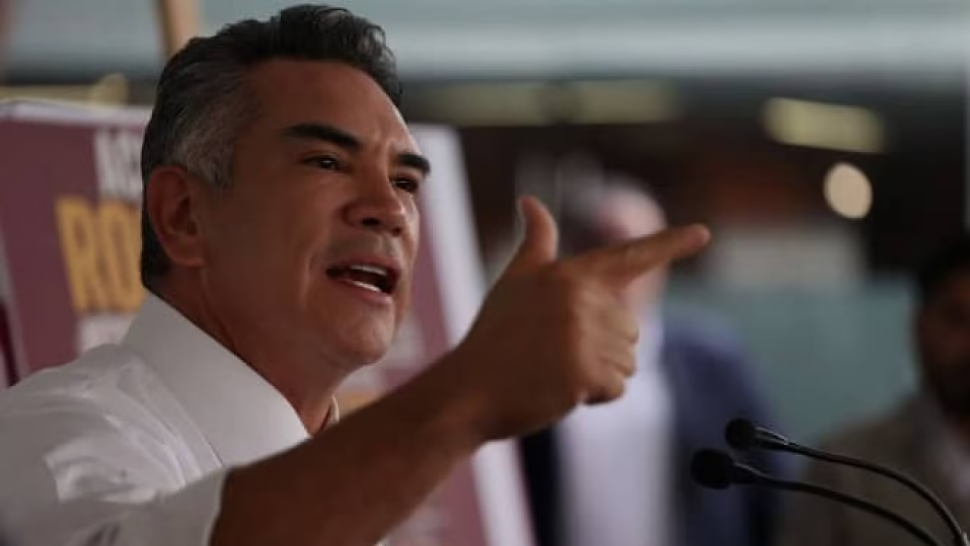
Alejandro Moreno Cárdenas, president of the party, asked the authorities to guarantee the safety of the families. He warned that these events should not be normalized due to the risk they represent for the civilian population.

The leader pointed out that in various communities in Guerrero they live under siege by armed groups. This has caused displacement, confinement of inhabitants and a constant climate of fear and uncertainty. He considered an immediate response from the State necessary.

Moreno Cárdenas also criticized the federal government for minimizing the situation of violence in the country. He affirmed that the population faces conditions of insecurity that require priority attention to restore the rule of law in the region.

Continue reading