Bobby’s aggressor identified in case of animal abuse in Culiacán

The community demands justice after a brutal attack that shocked animal rights defenders.

A call for justice and social conscience

The story of Bobby, the little dog who tragically lost his life in Mezquitillo Dos, has shaken not only Culiacán, but all of us who believe in compassion and respect for the most vulnerable beings. This case, beyond being an act of cruelty, is an opportunity to reflect on the value of life and the importance of raising one’s voice in the face of injustice.

According to the authorities, the alleged attacker, who acted under the influence of alcohol, used a machete to seriously injure Bobby, claiming that the animal had scared his son. However, nothing justifies violence, and today, thanks to pressure from animal protection groups and the State Prosecutor’s Office, progress is being made towards justice. Every life matters, and this case will be no exception!

RelatedGuanajuato Prosecutor’s Office investigates animal abuse with fireworks in rodeo

Law and society united for change

Feliciano Castro Melendrez, Secretary General of the Government, highlighted that Sinaloa has an animal protection law that penalizes these acts. But norms only come to life when we, as a society, demand them. The Balto and Togo Foundation, led by Marisela Castaños, has been key in this fight, reminding us that animal abuse is a reflection of deeper problems that we must eradicate.

The veterinarians who treated Bobby did everything possible to save him, but the injuries were too serious. Their sacrifice will not be in vain: this case has ignited a flame of collective conscience. Today more than ever, we raise our voices for those who cannot do it!

What can we learn from this? That every action counts. Reporting, educating and supporting organizations that protect animals is a step towards a more just world. Justice for Bobby is not only a legal claim, it is a call to be better human beings.

Share this story! May the message of respect and empathy reach more people. Together, we can be the change that animals need. Do you join this cause? Explore more content on how to help protect the defenseless and be part of the solution. #JusticeForBobby
INE defines rules to stop early campaigns

The INE seeks to avoid abuses in the internal selection of candidates towards 2027.

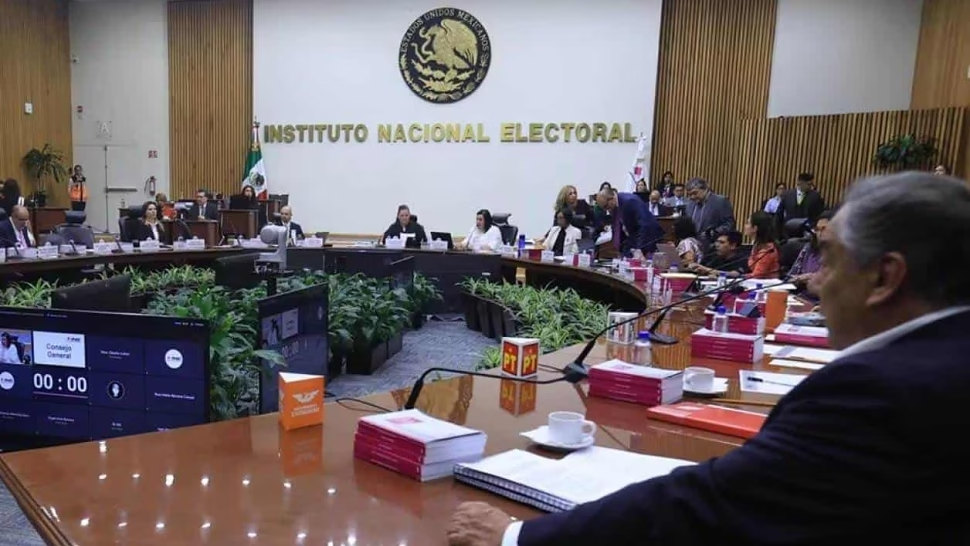
The National Electoral Institute (INE) will discuss this Thursday the guidelines to regulate the so-called “advance campaigns”, the period in which the parties choose their candidates for the 2026-2027 Electoral Process. The proposal, promoted by counselor Jorge Montaño, seeks to avoid abuses and guarantee an even floor among applicants.

What do the new guidelines contemplate?

The project establishes that internal selection expenses be charged to the parties as ordinary expenses, with limits: 3 million pesos for activities of candidates and 800 thousand for events with militants. In addition, the INE may send representatives to public events of the so-called “coordinators” or “defenders” to verify that they are not calling for voting before the pre-campaigns.

It also requires aspiring public servants who have not left office to avoid the use of public resources, submit expense reports and comply with rules on artificial intelligence. The proposal, perfected in working groups with parties, now covers all positions and not just governorships.

Adjustments for the Verification Commission

The General Council will also modify the Commission Regulations to allow the integration of the Candidacy Integrity Verification Commission, created in Claudia Sheinbaum’s electoral reform. Its goal is to prevent organized crime from infiltrating the ballots. Sources from the INE announced that next week the formation of this new body will be defined.

Continue reading

Sheinbaum and Greer review progress of the T-MEC in the National Palace

Sheinbaum and Greer discussed the review of the trilateral trade agreement.

Key meeting for the T-MEC

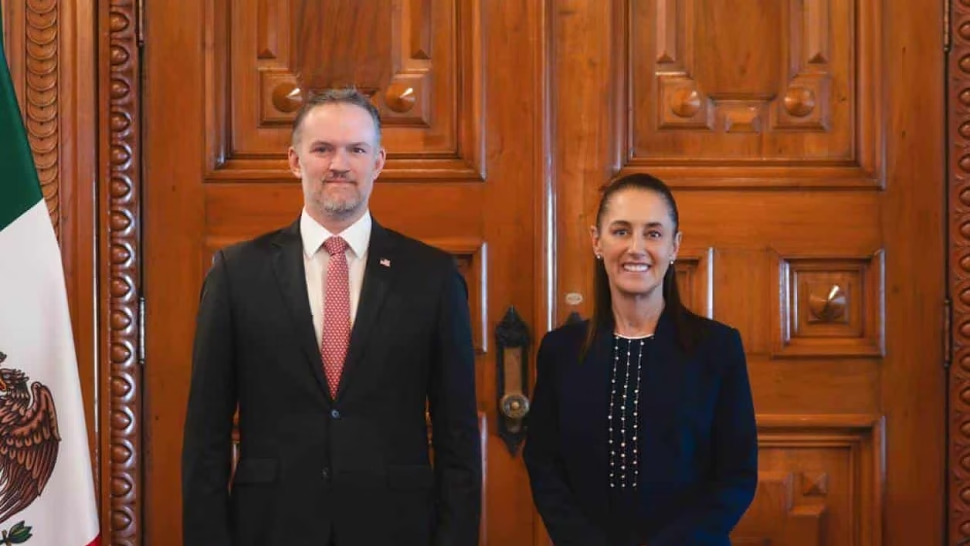
The United States trade representative, Jamieson Greer, left the National Palace at 11:31 a.m. after an hour and a half meeting with President Claudia Sheinbaum. An extensive security operation protected his departure, accompanied by Ambassador Ronald Johnson.

The meeting was attended by Marcelo Ebrard, Secretary of Economy; Julio Berdegué, former head of Agriculture; and Altagracia Gómez Sierra, coordinator of the Regional Economic Development Advisory Council. No official offered statements at the exit.

Sheinbaum published on social networks: “At the National Palace, we met with the United States trade representative, Jamieson Greer; we made progress in the review of the T-MEC and bilateral agreements for the benefit of both peoples.”

In her morning conference, the president affirmed that her government has done “everything humanly possible” so that Mexico faces the trade review in the best conditions. Sheinbaum assured that they will continue to defend national interests against unilateral decisions from Washington.

“We don’t know exactly what the United States is going to do; what we do is our best work to find the best conditions for our country,” he said.

The president rejected statements by US legislators about an alleged failure to deliver water. “We are complying perfectly and there is total agreement with the United States. This year we expect more rain and it will still be fulfilled; there is no problem at this moment with the issue of water,” he said.

He indicated that the meeting focused on trade issues, while security and other bilateral issues will be addressed at the coordination tables. Sheinbaum added that he will not respond to every statement made by US officials or legislators, as many correspond to other spaces for dialogue.

Continue reading

Automation reduces jobs in maquiladoras; 100 thousand fewer places

Layoffs in maquiladoras due to robots, high wages and tariffs.

The impact of automation

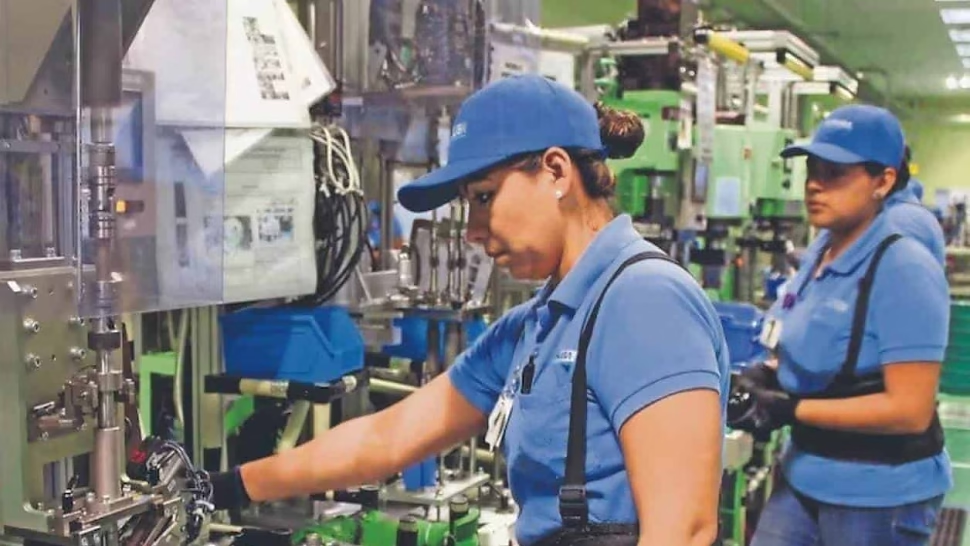
The wave of layoffs in the maquiladoras does not stop. The growing use of robots in production, especially at the border, has accelerated job losses. Added to this are higher minimum wages, increased vacation days, trade uncertainty and US tariffs.

According to data from Inegi, establishments with the Immex program had 3.19 million workers in May, 3% less than two years ago. That is equivalent to 100 thousand fewer places. Companies began laying off staff from the end of 2023.

Analysts consulted by EL UNIVERSAL point out that the combination of factors—automation, insecurity and tariffs—is behind this trend.

Humberto Martínez Cantú, president of the National Council of the Maquiladora and Export Manufacturing Industry (Index), explained that maquiladoras are being automated in the country. The process was accelerated by the increase in labor costs and external commercial pressure.

The northern border, a traditional bastion of the maquiladora industry, is the most affected area. There, robotization advances faster than in the rest of the country.

Official data reflect a sustained contraction. The sector is losing dynamism and with it, sources of formal employment for thousands of Mexicans.

Although the government has promoted incentives for investment, the reality is that technology replaces repetitive tasks. The least skilled workers are the most vulnerable.

Trade uncertainty with the United States and threats of additional tariffs complicate the outlook. Maquiladoras, which depend on global supply chains, adjust their workforces to remain competitive.

The immediate challenge is how to retrain the workforce. Without training and retraining policies, the loss of positions could worsen.

Continue reading