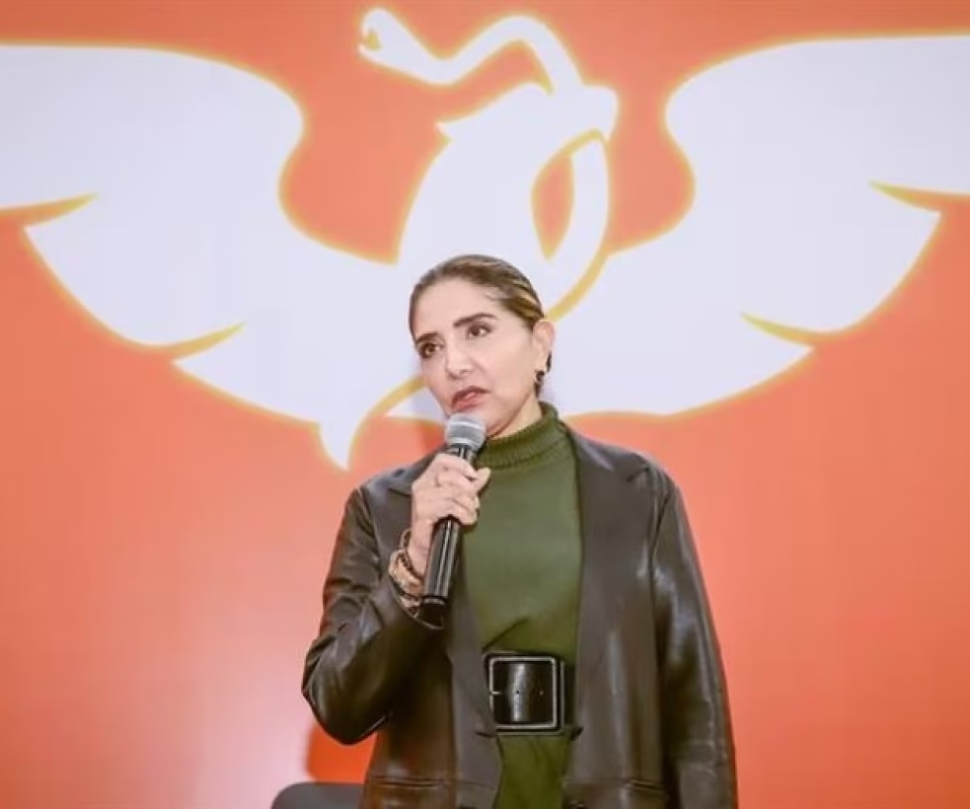
Barrales defends the two-day rest against government proposals

The senator defends the essence of the reform: two full days of rest to transform the lives of working families, against attempts to dilute it.

An Epic Battle for Stolen Time

In the heart of power, where the fate of millions is decided, a voice rose with the force of thunder. Alejandra Barrales Magdaleno, the vice coordinator of the Citizen Movement in the Upper House, launched a criticism as sharp as a stiletto against what she perceives as a devious attempt by the federal government. His accusation: trying to “turn around”, twist and empty of meaning the sacred proposal of the reduction of the working day to 40 hours a week. For her, this is not a mere technical discussion; It is a crusade for the soul of the worker, a fight to guarantee a reparative rest that is a balm for the spirit and a foundation for family coexistence.

The Dream of a Full Weekend: A Right, Not a Privilege

With the passion of someone defending a national treasure, the senator outlined the core of her initiative. It’s not about a few minutes less here or there, crumbs of time. No! The proposal proposes nothing less than two continuous days of rest, an oasis of peace in the desert of routine. With epic disdain, he rejected any alternative of partial and fragmented reductions during the week, denouncing that such ideas distort and betray the very spirit of the reform. A fragmented rest, he argued vehemently, is a mirage; It does not generate the miraculous social, emotional or even economic benefits that come from having complete and truly free weekends. It’s the difference between breathing and just sighing.

RelatedBen Stiller explores family legacy in documentary

Barrales’ narrative painted a picture of social transformation. This modification to the law is not a simple contractual adjustment, it is a silent revolution for the quality of life. It would finally allow work to not be an executioner of personal and family well-being, but rather a harmonious component of existence. From the trenches of Citizen Movement, support for this vision has been a unanimous cry, a call to the government to not only respect, but also fervently embrace and promote initiatives that return time, the most precious and elusive resource, to the punished working class. It is a struggle to redefine progress, where the supreme indicator is the happiness and fulfillment of people, not just the cold numbers on a payroll.

The debate, therefore, transcends the legislative. It is a philosophical pulse on what society we want to build: a slave to the clock or a mistress of its own destiny. The proposal for a 40-hour workday with two-day weekly rest thus stands as a beacon of hope, a renewed social pact that promises to rescue the stolen hours of playing with children, quiet dinners, abandoned readings and postponed dreams. Tension is in the air, and the outcome of this battle will mark the pace of life for entire generations.

Do you think this change is the key to a more balanced society? Share this story of fighting for time on your social networks and explore more content about the labor rights that are shaping our future.
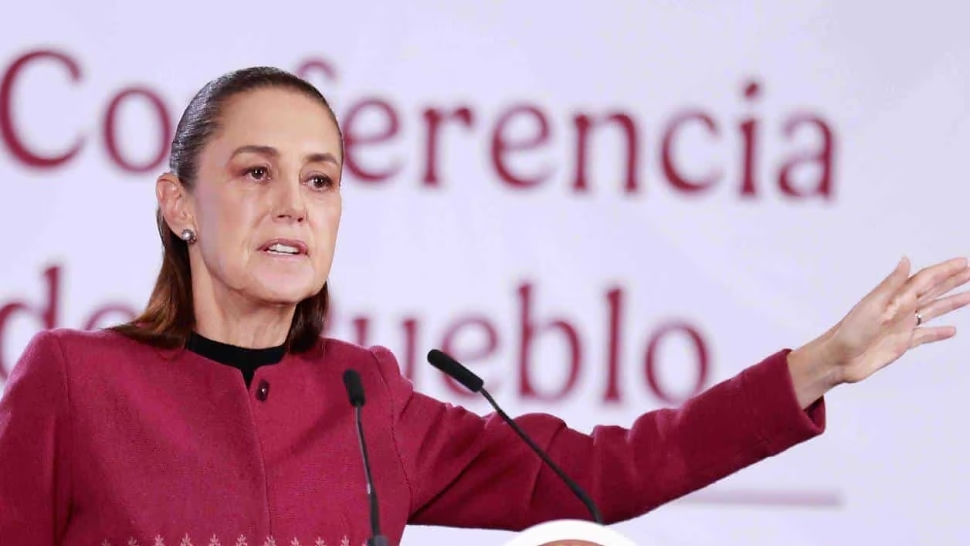
Sheinbaum recognizes Isaac del Toro’s feat in the Tour de France

Sheinbaum congratulates Isaac del Toro for his historic third place in the Tour de France.

President Claudia Sheinbaum celebrated Isaac del Toro’s third place in the Tour de France, a performance she described as historic for Mexican sport. The rider from Ensenada completed the 21 stages and became the first Mexican to reach the overall podium, in addition to being recognized as the best young cyclist in the competition.

“Many congratulations to young Isaac del Toro for his historic third place in the Tour de France. With this great achievement he becomes the first Mexican to get on the podium of this prestigious competition and the most outstanding young man in cycling today,” Sheinbaum wrote on his X account.

The president highlighted the effort and discipline of the athlete, and assured that Mexico is proud of his performance. “Let the successes continue,” he added.

Recognition of sports management

Sheinbaum also praised the work of Rommel Pacheco at the head of Conade, for Mexico’s 73 medals in the Central American Games. He announced that he will invite him to the National Palace to report on new actions in the commission.

“Rommel has many virtues: nothing is impossible, he wants athletes to be able to go to competitions… He is very active and the athletes love him a lot,” he said.

The president stated that practically all Central American athletes are on scholarships, and that the objective is to strengthen sports in schools.

Sheinbaum did not rule out also inviting Isaac del Toro to the National Palace, whom he described as “a very simple person.” The cyclist had already received the National Sports Award.

Continue reading

Applicants demand in-person exam after complaints of irregularities

Not admitted applicants demand a new in-person exam after denouncing the use of AI in a virtual test.

Demonstration in CU due to alleged irregularities in virtual exam

Applicants not admitted to the first virtual UNAM bachelor’s entrance exam gathered at 11:00 a.m. in the vicinity of the Ciudad Universitaria Metro and Insurgentes Sur. They marched towards the Rectory Tower demanding the cancellation of the process and the completion of a new in-person test.

The protesters reported alleged irregularities in the online evaluation, such as the use of artificial intelligence to gain advantage. With slogans like “No to AI, yes to the solution!” and “Clean and transparent exam!”, asked the authorities to guarantee equal conditions.

Melanie Maya, 18, a Psychology applicant who failed by one hit, noted that many students prepared for months. He considered it unfair that those who used improper tools had an advantage. The young woman asked to regulate the use of AI in the exam and for UNAM to investigate and sanction those who engaged in dishonest practices.

The protesters reiterated their request that the exam be held in person again to ensure transparency and equity for all young people seeking to enter the highest educational institution.

Continue reading

New audio reveals Marina del Pilar’s visa procedures

Leaked audio shows the governor's efforts to recover her US visa.

A new audio of intercepted calls from the governor of Baja California, Marina del Pilar Ávila, was released by journalist Héctor de Mauleón. The recording reveals alleged approaches by the president to United States authorities to recover her visa, withdrawn last year without public cause.

Deals with former FBI agent

In the audio, Ávila points out that she hired Juan Sandoval, an alleged former FBI agent, and lawyer Michael Nadler to support her in the process. He sought to establish communication channels with Washington. According to De Mauleón, there are also WhatsApp messages between the governor and an intermediary who acted through American contacts. Ávila requested that the following meetings be only between his lawyers and representatives of the United States to avoid appearing to seek other negotiation mechanisms.

Opposition criticism

The revelations raised questions from the opposition about the scope of the approaches and the possible delivery of security information. Ávila maintains that their conversations were only intended to clarify his visa situation.

Accusations against Jaime Bonilla

The governor accused her predecessor, Jaime Bonilla, of being behind the intervention and dissemination of the calls. Bonilla rejected the accusations. The government of Claudia Sheinbaum has expressed support for Ávila in the face of the leaks, although new audios are expected that the president herself acknowledged could be disseminated.

Continue reading