The CNTE rejects government proposals and maintains protests in CDMX

The teachers maintain their firm position after hours of fruitless dialogue with the government.

A call for teacher unity in the face of challenges

Comrades in struggle! Today more than ever, the spirit of resistance of the Mexican teaching profession shines brightly. After intense hours of dialogue with federal authorities, the CNTE leaders demonstrated that true transformation is born from unwavering conviction. Although no agreements were reached, each word exchanged is one more step on this path towards labor justice.

The demands that inspire a movement

The heart of this fight beats for historical rights: from the repeal of reforms that affect the educational sector to the review of retirement conditions. Did you know that these requests represent much more than individual benefits? They are the seed to rebuild the national educational system from its foundations. The government proposed gradual adjustments, but teachers know that big changes require decisive actions!

RelatedThe CNTE returns to the classrooms but maintains its fight against Sheinbaum

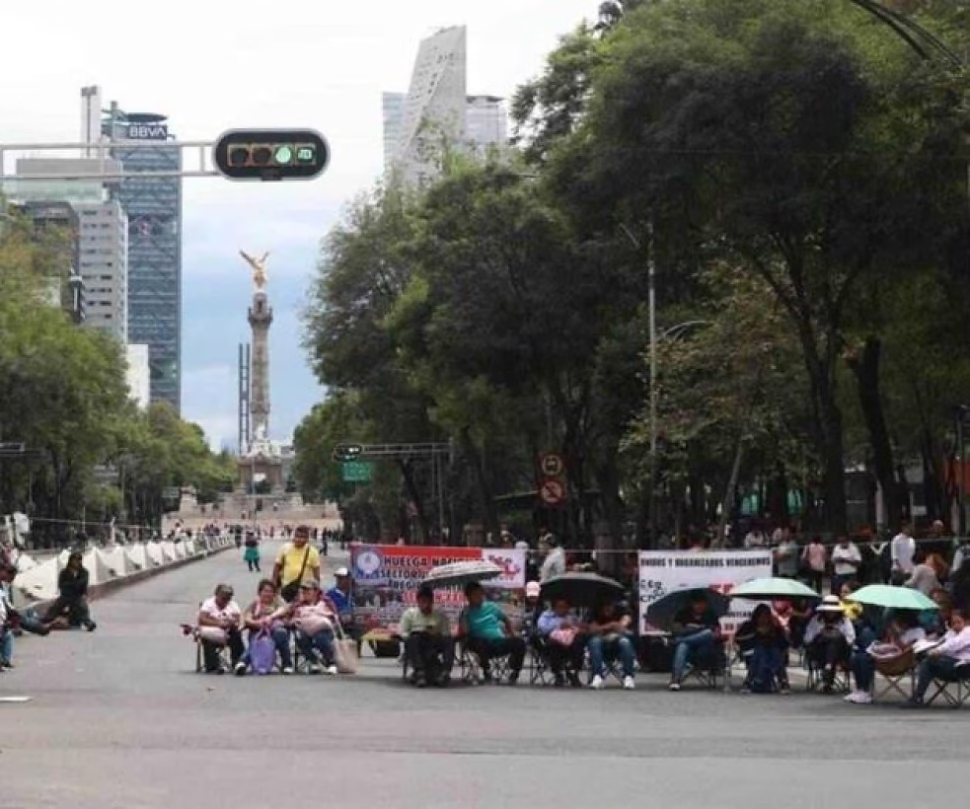
While the negotiations were taking place in the Ministry of the Interior, the streets of Mexico City became a symbol of peaceful resistance. Nine strategic points of Paseo de la Reforma housed the collective voice of thousands of educators. For eight powerful hours, they demonstrated that unity is their greatest strength, affecting traffic and transportation, but above all, making their cause visible.

The power of collective consultation

Here comes the most inspiring thing: the leaders will take the proposals to their teaching bases, because in this movement, all voices count! This democratic decision reflects the essence of the CNTE: an organization that transforms discontent into coordinated action. Each teacher will have the opportunity to shape the future of this historic struggle.

What’s next? More organization, more solidarity and above all, more conviction. This is not a simple labor dispute; It is a battle for the dignity of Mexican teachers and for the education that our future generations deserve. Blockades are not the end, but a means to make visible decades of accumulated demands.

Transforming obstacles into opportunities

For those who view these actions with skepticism, we say: every social advance in history began with organized resistance. The closed streets today are the stage where the next chapter of labor rights in Mexico is written. And although the road is long, each firm step brings us closer to the goal.

The time is now! If this cause resonates with you, share this information on your social networks. Let’s make not only the news viral, but the fighting spirit it inspires. Do you want to delve into other stories of social transformation? Explore our related content and join the conversation about the future of education in Mexico. #LaLuchaSigue #MagisterioUnido

Remember: great changes are born from moments like this, where perseverance writes stories that will transcend generations. Let’s move on!

CNDH demands clarification of deaths of Mexican migrants in ICE custody

The organization asks to investigate deaths of compatriots in US detention centers.

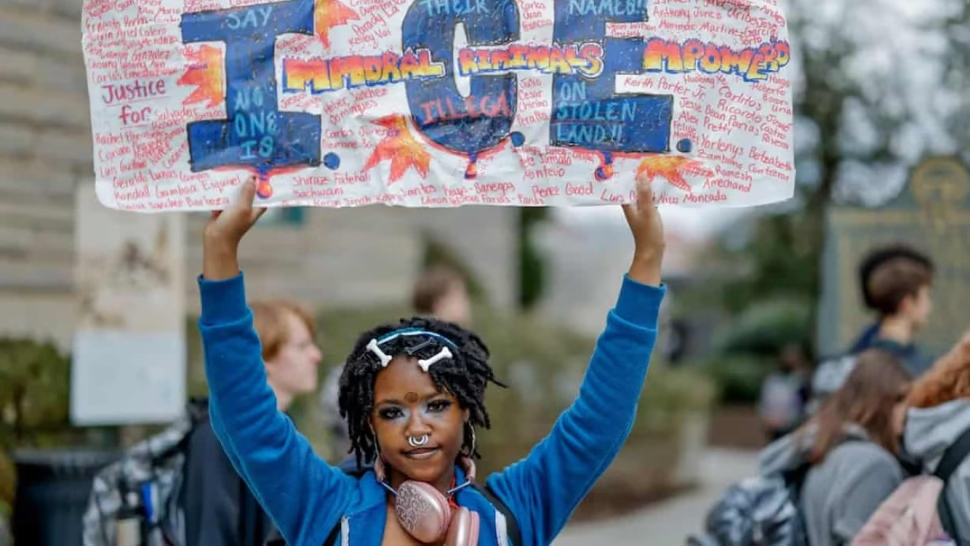
The National Human Rights Commission (CNDH) issued a condemnation for the deaths of Mexican migrants that occurred during operations and in detention centers of the United States Immigration and Customs Enforcement Service (ICE). The organization, chaired by Rosario Piedra Ibarra, demanded prompt, impartial and transparent investigations to clarify the facts and punish those responsible.

Concern about violations of fundamental rights

The CNDH described these cases as “most serious”, since they involve possible violations of the right to life, personal integrity, health, due process and dignified treatment. He expressed his concern about the immigration policies applied in the United States and recalled that the protection of human rights must be guaranteed regardless of nationality or legal status.

Consular assistance and accompaniment

The organization highlighted the need for Mexico to maintain consular assistance, legal accompaniment and humanitarian support for compatriots deprived of their liberty for immigration reasons, as well as for their families. He also reiterated that any death in state custody must be reviewed with the utmost rigor.

The CNDH requested that the investigations allow for determining responsibilities and guaranteeing truth, justice and comprehensive reparation for the victims.

Continue reading

Sheinbaum rejects accusations by the director of the DEA about links to crime

The head of the DEA pointed out an alleged alliance between authorities and cartels. Sheinbaum described it as unsupported.

Diplomatic tension due to DEA statements

The statements of the director of the DEA, Terry Cole, have caused friction in the bilateral relationship with Mexico. The official recently stated that the Mexican government and the cartels maintain a “deadly connection.” He said that combating this alleged alliance is a priority for his agency.

President Claudia Sheinbaum rejected the accusations. He described them as “unfortunate, unsupported and baseless.”

It is not Cole’s first controversy towards Mexico. Since taking office in 2025, his appointment has been questioned. Newspaper reports link him to the leak of sensitive information in 2011 that led to the civilian tragedy in Allende, Coahuila, attributed to the criminal group Los Zetas.

Cole has also supported measures by the Trump administration. Supports classifying Mexican cartels as Foreign Terrorist Organizations. In addition, he has defended the possibility of covert operations by US agencies inside Mexico.

In his most recent statements, Cole pointed to the case of Sinaloa. He suggested that Mexican officials may have collaborated with criminal groups. Sheinbaum insisted that there is no evidence and that his statements damage bilateral cooperation.

Continue reading

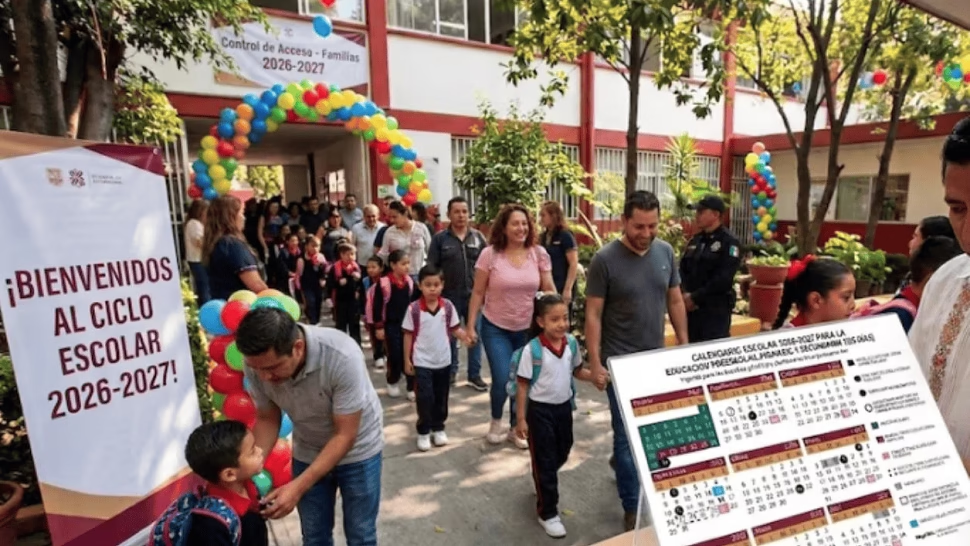
SEP publishes 2026-2027 school calendar with 185 school days

2026-2027 calendar published: 185 days of class, vacations and key dates.

Beginning and end of the school year

The Ministry of Public Education (SEP) published the calendar for the 2026-2027 cycle in the Official Gazette of the Federation. Classes will begin on August 31, 2026 and end on July 9, 2027, with 185 days effective for preschool, primary and secondary school. Normal schools will have 190 days and will end on July 13.

Relevant dates

The agreement, signed by Secretary Mario Delgado, includes an awareness day on sexual abuse and child abuse on September 7. There will be eight sessions of the School Technical Council on September 25, October 30 and November 27, 2026, in addition to January 29, February 26, March 26, May 28 and June 25, 2027.

The suspensions of teaching work will be on September 16, November 2 and 16, 2026, as well as February 1, March 15 and May 5, 2027. The winter holidays will run from December 21, 2026 to January 8, 2027. The Easter period will run from March 22 to April 2, 2027.

Pre-registration and tickets

The pre-registration process for the 2027-2028 cycle will be from February 2 to 13, 2027. The delivery of evaluation slips will occur from November 23 to 26, 2026, from March 22 to 25, 2027 and on July 12 and 13, 2027.

The agreement complies with the General Education Law, which requires between 185 and 200 class days. An additional week of recess is maintained in August for teachers, in recognition of their work and President Claudia Sheinbaum’s commitment to teaching. The SEP reiterates that only it can establish school calendars at the national level. The agreement comes into force the day after its publication and repeals the previous one, which regulated the 2025-2026 cycle.

Continue reading