Banorte wins and prepares for the World Cup with digital payments

Banorte announces profits and reveals its key role in the 2026 World Cup, operating cashless payments at the stadium.

Banorte: A solid first quarter and a view to the World Cup

The numbers have just arrived. The Banorte Financial Group reported a net profit of 15,458 million pesos between January and March. It is a modest growth, 1% compared to the same period last year, but in this economic theater, maintaining the pace is already an act worthy of applause.

The script behind these figures? Variations in interest income and, pay attention to this, an increase in provisions. It is as if the bank, seeing the future outlook, decided to save a little more for possible complicated scenes.

RelatedBanorte patients will have free access to the 2026 World Cup

But here comes the interesting plot. While the current credit portfolio grew by 6% (exceeding 1.25 trillion pesos), consumer credit jumped by 11%. People continue spending, trusting. And the Delinquency Rate remained stable at 1.4%, a sign that, for now, the work is developing without major shocks.

The big act: Banorte on the World Cup stage

Now, let’s move on to the second act, which is pure geopolitical and financial drama. Marcos Ramírez, general director of the group, broke the news: Banorte will be the brain behind the payments in the 2026 World Cup stadium.

“The institution will be responsible for the payment infrastructure within the building that will host the World Cup,” announced Ramírez.

Translation: forget about cash. Everything will be under a strictly ‘cashless’ scheme. Cards, apps, wearables… Banorte will manage the flow of digital money while millions shout the goals.

And there is a curious detail that smacks of international bureaucracy. By FIFA regulations, the stadium will no longer be called by its commercial name during the tournament.

“The venue will stop using its commercial name to be officially called ‘Mexico City Stadium’,” said the manager.

The property is already more than 90% complete and has a delivery date to FIFA: next May 11. The curtain rises soon. Banorte not only counts its quarterly profits; is preparing his participation in one of the biggest shows on the planet. Politics and money, as always, are the hidden protagonists of the game.
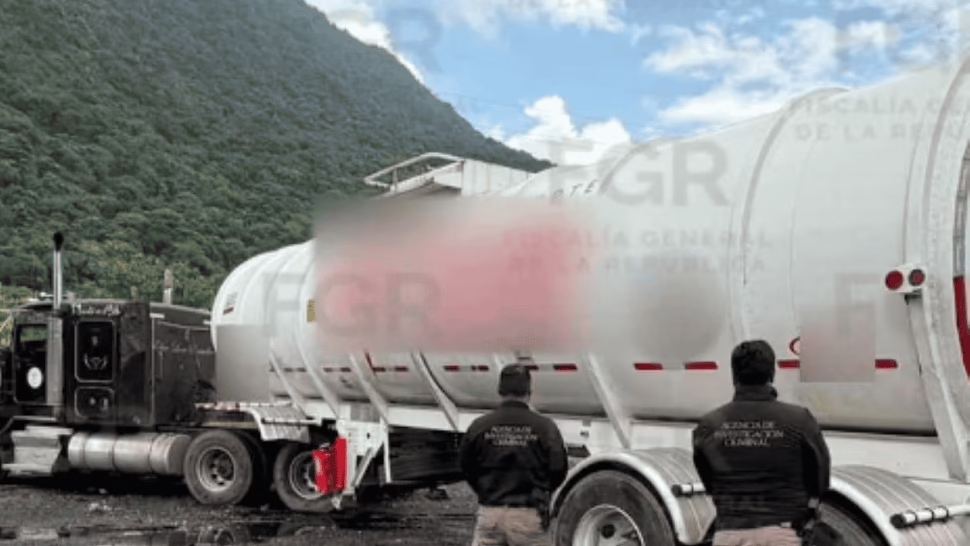
They secure more than 33 thousand liters of hydrocarbons in Veracruz

Search in Río Blanco leaves fuel seized without arrests.

Insurance in Veracruz

Elements of the Criminal Investigation Agency (AIC) of the Attorney General’s Office (FGR) seized approximately 33,250 liters of hydrocarbons in the municipality of Río Blanco, Veracruz. The operation derived from a search warrant issued by a judge for a possible crime contemplated in the Federal Law to Prevent and Punish Crimes Committed in the Matter of Hydrocarbons.

State and federal police participated in the search, as well as members of the Secretariat of the Navy (Semar) and the National Defense (Sedena), who provided perimeter security. In addition to the fuel, a property, a tank-type semi-trailer, a tractor-trailer, a scooter and two motorcycles were seized. Everything was left at the disposal of the Public Ministry, which continues the investigations. There were no arrests.

Conviction in Puebla

In a different case, the FGR reported that Cristian “N” was sentenced to 10 years in prison and paid a fine of 730,400 pesos for illicit possession of hydrocarbons. The man was arrested while driving a truck in the municipality of Amozoc, during surveillance tours by the state police. Four containers with 3,880 liters of fuel were found in the vehicle, without documentation proving its origin.

Both cases reflect the actions of the FGR against organized crime and the regulation of the hydrocarbon sector in the country.

Continue reading

AT&T loses a million prepaid users due to telephone registry

The mandatory registration of mobile lines already modifies the behavior of the prepaid market in Mexico.

Fall in prepaid

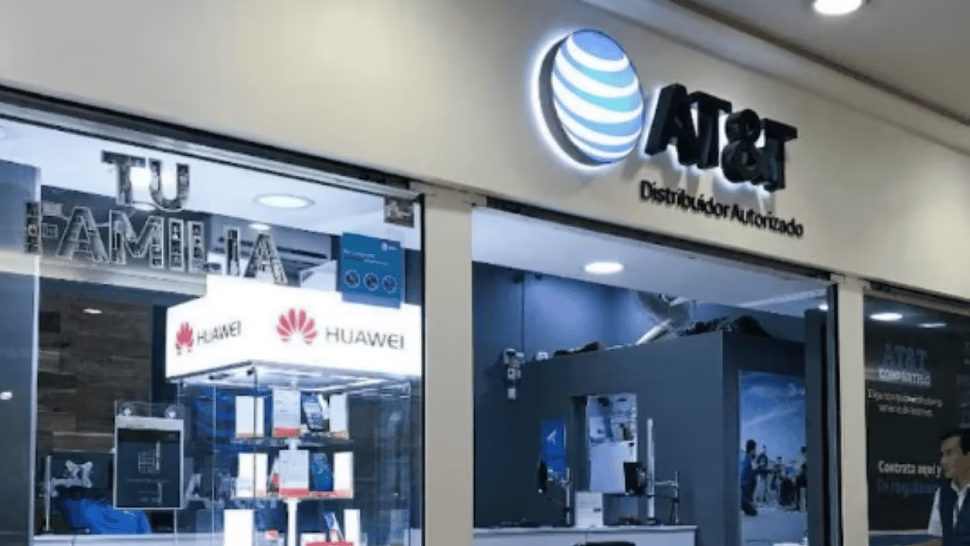
Mandatory cell phone registration already impacts operators. AT&T Mexico reported a loss of one million prepaid users during the second quarter of 2026. At the end of June, the company added 15 million 829 thousand subscribers in that segment, according to its financial results.

In contrast, postpaid customers grew by 369 thousand, an increase of 20.7%, to reach 7 million 457 users. The difference is due to the government requirement to register all lines in the cell phone registry.

The original deadline expired at the end of June, but only 43% of the lines had been registered. The federal government extended the date. The suspension of service will begin on August 15 and will be staggered until December 31, depending on the last digit of the number.

The consulting firm The Competitive Intelligence Unit (CIU) pointed out that the contraction of prepaid lines is directly due to this obligation.

Financial results

Despite the drop in prepaid, AT&T Mexico’s total revenue reached $1,224 million in the second quarter, an increase of 16.1% compared to the same period in 2025. The company attributed the growth mainly to the favorable exchange rate.

EBITDA amounted to 227 million dollars, an increase of 12.9%. In contrast, operating income fell by 8 million, reaching $38 million.

The general director of AT&T Mexico, Mónica Aspe, stated:

“The results for the second quarter of 2026 reflect the discipline with which we execute our strategy: strengthening the network, taking care of the relationship with our customers and maintaining focus on initiatives that drive profitable growth.”

Regarding the registration, Aspe added: “Looking to the second half of the year, we will continue to focus on successfully completing the process of linking mobile lines.”

The company also highlighted its deployment of 5G in stadiums and Fan Fest areas during the world soccer tournament, an investment that considers lasting infrastructure beyond the event.

Continue reading

Entangled humpback whale rescued in BCS

Humpback whale trapped in nets released in Baja California Sur.

Personnel from Profepa, the National Network for Attention to Entangled Whales and tourism service providers freed a humpback whale trapped in a nylon net in Baja California Sur.

The rescue

The environmental authority, headed by Mariana Boy Tamborrell, reported that they located the entangled marine mammal and, following safety protocols, removed most of the material. This reduced the risk of amputation, infection or impairment of mobility.

Gillnets represent a constant danger to cetaceans, especially during humpback whale season in the Gulf of California.

Threats to the species

The Action Program for the Conservation of the species indicates that entanglement, collisions with boats, acoustic disturbances, habitat degradation due to pollution and urban development are the main threats. It also mentions whale watching tourism and other forms of harassment.

In Mexico, humpback whales are found throughout the Pacific from November to May, although some remain in the Gulf of California year-round. They have an annual migratory cycle: in summer they feed in groups; In winter they hardly eat, as they dedicate themselves to childbirth, breeding and competition between males for females.

According to Conabio, these mammals are part of the 11 species of bearded cetaceans in the world and are distributed in all oceans.

Continue reading