Analysis of the Security Crisis in Baja California Sur
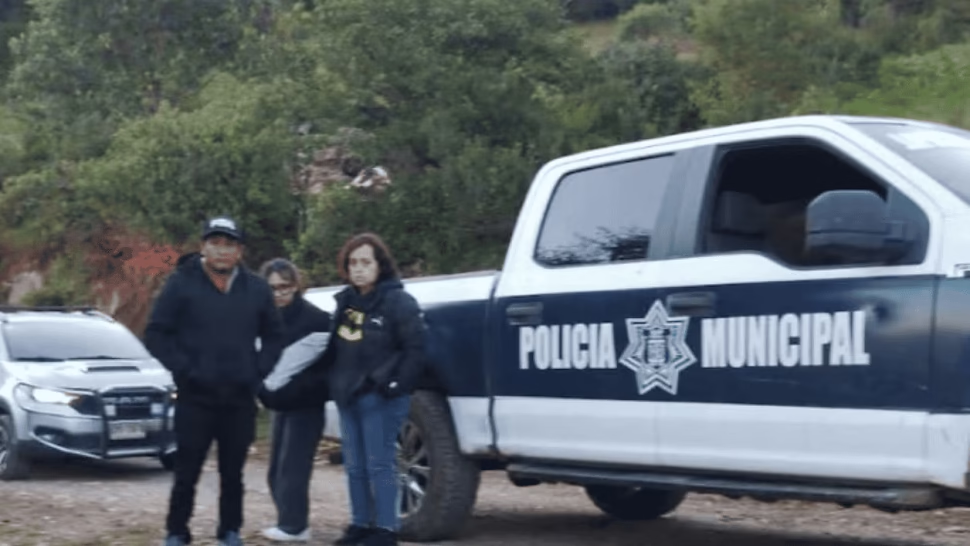
The government of Baja California Sur, headed by President Víctor Castro Cosío, has formalized a request for intervention from the federal government to contain the wave of violence that is plaguing the northern region of the entity. This decision arises as a direct response to the persistent clashes between criminal cells dedicated to drug trafficking, whose activities have overwhelmed the response capacity of local and state security forces.
The current operational context, which includes the deployment of 250 military and police elements since June, has proven to be insufficient. In a recent period of 48 hours, high-impact incidents were recorded in the municipalities of Comondú and Loreto, with one man murdered and four people injured by a firearm projectile, including two women and a child under five years old. These events highlight the critical situation and the prevailing need for reinforced strategies.
Federal Strategy and Conflict Background
Governor Castro Cosío announced that during an upcoming national meeting he will raise with President Claudia Sheinbaum the urgency of deploying a team specialized in security and intelligence, following the intervention model previously implemented in the state of Sinaloa. “We are going to request that they come to help us deal with the issue promptly,” declared the state executive, recognizing the open resistance that the security forces have encountered in the area.
The origin of this crisis dates back to last April, when disputes between factions of the Sinaloa Cartel spread to Baja California Sur. This internal conflict has generated an alarming spike in shootings, persecutions and direct attacks, even against security commanders. The local population experiences deep uncertainty, since the daily frequency of these violent acts was not observed since the wave of violence recorded between 2014 and 2017, the period after the second capture of Joaquín “El Chapo” Guzmán.
Despite the unfavorable outlook, state authorities report successful operations, including arrests of alleged generators of violence and the dismantling of an extensive network of illegal communication antennas installed in the rural area of the state, critical infrastructure for criminal operations.
Statistical Impact and Macabre Findings
The quantitative data provided by the Executive Secretariat of the National Public Security System confirms the seriousness of the trend. From January to July of this year, 79 intentional homicides have been recorded, a figure that not only exceeds all of the 56 cases registered in all of 2024, but also multiplies by more than three the 24 homicides in 2023. This dramatic increase has caused Baja California Sur to lose its status as one of the entities with the lowest incidence of crime, a title that the state of Yucatán still retains, with only 15 homicides in the same period.
The dimension of the crisis transcends homicide statistics. As a result of the search efforts of groups of relatives and authorities, the State Attorney General’s Office confirmed the discovery of 66 human skeletons in 50 clandestine graves. This macabre discovery shows the depth of violence and the disappearance of people linked to the conflict between criminal groups.
The request for federal intervention represents a critical turning point in the security strategy for the peninsula. The success of a potential specialized intelligence cell will depend on its ability to dismantle the logistical and financial networks of criminal cells, beyond purely reactive actions. The future stability of this important tourism region depends on a coordinated, comprehensive and sustained response that addresses the root causes of violence.
Share this analysis on your social networks to keep your community informed and explore more content related to national security on our site.