An 8.8 magnitude earthquake unleashes chaos in the Pacific with tsunamis

The ocean roared with fury as a colossal earthquake unleashed destructive waves that put half the world on edge.

The day the Earth roared with anger

The world held its breath when, in the early hours of Wednesday, an underground monster of magnitude 8.8 awoke with fury in the depths of the Russian East. The ground shook as if the very foundations of the planet were cracking, and in a matter of minutes, the Pacific Ocean became a battlefield, sending murderous waves toward distant shores. From the icy lands of Kamchatka to the paradisiacal beaches of Hawaii, terror spread like a dark blanket.

The tsunami that shook the world

The warning sirens resounded like warning cries in Honolulu, where thousands of people ran desperately to high ground, knowing that the sea could engulf them in a matter of minutes. Meanwhile, on the southern coast of Hokkaido, Japan, the waters rose with a roar, leaving behind a 40-centimeter tsunami that, although small in size, was a harbinger of things to come. Authorities were quick to issue evacuation orders, but the question on everyone’s mind was: Would they be safe?

RelatedEarthquake in Russia causes tsunami warning in the Pacific

In remote Severo-Kurilsk, Governor Valery Limarenko watched with his heart in his hand as the first waves hit the coast. “Stay on high ground,” he ordered, knowing that a single mistake could cost lives. Meanwhile, the Pacific Tsunami Warning Center released a terrifying message: “This tsunami could destroy entire coasts.” The words echoed like a sinister echo from Alaska to New Zealand.

Replicas that spread panic

The earth did not calm down. Aftershocks of up to 6.9 shook the Kamchatka Peninsula, shaking buildings and throwing cars like toys on the streets of Petropavlovsk-Kamchatsky. Power outages plunged the city into darkness, while telephone services collapsed, leaving thousands incommunicado in the chaos. Although there were no fatalities, the fear was palpable. Could this be the prelude to something worse?

Experts were quick to compare this earthquake with the Fukushima earthquake of 2011, one of the most devastating in history. Fortunately, the Japanese nuclear plants reported no anomalies, but the shadow of nuclear disaster still loomed in the air. Meanwhile, in the Philippines and New Zealand, authorities warned of treacherous currents that could sweep unwary people toward a fatal fate.

A reminder of the fury of nature

This earthquake, the strongest in Kamchatka since 1952, was a brutal reminder that the Earth remains unpredictable. Although aftershocks could continue for weeks, the most important thing was to remain alert. The ocean, once again, had demonstrated its destructive power.

Share this story and stay informed! Everyone’s safety depends on being prepared for the fury of nature. Explore more content about natural disasters and how to protect yourself.
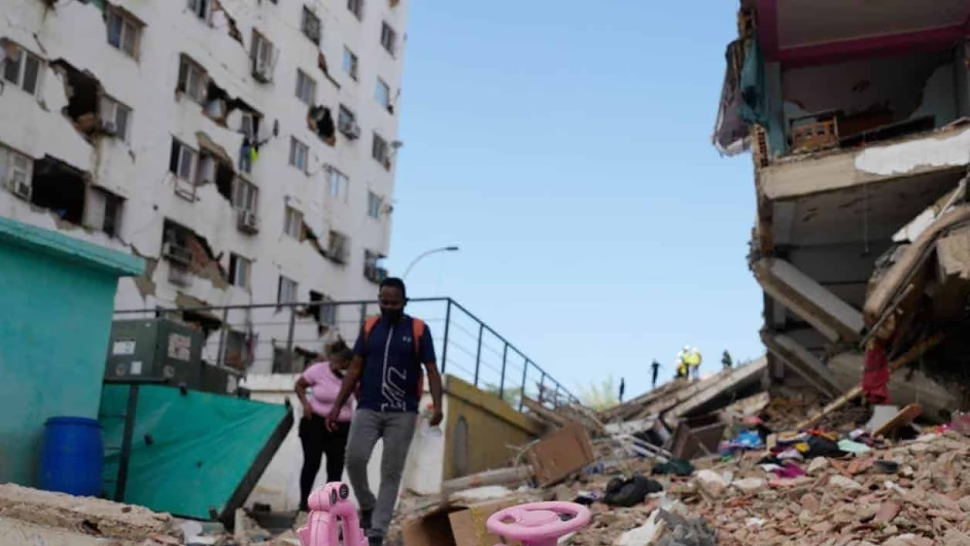
Earthquakes in Venezuela: more than 900 dead and 51 thousand missing

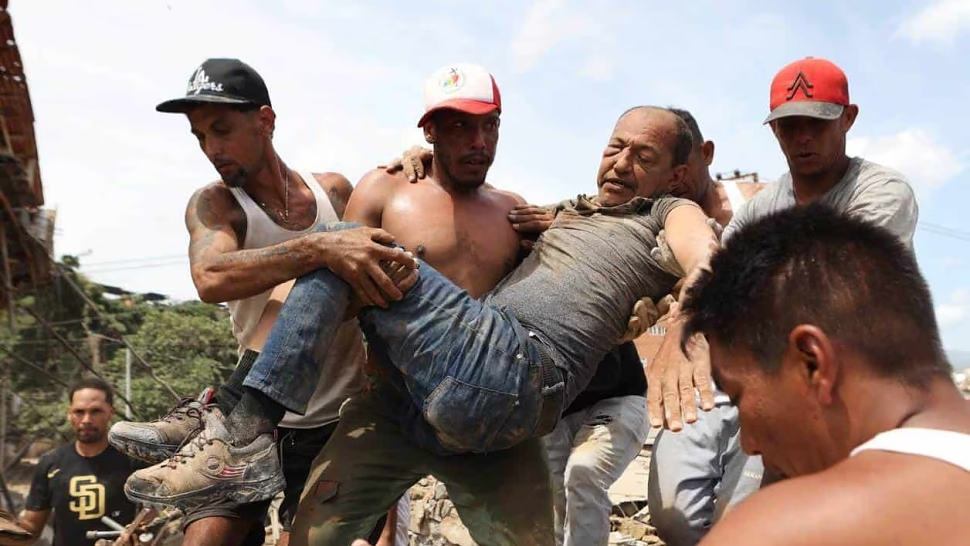
Families dig with their own hands as the arrival of international aid accelerates.

Two days after the earthquakes of magnitude 7.2 and 7.5 that shook Venezuela, the death toll exceeds 920 people and the missing amount to more than 51,000. In La Guaira, the epicenter of the destruction, families dig through the rubble with basic tools, while denouncing the scarce presence of government rescue teams.

Desperation in La Guaira

Nazareth Jiménez watched neighbors try to cut concrete slabs with hammers. “My God, how do I get all the people out of there?” he murmured. He pleaded for heavy machinery: “We call on the government, on the countries of the world, to help us. There are still people alive.”

The Venezuelan government announced that it will block access to La Guaira due to disorder and traffic. Those who want to enter must request official permits, without many details. Meanwhile, dozens of rescue teams from different countries begin to arrive.

“Every person saved is a miracle,” declared Jorge Rodríguez, president of the National Assembly.

The acting president Delcy Rodríguez stated that they are working on a total response during “these critical hours for the rescue of living people.” He welcomed international aid and confirmed the militarization of La Guaira. However, residents believe that the assistance received is only a fraction of what is needed.

The first 48 to 72 hours are crucial to finding survivors. Hope fades as families continue the search on their own.

Continue reading

Israel-Lebanon peace framework faces resistance from Hezbollah

Agreement seeks to disarm Hezbollah and restore Lebanese sovereignty, but the group rejects it and warns of civil war.

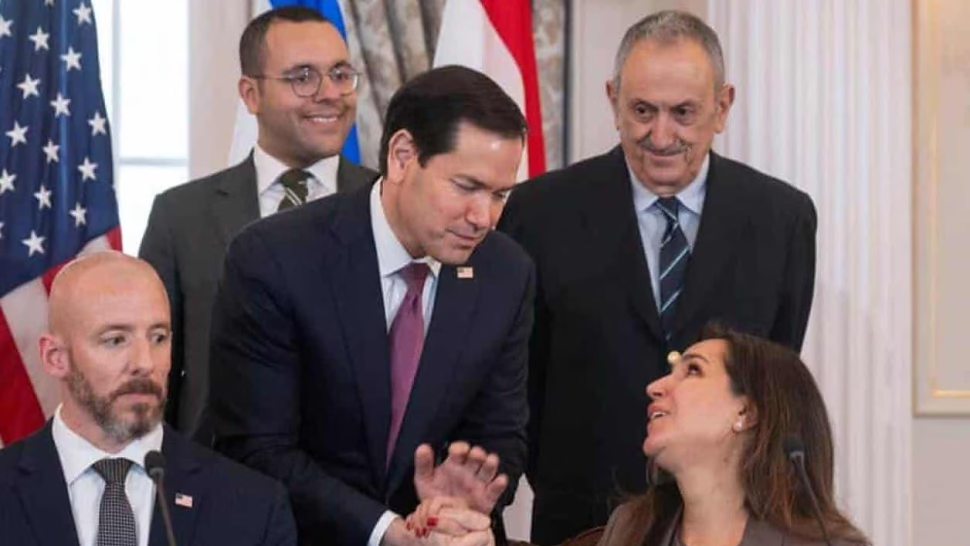
The US Secretary of State, Marco Rubio, announced together with the ambassadors of Israel and Lebanon a framework agreement that he described as a first step towards peace. The pact seeks to dismantle Hezbollah and return to Lebanon the territories occupied by Israel during the fighting.

The agreement excludes Hezbollah, which does not support it. Hassan Fadlallah, a member of the group’s parliamentary bloc, warned on Al-Mayadin TV that if the pact is imposed “it could spark a civil war.” He also called the deal an attempt to derail negotiations between the United States and Iran.

A framework with American backing

The State Department detailed that the framework creates a process to eliminate the threat of Hezbollah. Washington will facilitate a new “Military Coordination Group for Lebanon” and committed $100 million in humanitarian assistance.

“For Lebanon, this framework provides a genuine path out of a long-standing crisis,” the State Department said. “For Israel, it creates a verifiable path to eliminating the persistent threat on its northern border.”

Ambassadors Yechiel Leiter (Israel) and Nada Hamadeh Moawad (Lebanon) signed the document before Rubio. Leiter stated that the final destination is peace: “We want to get in our car in Tel Aviv and drive to Beirut.” However, he conditioned that advance on the disarmament of Hezbollah.

Hezbollah refuses to lay down its arms

The group maintains that it should only disarm south of the Litani River, near the border with Israel, in accordance with previous agreements and UN resolutions. Fadlallah reiterated that they reject Lebanon’s direct negotiations with Israel.

The most recent conflict erupted on February 28, when Hezbollah launched rockets into Israel days after the start of the war between Israel and Iran. Since then, more than 4,000 people have died in Lebanese territory and at least 37 Israeli soldiers have fallen in combat.

Position of Israel and Lebanon

Israeli Prime Minister Benjamin Netanyahu called the pact a “great achievement.” In a video, he assured: “Israel will remain in the security zone in southern Lebanon as long as Hezbollah has not been disarmed.”

For his part, Lebanese Prime Minister Nawaf Salam stated that the agreement aims to achieve the Israeli withdrawal from all Lebanese territory and restore the sovereignty of the State. President Joseph Aoun mentioned that the proposal for “pilot zones” controlled by the Lebanese army is under discussion.

Direct talks between Israel and Lebanon are moving forward separately from the interim US-Iran deal signed last week. The Lebanese government sought to negotiate directly with Israel so as not to be tied to Iranian interests.

Continue reading

Double earthquake shakes Venezuela: more than 900 dead

Hundreds of dead and thousands of injured after two consecutive earthquakes on the northern coast of Venezuela.

Devastating double earthquake

An unusual double earthquake hit Venezuela on Wednesday, with magnitudes of 7.2 and 7.5 just 39 seconds apart. According to the United States Geological Survey (USGS), the earthquakes occurred along the San Sebastián fault, on the north coast of the country. The first earthquake was located near Morón, about 170 kilometers west of Caracas, while the second, the most intense, had an epicenter 16 kilometers southwest of that town.

Authorities reported at least 920 deaths and more than 3,360 injuries, although it is feared that the number will increase. The most affected region is La Guaira, north of Caracas, where dozens of buildings collapsed. The president in charge, Delcy Rodríguez, declared the area a disaster and deployed rescue teams. Thousands of families spent the night in parks, highways and open spaces. Caracas’ main airport closed due to damage, the subway suspended service and gas and electricity supplies were cut off in some areas.

International aid

The international community responded quickly. The International Red Cross launched an emergency appeal for 50 million Swiss francs and sent 17 tons of supplies from Panama. The United States contributed 150 million dollars, two urban search and rescue teams, specialized dogs and logistical support. The European Union sent 520 troops from eight countries, activated its Copernicus satellite service and offered geospatial images.

The United Kingdom allocated 2 million pounds, a rescue team with 68 members and drones. China promised emergency humanitarian aid. Brazil dispatched a plane with firefighters, water purifiers and medical equipment. India sent two C-17 aircraft with a field hospital and 30 tons of supplies. Italy and Türkiye also mobilized rescue personnel and equipment.

Humanitarian situation

Classes were suspended and schools became shelters. In La Guaira, families settled on baseball fields with sheets and plastic bags. Rodríguez announced a reconstruction fund of 200 million dollars for hospitals and housing. The seismic crisis adds to the complex political situation facing the government, amid internal and external tensions.

Continue reading