Amnesty International demands recognition of the right to autonomous search

The international organization demands a legal framework that protects families who, in the face of official inaction, risk their lives to find their loved ones.

An urgent call in the face of the crisis of disappearances in Mexico

In the context of a deep humanitarian crisis that registers more than 133,552 missing people in the country, Amnesty International (AI) has issued a formal and structured position addressed to the Mexican State. The non-governmental organization demands the explicit recognition of the right to search by the relatives of victims of forced disappearance and disappearances committed by private individuals. This approach does not dilute, but rather emphasizes, the primary and inescapable obligation of the state apparatus to conduct effective investigations. The argument is based on a rigorous analysis of the gap between the regulatory framework and institutional practice, which frequently leaves families in a state of helplessness and extreme vulnerability.

The state deficiency and the emergency of autonomous search

During work tables convened by the federal government to analyze the approved search and investigation protocols, the head of research at AI México, Norma González Benítez, precisely explained the central paradox. Although the State has, in theory, the resources, capabilities and access to information to lead investigations, its intervention is usually deficient, prolonged or non-existent. This chronic omission forces family groups to assume the dangerous task of searching on their own. González Benítez explained that this effort implies a significant human and material cost: families mobilize their own resources for transportation, acquire tools such as shovels and pickaxes, and expose themselves to entering high-risk areas, frequently controlled by criminal groups, thus compromising their lives and physical integrity.

RelatedFamilies tour prisons in national search for missing persons

Amnesty International’s analysis identifies two clearly differentiated scenarios. The first, ideal, where family members participate in search processes led and coordinated by the authorities. The second, which reflects the most common reality, where families are forced to carry out autonomous search tasks. The organization is emphatic in pointing out that this second scenario does not exempt the State from its duty to protect. On the contrary, it intensifies it. The lack of legal recognition of these actions aggravates the situation, since on numerous occasions the authorities not only fail to provide protection, but also hold searchers responsible for the risks they face, arguing that their actions do not align with official procedures.

Search as an exercise of fundamental rights

AI’s position transcends mere operational criticism and is rooted in a human rights framework. The organization argues, based on international instruments, that when searching for a missing relative, people directly exercise their right to the truth and access to justice. Search is not just an emotional response to the information void; constitutes an act of demanding the right to know the whereabouts and fate of the disappeared person. Therefore, hindering or not protecting this exercise constitutes an additional violation of the rights of indirect victims.

Consequently, the specific proposal presented at the dialogue tables is the express inclusion of the recognition of self-initiated searches within the Approved Protocol for the Search for Missing and Unlocated Persons. This recognition must be conceptualized as a legitimate form of social participation, without implying a transfer of responsibilities. At the same time, the State must guarantee minimum conditions for its safe exercise: refrain from preventing or hindering searches, make relevant institutions available, activate protection mechanisms when the integrity of searchers is at risk, diagnose their specific needs and create ways for their prompt attention. The implementation of these measures would represent tangible progress towards an approach of informed co-responsibility focused on human rights.

Are you interested in delving into the struggle of search groups and public policies on disappearances?Share this analysis on your social networks to make this crisis visible and explore more content specialized in human rights on our site.

Morena accuses the opposition of bargaining for unity for deceased migrants

Ariadna Montiel asks that national interests take precedence over partisan differences.

Morena demands unity in the face of deaths of compatriots

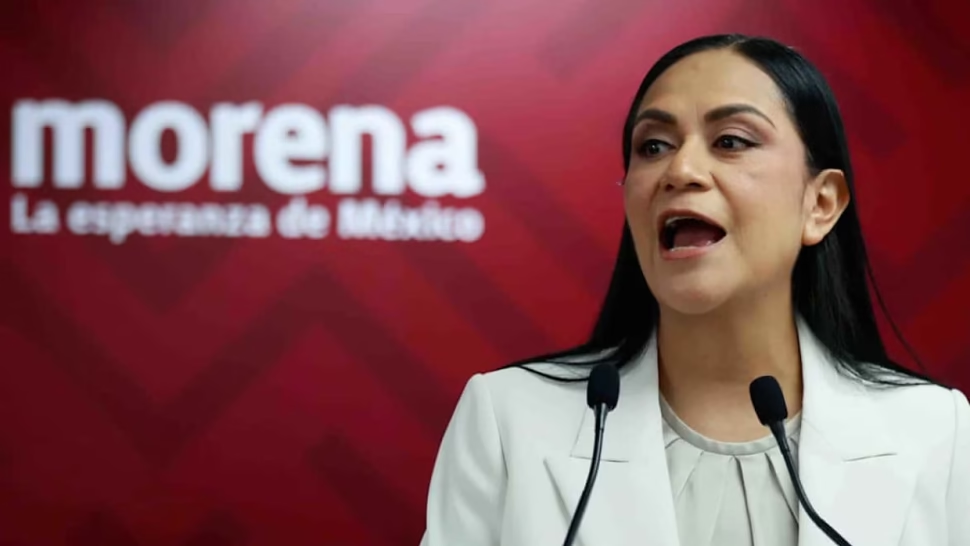
The national president of Morena, Ariadna Montiel Reyes, accused the opposition parties of “bargaining” unity from Mexico in the face of the cases of 17 compatriots who died in the custody of the United States Immigration and Customs Enforcement Service (ICE).

During a press conference, the Morenoist leader pointed out that the call to close ranks to demand answers from the US government must be above partisan and ideological differences. He considered that it is about the defense of the rights of Mexicans abroad.

Montiel Reyes affirmed that the opposition’s position reflects a lack of commitment to the country. He described it as “petty” that some leaders do not fully support the call for unity made by President Claudia Sheinbaum to address cases of alleged abuses against Mexican migrants.

The Morena leader maintained that the protection of fellow citizens must be a priority issue for all political forces. He called for placing national interests above partisan disputes.

Continue reading

Women’s Secretariat maintains support for wife of former director of Pemex

Government offers comprehensive care to wife of former Pemex director on trial for violence.

Permanent support from the Women’s Secretariat

The Women’s Secretariat reported that it will continue to provide comprehensive care, advice and psychosocial support services to María Felicia Jiménez, wife of the former director of Petróleos Mexicanos, Víctor Rodríguez Padilla. The support will be maintained if she requests it, within the judicial process she faces for alleged family violence.

In a statement, the agency clarified that any support will be granted with full respect for the will, autonomy and dignity of Dr. Jiménez. She also reiterated her commitment to assisting women who experience situations of violence through specialized protection mechanisms.

Decision not to attend hearing

The statement occurred after María Felicia Jiménez reported that she would not attend the hearing scheduled to ratify the pardon granted to her husband. He argued that he faces a strong media siege and seeks to protect his privacy and that of his children, especially that of his minor son.

The authorities keep open the possibility for the victim to access services when they consider it necessary. The case has generated public attention due to the power links of those involved, although the Secretariat assures that its actions are based on technical and human rights criteria.

Continue reading

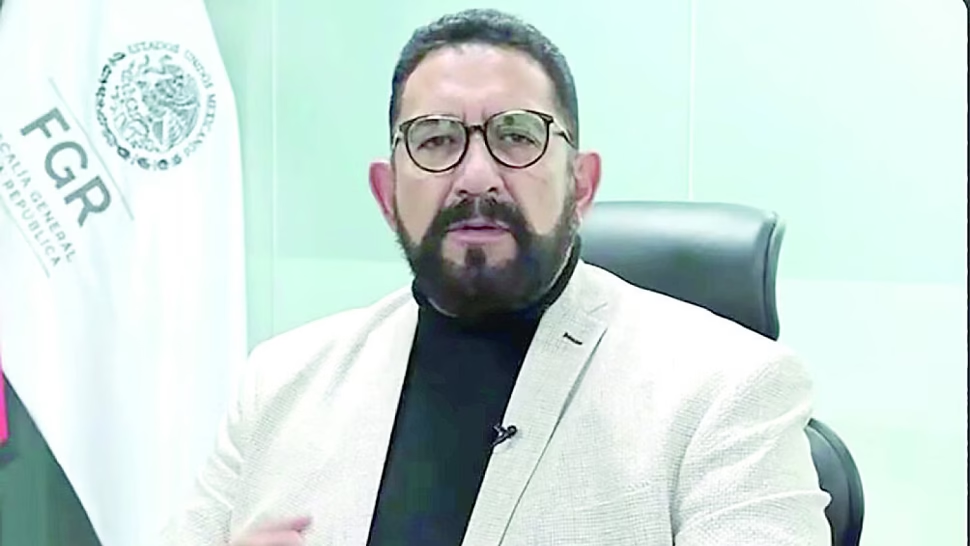
Ulises Lara leaves the FGR; alleges personal reasons

Spokesman of the FGR left office six months after assuming it. Sources point to personal reasons.

Changes in the FGR

Ulises Lara López left the ownership of the Special Prosecutor’s Office for Investigation of Relevant Matters and the spokesperson of the Attorney General’s Office (FGR). This was reported by federal sources. His departure occurred just six months after taking office.

According to the sources consulted, the separation was due to personal reasons. The specific causes were not detailed.

Lara López was appointed in January 2026 by Attorney General Ernestina Godoy Ramos. He headed the Relevant Affairs area and served as spokesperson for the institution. Before, he collaborated with Godoy Ramos in the Attorney General’s Office of Mexico City, where he held various positions. After his appointment, he thanked the trust and assured that he would continue working for justice.

During the administration of former prosecutor Alejandro Gertz Manero, Lara López was part of the FGR structure as a state delegate in Morelos. From there he participated in tasks related to federal investigations.

Continue reading