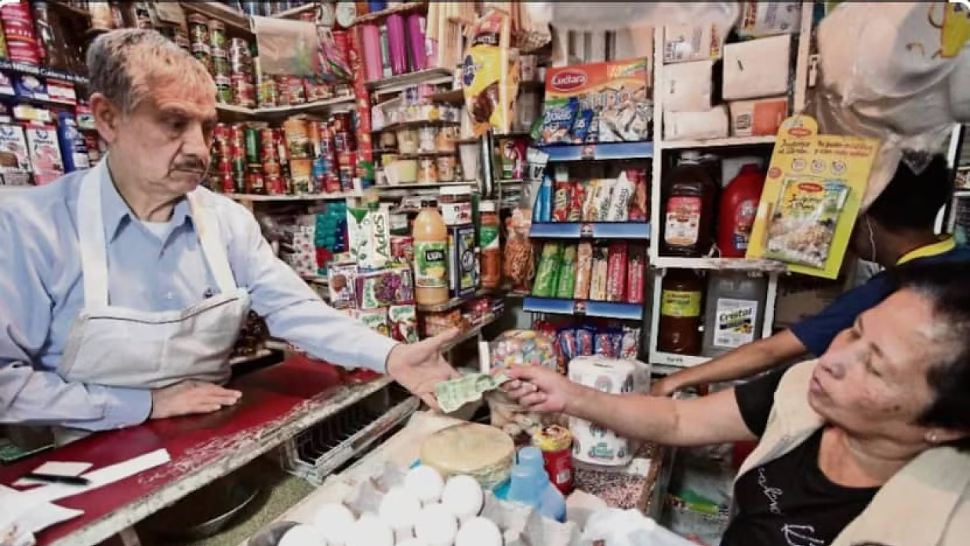
Adolescents in Mexico lead rates of psychological distress and violence

Official data show an alarming generational gap in psychological well-being, placing young people as the most vulnerable group.

The adolescent population of Mexico exhibits significantly higher indicators of psychological distress, behaviors associated with suicide and exposure to violent events compared to the adult population. These findings come from the results of the National Survey of Drug, Alcohol and Tobacco Consumption 2025 (ENCODAT), officially released by the Secretary of Health. The data configure an epidemiological panorama that demands urgent and focused interventions.

Analysis of critical mental health indicators

During the presentation of the study, Dr. David Kershenobich, head of the agency, highlighted that young people between 12 and 17 years old have the highest prevalence of mental health problems. This situation identifies them as the most vulnerable demographic segment, establishing them as an absolute priority for the design and implementation of public policies in the psychosocial field. The survey operates as a fundamental diagnostic tool to guide resources and strategies.

RelatedNational Survey Reveals Increase in Cannabis and Opioid Consumption in Mexico

Psychological discomfort or distress is reported more frequently in adolescence. The prevalence is 13.2% in adolescent females and 6.9% in their male peers. In contrast, the adult population presents figures of 10.2% and 5.1%, respectively. This disparity not only quantifies an immediate problem, but also evidences an rising generation gap in terms of emotional well-being and psychological resilience, possibly aggravated by contemporary social factors.

Risk behaviors and adverse environmental factors

In the area of suicidal behavior, ENCODAT 2025 reveals that adolescents register higher rates in the entire cascade of events. Suicidal ideation (recurrent thoughts) reaches 3.3% of young people, compared to 1.7% of adults. The planning phase occurs in 1.9% of adolescents versus 1.0% of older adults. Finally, the suicidal attempt stands at 1.5% in the youth group, practically tripling the figure for the adult group (0.5%). The analysis by gender indicates that adolescent women constitute the subgroup with the highest incidence in these indicators, pointing out an urgency for approaches with a gender perspective.

Exposure to violence, in its physical, emotional or sexual manifestations, also impacts the youth population more harshly. While the general prevalence (from 12 to 65 years) is 12.3%, among adolescents it rises to 18.1%. In the adult population, the figure remains at 11.4%. This environment of chronic adversity acts as a toxic stressor that undermines mental health and healthy development, with long-term consequences.

Other behavioral risk factors identified include participation in gambling and problematic video game use. Although the percentages are lower, 6.9% of adolescents participate in gambling, almost doubling the adult rate (3.9%). In both groups, participation is predominantly male. These behaviors can function as escape mechanisms or dysfunctional emotional self-regulation in the face of underlying psychological distress.

Faced with this complex scenario, the Ministry of Health has stressed that primary prevention and specialized care for adolescent mental health will be central axes of the national strategy. The pillars of action include early detection in school and community settings, strengthening psychosocial support networks and actively promoting safe and protective environments. The authorities emphatically called on families, caregivers and educational personnel to be trained in the identification of alarm signs and to know the referral protocols to specialized mental health services, guaranteeing an effective and timely care route.

Share this analysis to raise awareness of a crucial public health issue and explore more specialized content on our site.

Controversy over an interview with Monsiváis reaches the Senate and the Palace

The republication of a 1999 interview unleashes accusations between the Executive and legislators.

The republication of an old interview attributed to Carlos Monsiváis climbed to the center of the Mexican political debate this Wednesday. The issue was discussed both in the Senate and in President Claudia Sheinbaum’s morning conference.

The original text was written by journalist Edmundo Cázares in 1999 and recently republished by El Universal. It contains statements about the then head of Government Andrés Manuel López Obrador. Its veracity and context have been questioned, generating conflicting positions.

Sheinbaum describes the content as “grotesque”

During her conference, the president harshly criticized the publication. He described the content as “grotesque” and accused the medium of generating a controversy that distorts the tribute to the Mexican intellectual.

Reactions in the Senate

The issue also reached Congress. Senator Lilly Téllez read fragments of the text on the platform. In response, Gerardo Fernández Noroña rejected its use and maintained that it was a false publication with the intention of political attack.

The exchange reflects the polarization around the figure of López Obrador and the use of historical documents as partisan weapons.

Continue reading

PRI demands urgent action against violence in Guerrero

They denounce an incursion of armed civilians in Coyuca de Catalán; party calls for state intervention.

The national leadership of the PRI demanded that the Mexican State intervene urgently in response to the complaint by inhabitants of the Guajes de Ayala ejido, in Coyuca de Catalán, Guerrero. The residents reported the incursion of armed civilians into their community in the Sierra.

Call for safety

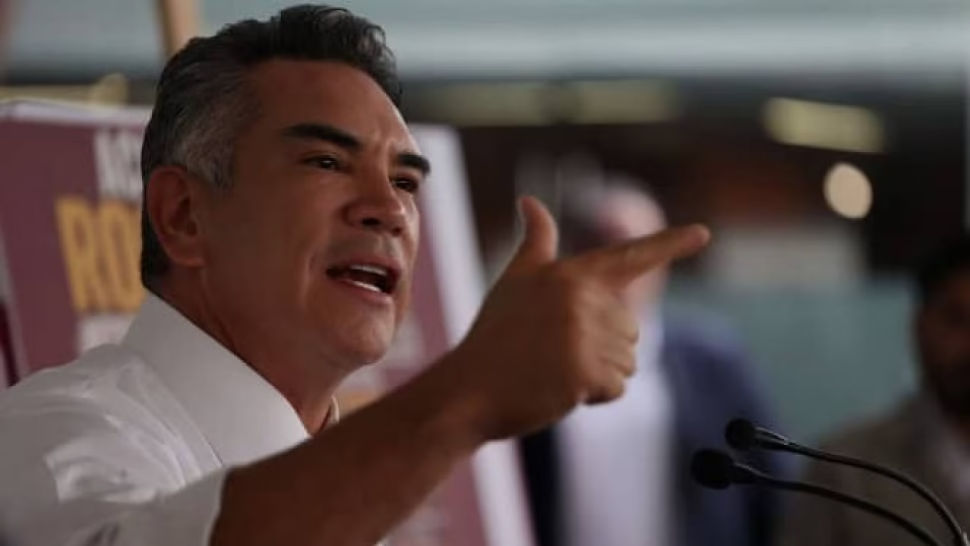
Alejandro Moreno Cárdenas, president of the party, asked the authorities to guarantee the safety of the families. He warned that these events should not be normalized due to the risk they represent for the civilian population.

The leader pointed out that in various communities in Guerrero they live under siege by armed groups. This has caused displacement, confinement of inhabitants and a constant climate of fear and uncertainty. He considered an immediate response from the State necessary.

Moreno Cárdenas also criticized the federal government for minimizing the situation of violence in the country. He affirmed that the population faces conditions of insecurity that require priority attention to restore the rule of law in the region.

Continue reading

Inflation in Mexico slows down and remains at Banxico’s goal

Inflation drops to 3.55% in the first half of June, within Banxico's target range.

Inflation in Mexico continues to decline. According to Inegi, it stood at 3.55% annually during the first half of June. This represents a drop of 0.11 percentage points compared to the second half of May.

With three consecutive months of deceleration, the indicator remains within Banxico’s target range (3% plus/minus one point). This level is key for purchasing power.

Pressures on core inflation

However, pressures remain. Core inflation—which reflects medium and long-term trends—was at 4.12%, with a biweekly increase of 0.19 points. Within this category, merchandise rose 3.65% annually and services, 4.57%.

Non-core inflation and seasonality

In contrast, non-core inflation slowed to 1.61% annually, driven by the drop in agricultural prices. Products such as tomatoes, eggs and poblano peppers recorded significant decreases.

The report also reflected seasonal movements in tourist services, related to the summer and the Soccer World Cup. Air transportation, hotels and tour packages increased. Despite this, analysts foresee a favorable trend towards the end of the year.

Continue reading