A night of drones and blackouts strains peace talks

A night of crossfire leaves casualties and massive blackouts, as the powers prepare for a crucial round of dialogue.

A Night of Fire and Shadow that Shook the World

In the deep darkness of a night that seemed destined for truce, destiny threw down its iron gauntlet. A Ukrainian drone attack, silent and lethal as a whisper of death, took the lives of two souls in the southwest of mother Russia. While the echo of the explosions still echoed in the Saratov region, shattering windows of kindergartens and clinics, a response of merciless fury fell from the sky on Ukraine. The Russian night attacks, a storm of steel and fire, plunged millions into darkness, turning off light, heat and hope in a strategic masterstroke. All this, on the eve of the restart of the peace talks led by the United States, an act that painted the already rarefied diplomatic panorama with cynicism and desperation.

The Iron Curtain of Negotiations and the Burning Front

As advisers to the powers prepared to meet in cold Berlin with the expected visit of President Volodymyr Zelenskyy, President Donald Trump pressed with growing exasperation for a quick end. But the search for compromises ran up against the insurmountable wall of reality: control of the industrialized region of Donbas. Moscow, in a statement that chilled the blood, made it clear through its advisor Yuri Ushakov that its police and National Guard would never abandon that territory, an ambition that kyiv would never accept, thus prolonging an agony that is now almost four years old.

RelatedNATO intercepts Russian drones in Polish airspace

On the battlefield, the narrative was one of chaos and epic resistance. The Russian Defense Ministry claimed to have shot down 41 drones, but the damage had already been done. Across the border, Zelenskyy revealed a terrifying figure: more than 450 drones and 30 missiles had rained down on his homeland. The port of Odessa, vital for economic survival, burned with grain silos converted into torches. More than a million people, civilians trapped in an endless war, were left at the mercy of the cold and darkness, in what the authorities denounce as a perverse strategy to “turn the cold into a weapon“.

The Battle for Truth and the Shadow of Destabilization

While in the crucial city of Pokrovsk Ukrainian forces refuted Russian claims of total control, a new act of shadow and mystery frayed nerves in Europe. Nearly 500 people were evacuated from a train between Poland and kyiv following a phantom threat, a chilling reminder that war extends beyond the trenches. Polish authorities, on high alert, point with evidence in hand to Russia behind previous sabotage attempts, painting a picture of regional destabilization that threatens to set the continent on fire.

This is the harsh reality: a macabre dance where each attack seeks to force the hand at the negotiating table, where each blackout is a message and each lost life, one more argument in a dialogue of the deaf. The path to peace is undermined by mistrust, territorial ambition and the iron will not to give in. The world watches, holding its breath, to see if diplomacy can finally put out this inferno or if we are doomed to watch it escalate toward the point of no return.

Do you think these military actions will define the outcome of the peace talks?Share this analysis on your social networks and join the conversation about this crucial geopolitical moment. Explore more related content to understand all the aspects of this conflict that shapes our time.
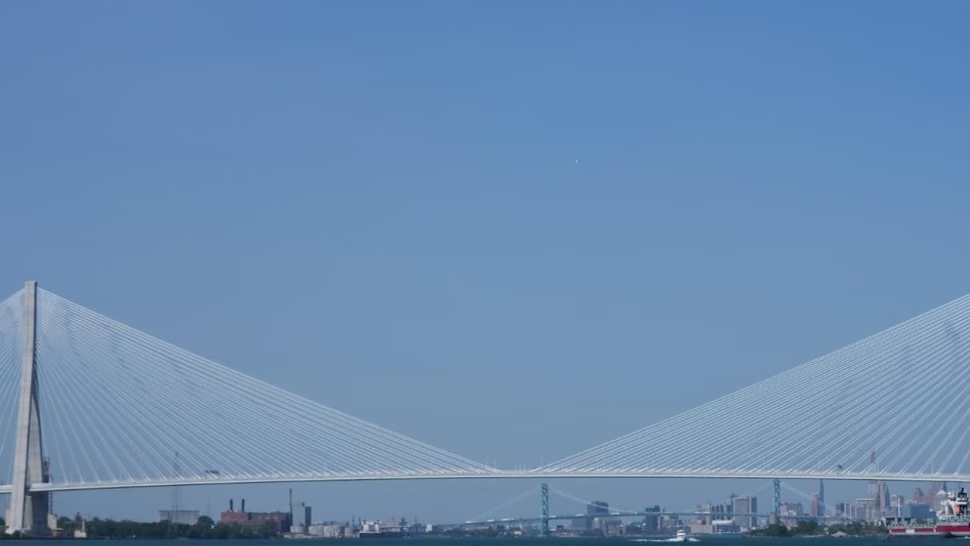
Canada cancels ceremony with the US due to Trump’s tariff threats

Ottawa cancels joint event with Washington due to tariff tensions. The bridge opens on July 27.

The Government of Canada decided to cancel the joint ceremony with the United States for the inauguration of the new Gordie Howe International Bridge, which connects Windsor with Detroit. The measure responds to recent tariff threats from President Donald Trump.

“In light of the trade actions threatened by the United States this week, it would be inappropriate to move forward with a celebratory event between the two countries,” said Jenna Ghassabeh, spokesperson for Canadian Infrastructure Minister Gregor Robertson.

The binational event was scheduled for July 24 with authorities from both countries. However, Ottawa will maintain the opening date to traffic on July 27, with an exclusively Canadian celebration.

Commercial tension and key work

The decision comes after Trump announced 50% tariffs on various Canadian imports, arguing alleged discriminatory treatment of American cars, alcoholic beverages and dairy products.

The Gordie Howe Bridge required an investment of $4.7 billion. It is one of the most relevant infrastructure works in North America and seeks to relieve the flow of the Ambassador Bridge, through which 126 billion dollars in merchandise circulated during 2023.

Despite the suspension of the joint event, the border crossing will begin operating as scheduled.

Continue reading

The official number of deaths from earthquakes in Venezuela rises to 5,346

5,346 dead and 16,740 injured: new official balance after the earthquakes of June 24 in Venezuela.

The Venezuelan authorities updated this Tuesday the official balance of the double earthquake registered on June 24. The death toll rises to 5,346 after adding 68 additional deaths in the last few hours.

Jorge Rodríguez, president of the National Assembly, reported that the injured remain at 16,740. A total of 17,265 people remain homeless, while 23,122 victims remain housed in 107 temporary camps. So far, authorities have provided care to 128,324 affected families.

Material damage and disappearances

The official report registers 856 buildings damaged and 190 collapsed. Civil society organizations estimate 29,460 people missing under the rubble, a figure that the government has not officially confirmed.

This new count is released 27 days after the earthquakes that generated a large-scale humanitarian emergency in the country. Rodríguez disseminated the data through his Telegram channel, where he detailed the progress in the care work for those affected.

The authorities maintain active search, rescue and humanitarian assistance tasks in the impacted areas. Thousands of people continue to depend on state aid and international cooperation to face the consequences of the tragedy.

Continue reading

The skeleton of a Triassic giant is restored in Poland

Volunteers restore a 6-meter-long prehistoric amphibian skeleton in Warsaw.

Volunteers restore the fossil of a prehistoric colossus in Warsaw

At the Copernicus Science Center in Warsaw, a team of more than 2,000 volunteers is working on restoring the skeleton of a Mastodonsaurus, a giant amphibian that lived 240 million years ago. With chisels, brushes and protective glasses, they remove the rock that covers the bones millimeter by millimeter.

Visitors watch through a window as the work progresses. The skeleton measures almost 6 meters and weighs 1,300 kilograms. It will be the largest of its kind displayed in a museum in the world, according to Tomasz Sulej, a paleontologist at the Polish Academy of Sciences.

An experience open to citizens

The volunteers are not scientists, but managers, cleaning staff and tattoo artists, among others. They receive training and protective equipment before supervised two-hour sessions. “I imagine that those bones were underground for 240 million years and I am the first human being to touch them,” commented Tatyana Kozyk, team coordinator.

The specimen was discovered in southern Poland in 2023 by Sulej and Wojciech Pawlak. Unlike other finds in Germany and Russia, which measure 2 to 3 meters, this specimen offers new information about the species. “The structure of the body is different from what we knew,” Sulej said.

A message of natural resilience

Dorota Serafín, a 51-year-old manager, described the experience as “relaxing and philosophical, even mystical.” The Mastodonsaurus lived after the largest mass extinction on the planet, just before the rise of the dinosaurs. For Sulej, his story sends a message of hope in the face of climate change: “Nature and life always find ways to survive.”

The restoration will be completed in October or November. The skeleton will then be displayed to the public at the same center.

Continue reading