A Chilean submarine surprises tourists in Puerto Vallarta

An unexpected visitor to the beaches of Jalisco unleashes curiosity and security protocols.

A metallic visitor that you did not expect on your vacation

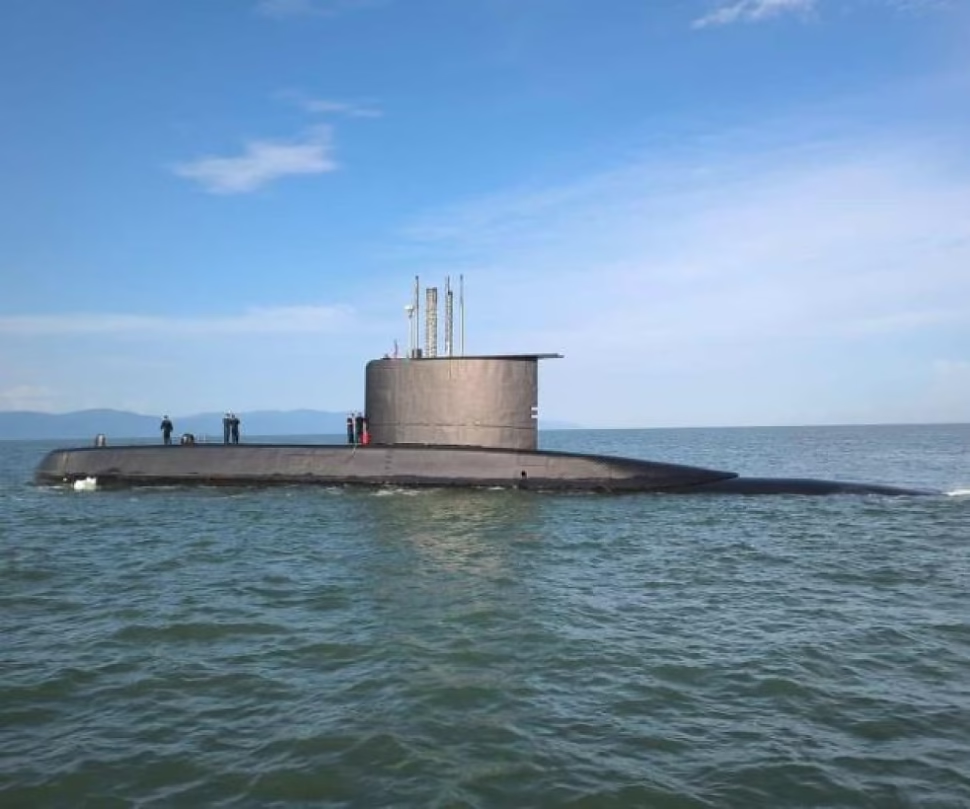
Imagine this: you are in Puerto Vallarta, enjoying your tacos al pastor with an ocean view, when suddenly… bam! A Chilean submarine appears as if it were an unexpected cameo in your favorite Netflix series. Yes, that’s random. The Thomson’ Submarine of the Chilean Navy decided that Jalisco was the perfect place for a technical stop, and the tourists, like potential good influencers, did not hesitate to document the moment for the ‘gram.

What is a submarine doing here? (No, it’s not drug trafficking)

Before you start speculating with conspiracy theories like “Are they smuggling avocados?”, the Secretary of the Navy (Semar) clarified that this is pure bilateral cooperation. That is, basically a “friend with benefits” between Mexico and Chile, but in a naval version. The submarine arrived for an “operational visit”, which in Christian means: rest, resupply of food (because even sailors need their Cheetos) and fuel. No clandestine passengers or shady merchandise.

RelatedChile and Google promote the first submarine cable between South America and Oceania

In case you didn’t know, supply is like the “meal prep” of submarines: without it, there is no autonomy on the high seas. So imagine the “Thomson” carrying groceries like your monthly purchase at Costco, but with more torpedoes and less toilet paper.

Safety protocols: No, you cannot take a selfie with the submarine

The authorities, in “this is not Disneyland” mode, issued a Maritime Safety Notice. Basically a reminder that the submarine is not a tourist attraction. If you have a jetski, kayak or paddle board, it is best to stay away from the anchoring area (August 15-18). And just in case: it is prohibited to approach or attempt to approach it. No, not even “just for a photo.”

The reason? Avoid incidents like that meme of the dog barking at a tank. Because, let’s be honest, a submarine vs. A jetski is the maritime equivalent of David and Goliath, but without an inspiring ending.

Why is this relevant? (Beyond the morbid)

This event reflects the strategic collaboration between countries, something key in geopolitics (yes, that sounds boring but even affects the price of your coffee). Plus, it’s a reminder that naval operations don’t just happen in Tom Cruise movies. Although, let’s face it, seeing a submarine in Mexican waters is as unusual as finding a unicorn in the Oxxo.

Did you like this note? Share it on your networks and tag that friend who always believes in extravagant theories. And don’t forget to explore more content like this in our current affairs section!

PS: If you see the submarine, don’t wave at it with the drone. It won’t end well.
More than 12 thousand refugees access bank accounts in Mexico

Banorte and UNHCR facilitate the financial inclusion of refugees in Mexico.

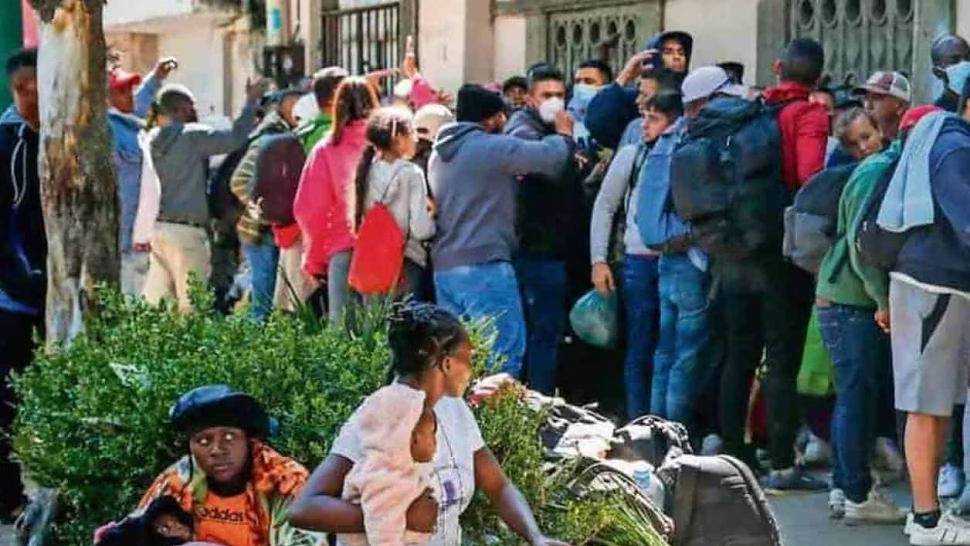
More than 12 thousand refugees with a legal residence permit in Mexico have managed to open a bank account, a fundamental step for their integration into formal employment. The initiative, promoted by Banorte in alliance with the UN Refugee Agency (UNHCR), began in 2022.

Felipe Medina, executive director of Funding at Banorte, pointed out that the main obstacle was the lack of access to an account to deposit payroll. Although the regulations allow opening accounts with CURP and immigration documents, in practice many branches did not recognize this documentation.

“There were people who already wanted to work, join formal employment and could not find an account that would allow them to receive their resources,” Medina explained.

The bank designed a digital opening process in about five minutes, with a simplified file. Refugees can receive salary deposits, make transfers and use a digital debit card. The physical card is then obtained in commercial establishments, without having to go to a branch.

Banorte also collaborated with companies that hire refugees—such as FEMSA, Mabe, LEGO and Alpura—to speed up account opening during job incorporation. Human resources teams received specialized training.

Banking has allowed full integration into the formal economy. The accounts in this segment record monthly deposits between 2,000 and 14,000 pesos, an average balance of 1,900 pesos and about six digital transactions per month. Companies report lower staff turnover and higher productivity among refugee workers, many with professional experience or specialized studies.

Continue reading

Sheinbaum’s government launches telephone alert against El Niño

Telephone warning system against El Niño will be ready in two months.

Warning system for climate phenomena

President Claudia Sheinbaum announced that the Federal Government is developing a telephone alert system for meteorological phenomena. It is expected to be ready in approximately two months. The initiative is carried out by the Digital Transformation and Telecommunications Agency, the National Civil Protection Coordination and the National Meteorological Service (SMN).

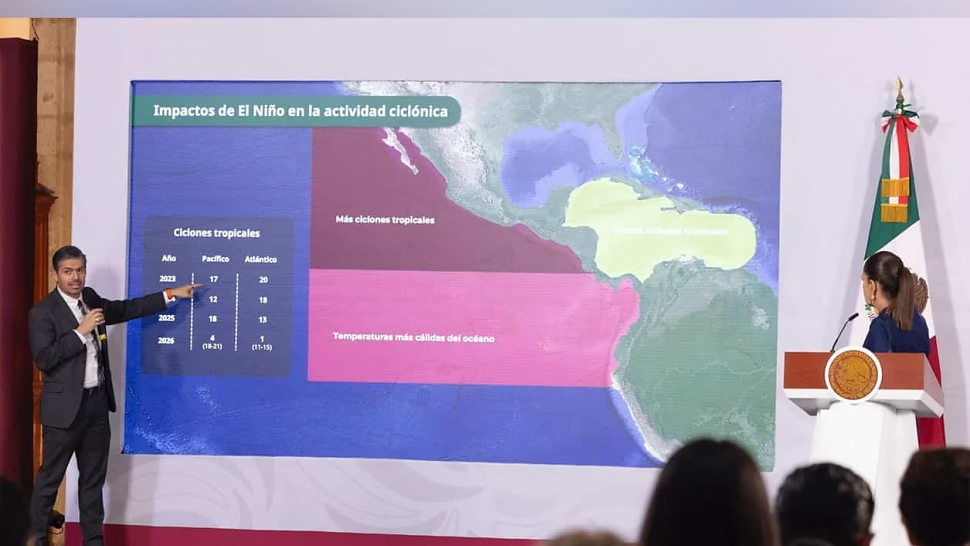
The project is part of preventive actions against the El Niño phenomenon, which according to authorities will manifest itself with great intensity this year and next.

Expected impact of El Niño

According to official forecasts, El Niño will leave more intense rainfall towards the end of the year, especially in the north of the country. A high probability of larger cyclones and drought conditions is also forecast for central Mexico in 2027.

The coordinator of the SMN, Fabián Vázquez Romaña, pointed out that there is a 63% probability that the event will be “very strong.” He added that it will reach its highest point in December and warned of a rebound in high temperatures during the spring of 2027.

Civil protection measures

The national coordinator of Civil Protection, Laura Velázquez, explained that communication is maintained with the 32 states to deploy relief teams, supervise shelters and update risk maps in collaboration with the National Water Commission.

As a key strategy, Command Posts are installed in the 17 coastal entities. Eleven are already formalized; the remainder will be completed the following week. The Pacific coast is prioritized before expanding coverage to the center of the country.

In addition, preventive infrastructure work is being accelerated throughout the territory: clearing dams, cleaning and opening the diameter of rivers, and placing containment barriers to mitigate possible floods.

Continue reading

The US recognizes the origin of weapons seized in Mexico: Sheinbaum

Sheinbaum affirms that the US recognizes that 75% of weapons seized in Mexico come from its territory.

Bilateral recognition of arms trafficking

President Claudia Sheinbaum reported that the United States government formally accepted that the majority of weapons seized in Mexico come from its territory. This recognition, he noted, reinforces the need to stop illegal trafficking as a priority in security cooperation.

“They already recognized it. And in the understanding that we have, now with President Trump’s government, they recognize that something fundamental is to seize the weapons that come to Mexico,” declared Sheinbaum.

The key data was given by the US Department of Justice before the end of Joe Biden’s administration: about 75% of the weapons seized in Mexican territory originate in the American Union.

Civil litigation and progress in the evidence phase

The Secretary of Foreign Affairs, Roberto Velasco, confirmed that the civil lawsuit that Mexico maintains against arms manufacturers and distributors in the United States is still active. It is currently in the discovery phase, despite the fact that other previous litigation was dismissed by US courts.

“This demand continues. We are going to follow up on it and we are committed to ensuring that this phase goes well,” Velasco said.

Concrete actions at the border

Velasco explained that the fight against arms trafficking is also addressed in bilateral coordination tables. The United States has increased actions to detect weapons and ammunition in its border area.

Additionally, Mexico has direct access to the ATF’s eTrace tracking system, which allows the origin of seized weapons to be identified. According to data from that platform, approximately 70% of the weapons seized and tracked come from American gun stores or distributors.

The chancellor also highlighted a recent operation in the United States that secured a shipment of weapons destined for the Mexican border, including detainees. This reflects greater cooperation to stem the flow of arsenal into the country.

Continue reading