A blackout interrupts the session of the Supreme Court of Justice

Darkness disrupts justice on a crucial day. Tension takes over the highest court in a session marked by suspense.

The Shadow that Fell on the Highest Court

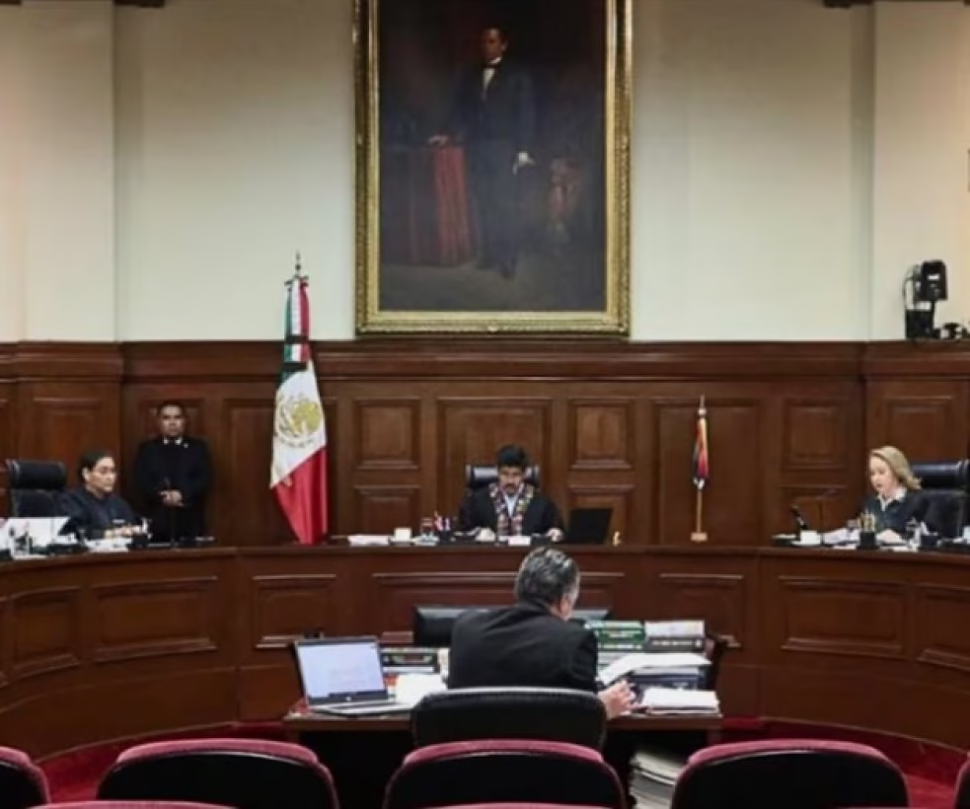
In a twist worthy of the most exciting political thriller, the Supreme Court of Justice of the Nation (SCJN), the beacon of Mexican justice, was plunged into surprising and absolute darkness. It was not an announced eclipse, but a sudden blackout that, like a rag knife, interrupted the solemn session of the plenary session, plunging into chaos and mystery one of the most crucial days in the recent history of the court. For four minutes that felt like an eternity, the fate of a highly sensitive sentencing project hung in the balance, in an atmosphere charged with tension and confusion.

The electrical failure, an invisible and unpredictable antagonist, broke out at the precise moment when the project of Minister Loretta Ortiz Ahlf was being debated. The discussion, a dialectical duel of giants, was abruptly paused, freezing the arguments in the air and leaving the entire nation holding its breath. The cameras of the judicial channel, eyewitnesses of the exceptional nature of the moment, hesitated, but a group of anonymous heroes, the hosts of the broadcast, fought a fierce battle in the shadows to keep the signal on the air, becoming the only link between the citizens and the dramatic event.

RelatedLoretta Ortiz Ahlf retains her position on the Court with votes and promises

Chain Consequences and a Minister in the Dark

The ramifications of the power outage were as immediate as they were devastating. The remote connection of Minister Arístides Guerrero García, who was following the deliberations from his residence after suffering a serious car accident, vanished into cyberspace. His screen turned black, isolating a key judge in the most critical of moments, in a scene that added a layer of personal tragedy to the already rarefied atmosphere. The question floated in the gloom: was fate conspiring to silence his vote?

However, like the phoenix that is reborn from its ashes, the light returned. After those endless four minutes of uncertainty, the power was restored and the public session could continue. The relief was palpable, but the intrigue was not over. The question everyone was asking was whether the dramatic interruption had altered the delicate balance of consciences. The response, when it came, was overwhelming and unanimous. With a force that seemed to want to overcome any shadow of doubt, the plenary session of the Court unanimously approved the opinion of Minister Ortiz Ahlf.

The project, which now stood as a final verdict, proposed declaring unfounded the appeal for review promoted by the Legal Department. This institution had put forward an argument of maximum weight: the disclosure of certain official communications represented a direct and urgent threat to national security. The ministers’ decision, taken in a setting of true suspense, thus sealed a state secret, closing a chapter that had kept the country in suspense and leaving a trail of questions about what the darkness was really hiding.

This episode, beyond the technical anecdote, stands as a powerful reminder of the fragility of institutions in the face of the unexpected. A critical situation that tested the emergency protocols of the highest judicial body and demonstrated that, even in the highest spheres of power, the course of justice can be threatened by imponderables. A day in which the interruption of the electrical flow almost altered the flow of the legal history of Mexico.

Do you think it was a simple coincidence or an event with deeper meaning? Share this unusual story on your social networks and keep the conversation alive about the mysteries that surround our institutions. Explore more content related to transparency and national security on our site.


They urge SEP to strengthen actions against bullying

28.5% of adolescents suffered bullying; They urge SEP to reinforce protection protocols.

The Second Commission of the Permanent Congress approved an opinion that urges the Ministry of Public Education (SEP) and the educational authorities of the 32 entities to reinforce strategies for preventing bullying and school violence. The request is part of the “Safe School Environments” program.

According to the National Discrimination Survey (ENADIS) 2022, carried out by Inegi, Conapred and the CNDH, around 28.5% of people between 12 and 17 years old have experienced some form of harassment or mistreatment at their school. The National Educational System serves more than 34 million students in 258 thousand basic, upper secondary and higher education schools.

The “Safe School Environments” strategy promotes co-responsibility between authorities, families and school communities to prevent risks and promote a culture of peace. The opinion highlights that this mechanism articulates guidelines, protocols and actions to guarantee safe, healthy and inclusive spaces, without restricting fundamental rights.

The legislators considered it necessary to maintain permanent prevention and care actions. The exhortation seeks to ensure that educational centers are environments free of harassment, with full respect for human rights and the best interests of children.

Continue reading

Sheinbaum reinforces security and housing in Cuautla

The president presented a package of social and security actions in Cuautla, Morelos.

President Claudia Sheinbaum visited Cuautla, Morelos, to announce a set of social and security measures. Among them, the construction of 10 new schools of the “Margarita Maza” National High School, house-to-house visits, more jobs through Young People Building the Future and a greater presence of the National Guard.

“We are going to build together, because this is a job for everyone, for families to care for their children, for the state government and for the federal government,” the president highlighted.

The visit occurred after the arrest of the mayor of Cuautla. Sheinbaum instructed strengthening the federal presence with attention to the causes, as part of the National Security Strategy. Next week they will begin house-to-house tours and outreach to merchants. He promised to return in three months to monitor progress.

Housing for Wellbeing

At the event, 128 Infonavit homes and 207 Insus deeds were also delivered. Sheinbaum recalled the four components of the program: build 1.8 million new houses for people with incomes of one to two minimum wages; deliver the same number of credits for improvement; grant a million deeds; and restructure unpayable loans for 5 million families.

Octavio Romero Oropeza, director of Infonavit, reported that of the goal of 1.2 million homes, there are already 440 approved complexes that total 514 thousand houses (43% progress). In Morelos, the goal is 13 thousand new homes with an investment of 8,150 million pesos.

Edna Elena Vega Rangel, head of Sedatu, explained that 128 homes and 207 deeds were delivered. Governor Margarita González Saravia thanked the expansion of the state goal to 24 thousand houses in the six-year term, in addition to other works such as modernization of the countryside, a Convention Center in Cuernavaca and the “Circuito Tierra y Libertad” highway program.

The beneficiary Kendra Ramírez Orozco expressed her gratitude for access to housing. Sheinbaum reiterated his commitment to return in three months to follow up.

Continue reading

They demand justice for a journalist in Oaxaca; colleague receives threats

Threats against journalist in Oaxaca after the murder of Alejandro Leyva; protest in the Guelaguetza.

Threats against correspondent

After the murder of Francisco Alejandro Leyva Aguilar, Proceso‘s correspondent in Oaxaca, Pedro Matías Arrazola, was intimidated through social networks. They warned him that he would be next.

Organizations such as Reporters Without Borders and the UN demanded that the threats be investigated and security guarantees granted. The Oaxaca Prosecutor’s Office deployed two agents to protect him, and the state police carry out patrols near his home.

“I didn’t find out until they told me about Reporters Without Borders and then the UN, but I didn’t pay much attention to it (…). Better to keep a low profile,” declared Matías.

The journalist explained that he avoided spreading the threats so as not to divert attention from Leyva’s case. However, colleagues advised him not to minimize the risk, in a context of growing attacks against the press.

Two years ago, individuals threw Molotov cocktails with nails at his home, without causing any injuries. That attack forced him to leave the country for six months. Sixteen years earlier he was kidnapped and tortured.

“I am not afraid. I am a believer. I have a mission in this life and it will be until God decides,” he stated.

Matías filed a complaint for threats with the State Prosecutor’s Office. Its incorporation into the federal protection mechanism began.

“If we remain silent, they will have achieved their purpose. In recognition of Alejandro Leyva, I will continue along the same critical line,” he said.

Protest in Guelaguetza

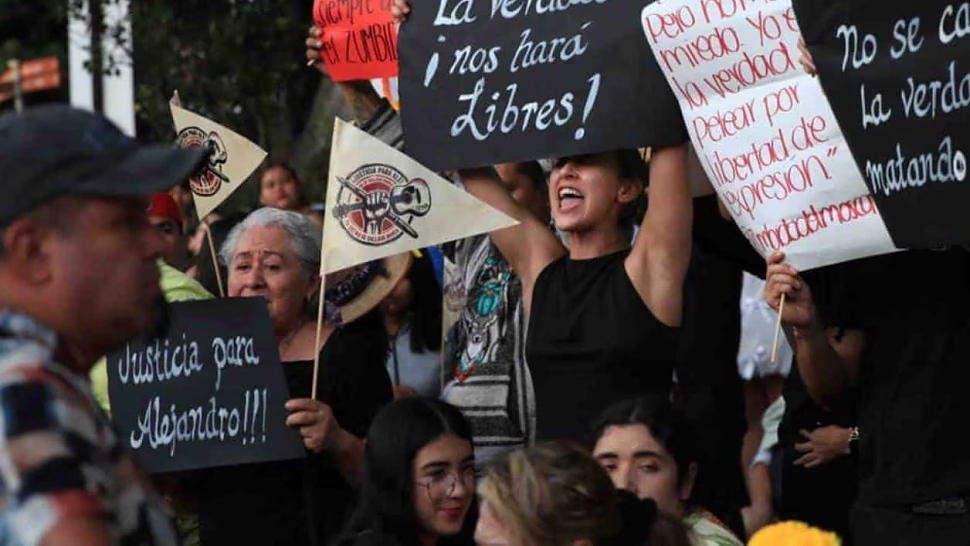
Relatives and friends of Alejandro Leyva protested during the Guelaguetza delegation parade. With tarps, banners on the roof of a house and dressed in black, they demanded justice.

“We are Alejandro’s family and we ask for justice for my uncle. We know the situation in the country. It is not just Oaxaca, it is the entire country. Please join our cause,” expressed the protesters.

Continue reading