Zelenskyy proposes demilitarized zone in Donbas with international supervision

The Ukrainian president details a bold strategy for de-escalation, linking the withdrawal of troops to international guarantees and popular consultation.

A strategic proposal for de-escalation

Ukraine’s president, Volodymyr Zelenskyy, has unveiled a bold initiative to defuse tension in his country’s eastern industrial heartland. Their proposal consists of a reciprocal withdrawal of military forces from the Donbas region, conditional on the Russian Federation executing a symmetrical movement. The ultimate objective is to transform this territory into a demilitarized special economic zone, whose integrity and neutrality would be guaranteed by international supervision mechanisms. This approach is not a mere declaration of intent, but a central element of a comprehensive 20-point plan developed in consultation with US negotiators.

The viability and legitimacy of this measure would depend, according to the proposal, on the holding of a referendum that would allow Ukrainian citizens to vote on its implementation. This requirement underscores the kyiv government’s commitment to democratic processes, even in the complex context of armed conflict. The strategy seeks to create a new security paradigm, where economic cooperation replaces military confrontation, under a surveillance scheme that involves global actors.

RelatedZelenskyy proposes joint management of the Zaporizhzhia nuclear plant

Extension of the model to the critical Zaporizhia plant

The scope of the initiative is not limited to Donbas. Zelenskyy has indicated that an analogous security mechanism could be applied around the Zaporizhzhia nuclear plant, the largest in Europe and currently under the control of Russian forces. For this critically important site, it is specifically proposed that the city of Enerhodar and its adjacent areas be designated as a free and demilitarized zone. This approach aims to mitigate the risk of a nuclear incident, one of the scenarios of greatest concern to the international community since the beginning of the invasion.

At the same time, it has been learned that the United States has circulated a complementary proposal: the formation of an international consortium for the management of the plant, with equal participation between Ukraine, Russia and the North American power itself. However, sources close to the Ukrainian government have described this idea as unrealistic in the current context, given the level of mistrust and violations of international law that kyiv attributes to Moscow. The Ukrainian position seems to prioritize first the recovery of sovereignty and full control over its critical infrastructures, before contemplating shared management schemes.

Together, these proposals represent an effort to translate de-escalation principles into concrete operational frameworks. The idea of ​​an internationally supervised demilitarized zone seeks to establish facts on the ground that facilitate a lasting cessation of hostilities, while the economic component aims to generate incentives for long-term peace. However, the execution of this plan faces formidable obstacles, starting with Russia’s willingness to withdraw its troops and submit to external verification. The Kremlin’s response to these approaches will be the true thermometer of its viability and will set the course for the next stages, or stalemates, in this conflict of historic proportions.

Do you think initiatives like this can open a viable path to peace? Share this analysis on your social networks to expand the conversation and explore more content on geopolitics and international security on our site.
Canada cancels ceremony with the US due to Trump’s tariff threats

Ottawa cancels joint event with Washington due to tariff tensions. The bridge opens on July 27.

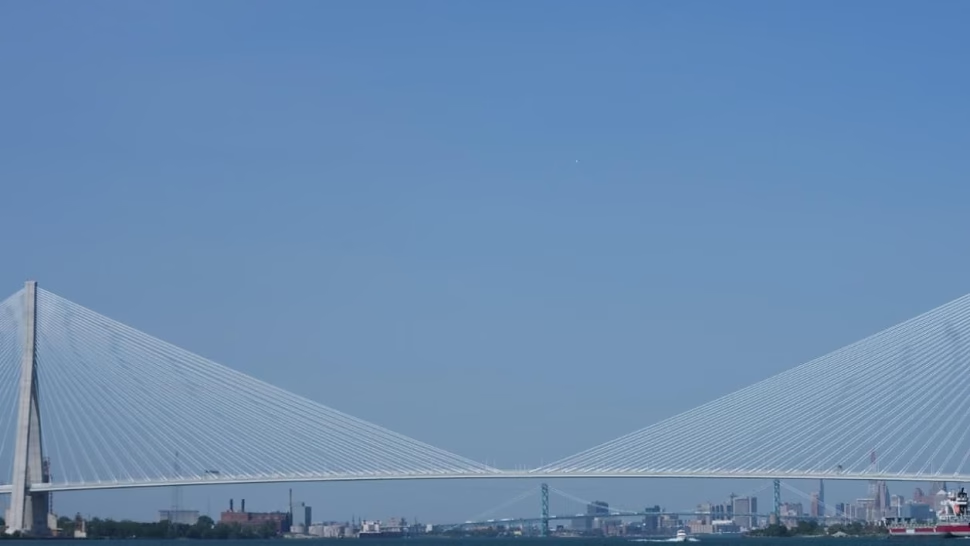
The Government of Canada decided to cancel the joint ceremony with the United States for the inauguration of the new Gordie Howe International Bridge, which connects Windsor with Detroit. The measure responds to recent tariff threats from President Donald Trump.

“In light of the trade actions threatened by the United States this week, it would be inappropriate to move forward with a celebratory event between the two countries,” said Jenna Ghassabeh, spokesperson for Canadian Infrastructure Minister Gregor Robertson.

The binational event was scheduled for July 24 with authorities from both countries. However, Ottawa will maintain the opening date to traffic on July 27, with an exclusively Canadian celebration.

Commercial tension and key work

The decision comes after Trump announced 50% tariffs on various Canadian imports, arguing alleged discriminatory treatment of American cars, alcoholic beverages and dairy products.

The Gordie Howe Bridge required an investment of $4.7 billion. It is one of the most relevant infrastructure works in North America and seeks to relieve the flow of the Ambassador Bridge, through which 126 billion dollars in merchandise circulated during 2023.

Despite the suspension of the joint event, the border crossing will begin operating as scheduled.

Continue reading

The official number of deaths from earthquakes in Venezuela rises to 5,346

5,346 dead and 16,740 injured: new official balance after the earthquakes of June 24 in Venezuela.

The Venezuelan authorities updated this Tuesday the official balance of the double earthquake registered on June 24. The death toll rises to 5,346 after adding 68 additional deaths in the last few hours.

Jorge Rodríguez, president of the National Assembly, reported that the injured remain at 16,740. A total of 17,265 people remain homeless, while 23,122 victims remain housed in 107 temporary camps. So far, authorities have provided care to 128,324 affected families.

Material damage and disappearances

The official report registers 856 buildings damaged and 190 collapsed. Civil society organizations estimate 29,460 people missing under the rubble, a figure that the government has not officially confirmed.

This new count is released 27 days after the earthquakes that generated a large-scale humanitarian emergency in the country. Rodríguez disseminated the data through his Telegram channel, where he detailed the progress in the care work for those affected.

The authorities maintain active search, rescue and humanitarian assistance tasks in the impacted areas. Thousands of people continue to depend on state aid and international cooperation to face the consequences of the tragedy.

Continue reading

The skeleton of a Triassic giant is restored in Poland

Volunteers restore a 6-meter-long prehistoric amphibian skeleton in Warsaw.

Volunteers restore the fossil of a prehistoric colossus in Warsaw

At the Copernicus Science Center in Warsaw, a team of more than 2,000 volunteers is working on restoring the skeleton of a Mastodonsaurus, a giant amphibian that lived 240 million years ago. With chisels, brushes and protective glasses, they remove the rock that covers the bones millimeter by millimeter.

Visitors watch through a window as the work progresses. The skeleton measures almost 6 meters and weighs 1,300 kilograms. It will be the largest of its kind displayed in a museum in the world, according to Tomasz Sulej, a paleontologist at the Polish Academy of Sciences.

An experience open to citizens

The volunteers are not scientists, but managers, cleaning staff and tattoo artists, among others. They receive training and protective equipment before supervised two-hour sessions. “I imagine that those bones were underground for 240 million years and I am the first human being to touch them,” commented Tatyana Kozyk, team coordinator.

The specimen was discovered in southern Poland in 2023 by Sulej and Wojciech Pawlak. Unlike other finds in Germany and Russia, which measure 2 to 3 meters, this specimen offers new information about the species. “The structure of the body is different from what we knew,” Sulej said.

A message of natural resilience

Dorota Serafín, a 51-year-old manager, described the experience as “relaxing and philosophical, even mystical.” The Mastodonsaurus lived after the largest mass extinction on the planet, just before the rise of the dinosaurs. For Sulej, his story sends a message of hope in the face of climate change: “Nature and life always find ways to survive.”

The restoration will be completed in October or November. The skeleton will then be displayed to the public at the same center.

Continue reading