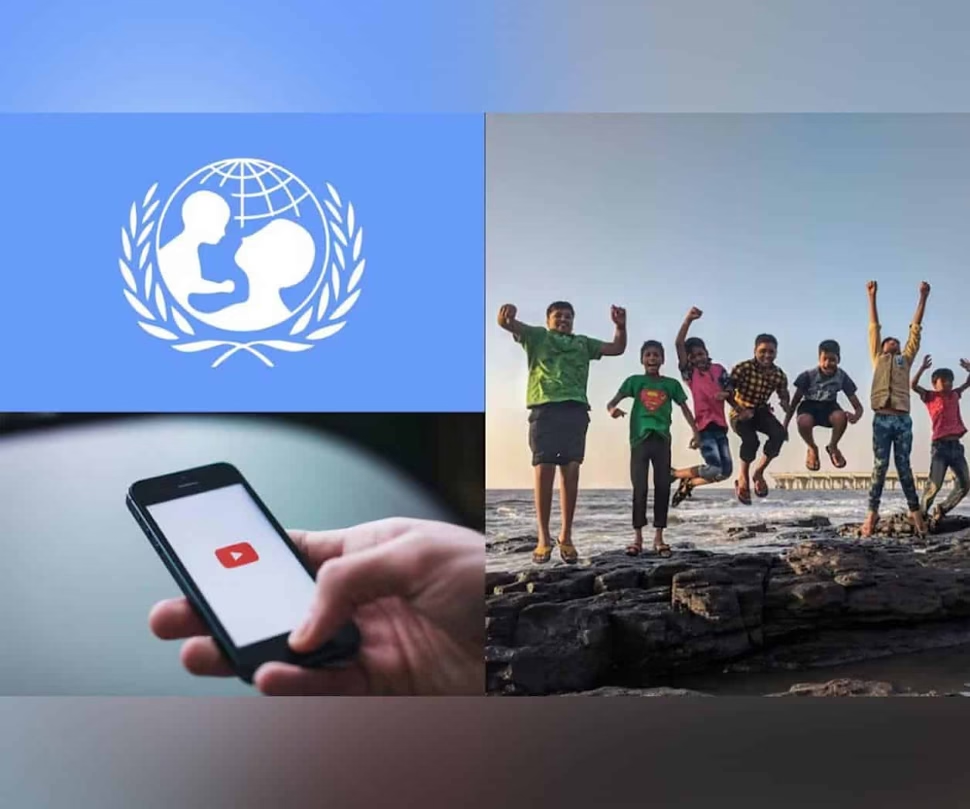
YouTube and UNICEF offer parenting without violence course

A digital guide to transform the daily challenges of parenting into opportunities for family connection and respect.

Because nothing says “unconditional love” like a YouTube tutorial

In a twist that no one saw coming, but that we all need, the United Nations Children’s Fund, better known as UNICEF, and the giant of kitten videos and makeup tutorials, YouTube, have decided to join forces. Their mission: save desperate parents from supermarket tantrums with an online Positive Parenting course. Because, clearly, the ancestral wisdom passed down for generations must now be validated by a YouTuber with an LED light microphone.

The initiative, available on the official channel of UNICEF Mexico, promises to strengthen family ties and promote homes free of violence. Or, what is the same, try to stop your child from shouting at the tablet and stop you from contemplating the idea of running away to live in a Tibetan monastery.

RelatedYouTube tests age verification with AI to protect minors

Ten modules to tame (lovingly) the creature

The course offers ten modules totaling a dazzling 37 minutes of content. Yes, you read that right. Less time than a Disney movie, but with the potential to reduce physical abuse in homes by half. Isn’t it wonderful? All this, developed by a dream team of clinical psychologists, parental therapists and, of course, specialized content creators. Because in the 21st century, credibility comes with a high number of subscribers.

The content addresses crucial topics for modern parental survival: management of emotions (both theirs and yours, which tend to be the most alarming), safety on the internet (so they don’t buy 100 packages of Fortnite with your card) and strategies for the famous “tantrums”, those dramatic monologues that your child performs in the cereal aisle.

During the announcement, Rocío Aznar, Head of Protection at UNICEF in Mexico, dropped the pearl: “Raising girls and boys is an enormous challenge and can sometimes feel overwhelming.”. Wow, what a revelation. Thank goodness we have an international organization to confirm what any parent with a 3-year-old child and an empty paint can already knows. But hey, we are not alone. Now we have simple and practical tools that can transform chaos into “moments of dialogue, respect and family unity.” Or at least, in a lull long enough so you can drink your hot coffee.

The numbers of despair (and a pinch of hope)

They didn’t invent the course last night between unboxing videos. It is inspired by the Parenting with Positive Conscience (CC+) program, which in the glorious Mexican territory managed to reduce physical abuse by 51%, emotional abuse by 37% and general abuse by 45% in participating homes. Statistics that, to be honest, are as hopeful as they are terrifying. Because they mean that before the intervention, the numbers were even more Dantesque.

UNICEF delights us with another comforting fact: one in every two girls, boys and adolescents between 1 and 14 years old suffers violent discipline. Aren’t you in the mood to celebrate? This, as expected, has an impact on their mental health, school performance and social development. Or what is the same: parenting with screams and slaps today means paying for therapy tomorrow. A long-term investment.

And to ensure that the message reaches every corner, Daniela Guerra, Creators and Responsibility Leader for YouTube Latin America, took the virtual stage to proclaim the gospel. “YouTube is committed to being a global platform for learning and community,” he stated. That is, between the ice bucket challenge and the latest viral dance, now you can also learn not to lose your mind when your child decides to bathe the cat in yogurt.

The alliance seeks to bring clear and practical tools to millions of families. That is, democratize access to common sense and parenting techniques that, perhaps, should be basic knowledge. But since they are not, digital initiatives are welcome. They promise to foster more resilient communities, which is the fancy way of saying “parents who no longer give up at 8 in the morning.”

And if this were not enough, both institutions have already announced that in 2026 they will continue collaborating. What does the future hold for us? An advanced negotiation course to put your shoes on? A manual to survive adolescence? Time, and the YouTube algorithm, will tell.

So now you know. The next time you feel like parenthood is overwhelming you, don’t run and hide in the bathroom. Open YouTube. Peace begins at home, and apparently, also in the cloud.

Do you think this course can make a difference? Share this news on your social networks and help it reach those who need it most. Explore more content related to family well-being and child development in our specialized section.


Satellite Internet, the bet to close the digital divide in Mexico

Mexican geography limits fiber deployment, but low orbit satellites are emerging as an alternative.

Satellite internet as a solution to the digital divide in Mexico

Mountains, jungles and deserts make Mexico one of the countries with the most complex orography in Latin America. Bringing fiber optics to isolated communities implies an investment that is difficult to recover with few users. As a result, one in five households still lack internet access or receive poor service.

Faced with this scenario, low orbit (LEO) satellite internet is emerging as a strategic alternative. “Deploying physical infrastructure in Mexico is expensive due to geography. In many cases, satellite internet represents the most viable option to connect areas where fiber will not reach in the short term,” explains Ernesto Piedras, director of The CIU. Companies like Starlink, with more than 10,300 active satellites, already operate in the country. Since May 2021, it obtained a concession and closed 2024 with 160,631 subscriptions, making Mexico its second Latin American market, only behind Brazil. Starlink has signed contracts with CFE Telecomunicaciones for up to 1,556 million pesos to connect remote communities.

However, cost remains a barrier. While a fiber optic plan costs an average of 544 pesos per month, satellite internet starts at 899 pesos, plus equipment and installation. “Commercially it is still not as viable because it is still more expensive and requires purchasing an antenna whose price remains high,” says Fernando Esquivel, from The CIU. The service makes economic sense when it is shared between communities or companies, and with the support of public policies.

Experts agree that this technology will not replace fiber optics, but will complement it. “Terrestrial services are faster and have lower latency. Satellite communication reaches areas that fixed internet would not reach,” says Hugo Simg, from MediaTek. Deployment also requires regulation and coordination between governments and companies. The race to connect Mexico is no longer only being fought underground, but from space, where a new generation of satellites promises to reduce the digital divide that keeps millions out of the digital world.

Continue reading

Banks prepare for biometric facial controls in October

Banks claim to be ready for facial biometrics in branches since October.

The main banking institutions in the country claim to be prepared for the new regulations on facial biometric controls when opening accounts, which will come into force next October.

What did the banks declare?

Marcos Ramírez, general director of Grupo Financiero Banorte, pointed out that the institution has made progress to reinforce the identification and security of its users. “We are in time and form with everything established by law and a little ahead, with the prudential limits of the law,” he indicated.

These measures will strengthen control over customer identification. Since 2018, by regulation, fingerprint biometrics are already required to open accounts.

Implementation details

On July 1, the National Banking and Securities Commission (CNBV) incorporated facial biometrics into the regulation for multiple banking in customer identification and authentication. Institutions that opt ​​for this mechanism must comply with technical, operational and security requirements.

Continue reading

AI detects breast cancer with 90% accuracy

An autonomous model analyzes thermographs and classifies tissues without human intervention.

An artificial intelligence model developed by Raúl Castro Ortega, a researcher at the Polytechnic University of Tulancingo, manages to identify breast cancer with an accuracy of 90%. The results were presented during the SPIE Photonics Europe 2026 International Congress, in Strasbourg, France.

How the system works

The system uses convolutional neural networks with attention mechanisms to analyze breast thermographs. Unlike traditional methods, the model autonomously learns the patterns of healthy and diseased tissue, without a specialist previously defining the characteristics of the images. This reduces processing time and improves consistency of results.

The study, titled “Breast thermography analysis using convolutional neural networks with attention mechanisms,” uses an algorithm based on the heat diffusion equation. This approach focuses analysis on thermogram regions of interest and classifies tissues with high levels of sensitivity and specificity.

Impact on early detection

The accuracy achieved represents a significant advance for the early detection of breast cancer, which can improve survival rates and facilitate timely treatment. The researcher highlighted that the system does not replace the specialist, but rather works as a support tool for faster and more consistent diagnoses.

Continue reading