Wrestling conquers the World Cup in Mexico

Tourists from all over the world surrender to the magic of wrestling during the World Cup.

A Mexican classic in football times

It appears everywhere: around stadiums, at celebrations, having a beer in bars. The anonymous masked wrestler has become one of the emblematic images of the World Cup in Mexico. Mexican wrestling found a new showcase in the soccer arena.

Travelers from all over the world have surrendered to this sport that, along with football, leads national passions. Inside the arenas, they forget about the World Cup fever for a few hours to live a unique night.

RelatedWrestling masks, ready to conquer the 2026 World Cup

How is wrestling experienced in the context of the World Cup?

As Spain took on Uruguay in Guadalajara, tens of thousands of fans tuned in to another spectacle: Místico and Máscara Dorada against The Bestia Mortos and Sammy Guevara in the iconic Arena México, known as the cathedral of wrestling.

“It was just fantastic, we really enjoyed it,” said Andy Winston, a native of Manchester, who has visited the three World Cup venues with his family. “You can’t come to Mexico and not come to wrestling. It’s a great tradition, a classic.”

In the stands, fans supported their favorites wearing jerseys from teams such as England, Japan, Brazil, Colombia and Mexico.

“It was a wonderful night, much better than I imagined,” said Brazilian Henrique Nunes dos Santos. “You connect in a way that seems like it’s all real… there’s a gigantic energy.”

The identity of a country

The origins of Mexican wrestling date back to the beginning of the 20th century. His style fuses techniques from American wrestling and Greco-Roman wrestling with aerial acrobatics. It was declared cultural heritage of Mexico City in 2018.

“Wrestling is in our roots. For almost 93 years of history it has been part of us Mexicans and it has also become a letter of introduction,” explained Julio César Rivera, spokesperson for the World Wrestling Council (CMLL).

The show combines sport, theater and tradition. The vibrant and colorful masks represent superheroes, animals or symbolic figures. Each one is designed to convey a unique visual language.

“Wrestling is my life,” said Star Black, a 30-year-old wrestler. “I began to fall in love with the masks, the capes, the flights, the sets and one day I made the decision to train.”

High prices at other tournament venues made Mexico a popular destination for tourists, according to José Ángel Garfias Frías, a UNAM wrestling expert. “The arenas are much more crowded and we see many tourists wearing t-shirts of their teams,” he said.

Although FIFA banned the use of masks in stadiums for safety, many fans wore them outside. “Wrestling is Mexico. It is part of our identity and it is as popular as soccer,” said Claudio Díaz, one of the masked men at the celebrations.

For some, wrestling best represents the country. “I feel that soccer does not represent us Mexicans so much; wrestling represents us more,” said the Legendary Dragon wrestler. “Here comes from all types of social classes: from the grandmother to the businessman.”
Mexico and PAHO/WHO sign health strategy 2026-2030

Mexico and PAHO/WHO sign agreement to strengthen the health system and reduce the burden of diseases.

Bilateral agreement to strengthen the health system

The Government of Mexico, through the Ministry of Health, and the Pan American Health Organization/World Health Organization (PAHO/WHO) signed the Country Cooperation Strategy 2026-2030. The goal: strengthen the national health system and reduce the burden of disease.

The agreement includes priority actions to address non-communicable diseases, cancer and mental health disorders. It also promotes prevention strategies and timely care throughout the population’s life course.

In addition, it seeks to strengthen the stewardship of the Ministry of Health and the coordination between the institutions of the National Health System. The goal is to move towards a model of universal access to quality medical services.

Among the central axes are the strengthening of the capacity to respond to health emergencies, the promotion of health self-sufficiency and the strengthening of the national regulatory authority.

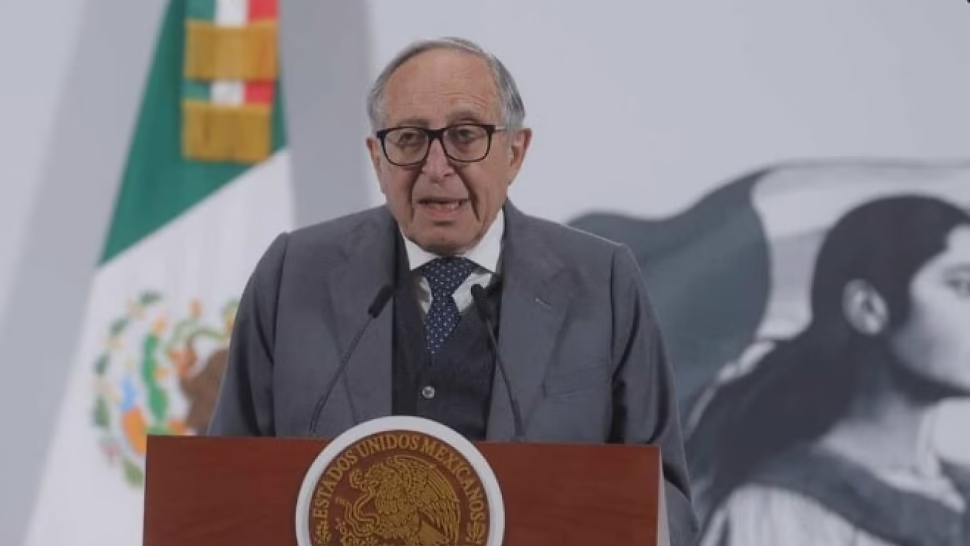
Health Secretary David Kershenobich said:

The strategy will allow national priorities to be aligned with the technical experience of PAHO/WHO, which will contribute to expanding access to health services, with emphasis on prevention, primary care and universal coverage.

The agreement lays the foundations for technical cooperation that addresses the country’s main health challenges in the next five years.

Continue reading

Mexican peso recovers after confirming the validity of the T-MEC

The peso recovers after confirming the validity of the T-MEC until 2036 with annual reviews.

The peso recovers ground against the dollar

The national currency registered an appreciation of 0.4% this Thursday, closing at 17.48 units per dollar in wholesale operations. At bank windows, the greenback stood at 17.91 pesos for sale, breaking a streak of two consecutive days with losses.

The recovery occurs after the continuity of the Treaty between Mexico, the United States and Canada (T-MEC) was confirmed until 2036, under the annual review scheme agreed upon by the three countries.

The details of the official announcement

The Secretary of Economy, Marcelo Ebrard, reported that the first formal review will begin on July 20 with the visit of a US delegation to Mexico. During the virtual meeting with their counterparts from the United States and Canada, Washington’s concern about the trade deficit was addressed.

Ebrard highlighted that more than 80% of Mexican exports to the United States continue to be tariff-free, with no changes to that scheme expected. The next working groups will focus on strengthening regional integration in strategic sectors such as the pharmaceutical industry and semiconductors, with the aim of reducing dependence on imports from other regions.

He specified that negotiations on the future of the treaty are limited exclusively to trade issues and do not include security issues.

Continue reading

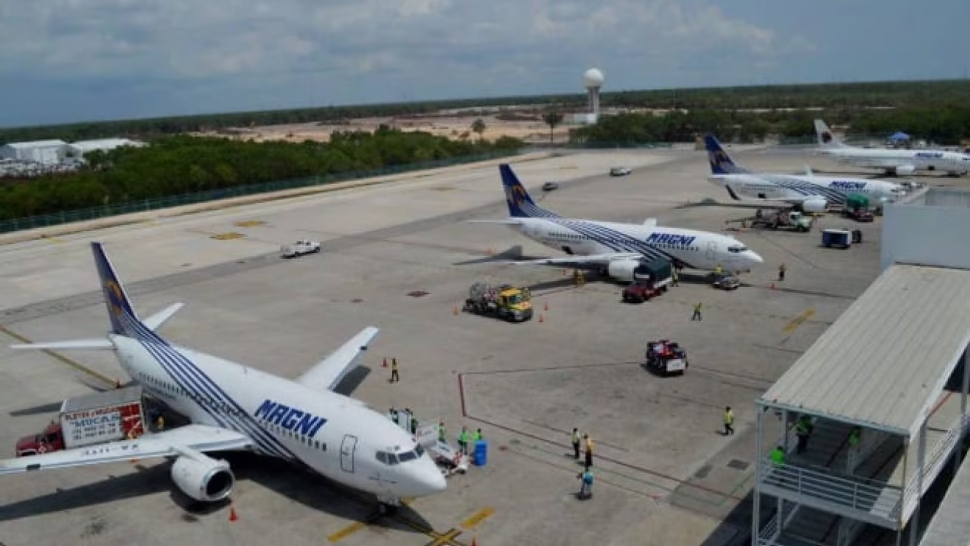
AFAC revokes Magnicharters certificate after non-compliance

The airline could not prove regulatory compliance after an extraordinary verification.

Regulatory decision

The Federal Civil Aviation Agency (AFAC) revoked Magnicharters’ air services operator certificate. The measure was notified on June 29, after a regulatory review process.

The Secretariat of Infrastructure, Communications and Transportation (SICT) reported that the company’s right to a hearing was respected throughout the procedure. It was granted legal deadlines to present information and evidence that demonstrated compliance with current aeronautical regulations.

However, the documentation provided was insufficient. The airline was unable to prove that it met the necessary requirements to continue operating as a provider of passenger air transportation.

Origin of revocation

The decision derives from an extraordinary major verification carried out in January 2026. In it, non-compliance with the regulation of the sector was detected. This led to formal requirements and, subsequently, the temporary suspension of operations in April, as a preventive measure.

The SICT stressed that the revocation is based on the lack of sufficient evidence on the part of Magnicharters to prove its regulatory status. The company now faces the loss of its certificate, which prevents it from offering commercial air services.

Continue reading