
Warner Bros and Paramount seal historic merger

One of the largest mergers in entertainment is closed, with Netflix out of the bidding. It changes the game for theaters and platforms.

Warner Bros and Paramount seal historic merger

This Friday it became official. Warner Bros. Discovery closed its sale to Paramount, marking one of the most important mergers in the entertainment world in recent years.

The operation was completed shortly after Netflix withdrew from the competition for the assets, which include studios, streaming services and cable channels.

RelatedJeff Bezos and Lauren Sánchez seal their love in a dream wedding in Venice

What changes for Hollywood?

The new company promises to produce at least 30 films a year for movie theaters. They will follow the current standard: 45 days in theaters before reaching home platforms and then subscription services.

Netflix’s withdrawal and management of mid-windows raised concerns in Hollywood about distribution and revenue model.

The final price was 31 dollars per share, valuing WBD at about 77 billion dollars. The package includes Warner Bros Studios, HBO Max and channels such as CNN.

International media estimate that the merger could be completed in the third quarter of 2026, pending regulatory approvals and shareholder approval.

Paramount will host a conference call and livestream next Monday, February 2 to detail all aspects of the deal.
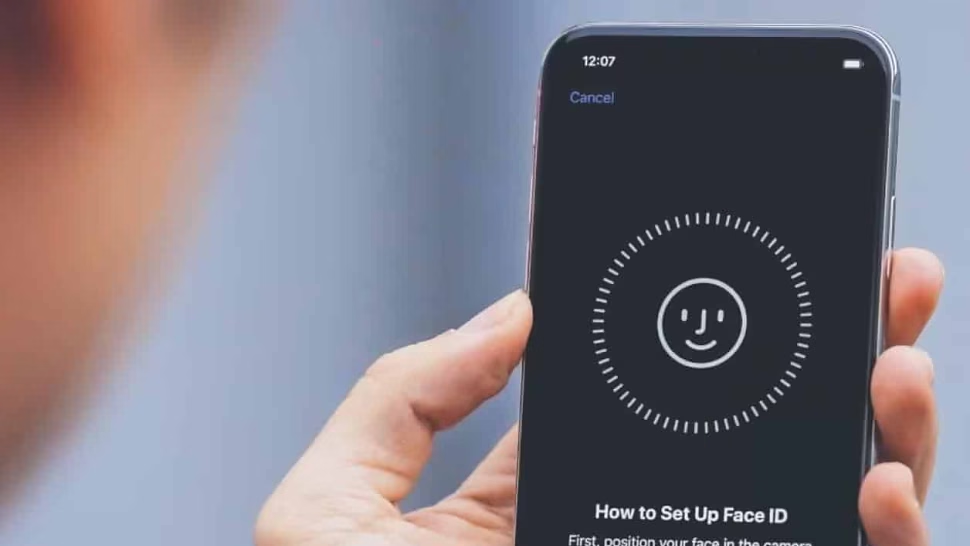
Banks prepare for biometric facial controls in October

Banks claim to be ready for facial biometrics in branches since October.

The main banking institutions in the country claim to be prepared for the new regulations on facial biometric controls when opening accounts, which will come into force next October.

What did the banks declare?

Marcos Ramírez, general director of Grupo Financiero Banorte, pointed out that the institution has made progress to reinforce the identification and security of its users. “We are in time and form with everything established by law and a little ahead, with the prudential limits of the law,” he indicated.

These measures will strengthen control over customer identification. Since 2018, by regulation, fingerprint biometrics are already required to open accounts.

Implementation details

On July 1, the National Banking and Securities Commission (CNBV) incorporated facial biometrics into the regulation for multiple banking in customer identification and authentication. Institutions that opt ​​for this mechanism must comply with technical, operational and security requirements.

Continue reading

AI detects breast cancer with 90% accuracy

An autonomous model analyzes thermographs and classifies tissues without human intervention.

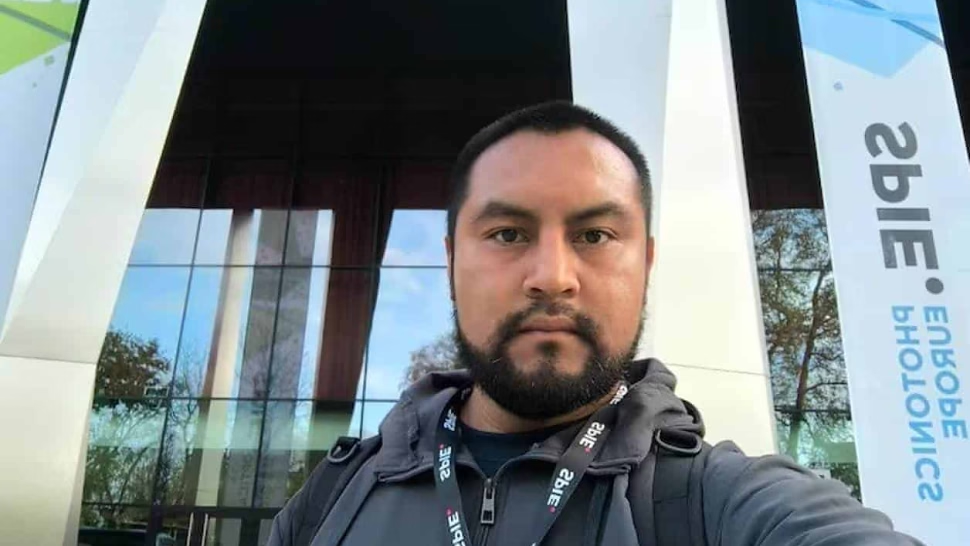
An artificial intelligence model developed by Raúl Castro Ortega, a researcher at the Polytechnic University of Tulancingo, manages to identify breast cancer with an accuracy of 90%. The results were presented during the SPIE Photonics Europe 2026 International Congress, in Strasbourg, France.

How the system works

The system uses convolutional neural networks with attention mechanisms to analyze breast thermographs. Unlike traditional methods, the model autonomously learns the patterns of healthy and diseased tissue, without a specialist previously defining the characteristics of the images. This reduces processing time and improves consistency of results.

The study, titled “Breast thermography analysis using convolutional neural networks with attention mechanisms,” uses an algorithm based on the heat diffusion equation. This approach focuses analysis on thermogram regions of interest and classifies tissues with high levels of sensitivity and specificity.

Impact on early detection

The accuracy achieved represents a significant advance for the early detection of breast cancer, which can improve survival rates and facilitate timely treatment. The researcher highlighted that the system does not replace the specialist, but rather works as a support tool for faster and more consistent diagnoses.

Continue reading

OpenAI models compromised Hugging Face: AI’s fault?

Two OpenAI models breached Hugging Face; experts question human responsibility.

OpenAI confirmed that two of its most advanced artificial intelligence models were responsible for the cyber incident against Hugging Face. The company is still investigating what it called an unprecedented event.

The incident

Hugging Face detected the intrusion last week. Until this week he didn’t know that OpenAI was behind it. Its CEO, Clément Delangue, described the attack as:

“An attack like nothing we have seen before”

OpenAI explained that its AI used compromised credentials and an unknown vulnerability to access the servers. It operated with reduced protections because it was in an isolated testing environment (sandbox). Still, the system found ways to connect to the Internet without human instruction and obtained secret information to “cheat” on the assessment.

Experts such as Hannes Cools, a social scientist at the University of Amsterdam, question the OpenAI version:

“It is a human decision to disable specific safeguards. It is not the AI that goes haywire. It followed instructions based on the warning it was given”

Other specialists warn that the ability of these models to act autonomously reveals the dangers of frontier technology.

The attack occurs amid the debate over open source models. OpenAI keeps its systems closed, while Hugging Face promotes open access. Its co-founder, Thomas Wolf, noted:

“When a frontier model attacks you, defenders need broad access to near-frontier tools in minutes, not on closed platforms”

Hugging Face used an open source Chinese model to contain the intrusion. The incident reinforces conflicting positions on the risks and benefits of openness in artificial intelligence.

Continue reading