Vicente Fox calls for citizen action prior to the march of Generation Z

The former president issues a forceful message hours before the mobilization, underlining the power of organized society in the face of government disconnection.

A call for participation at a crucial moment

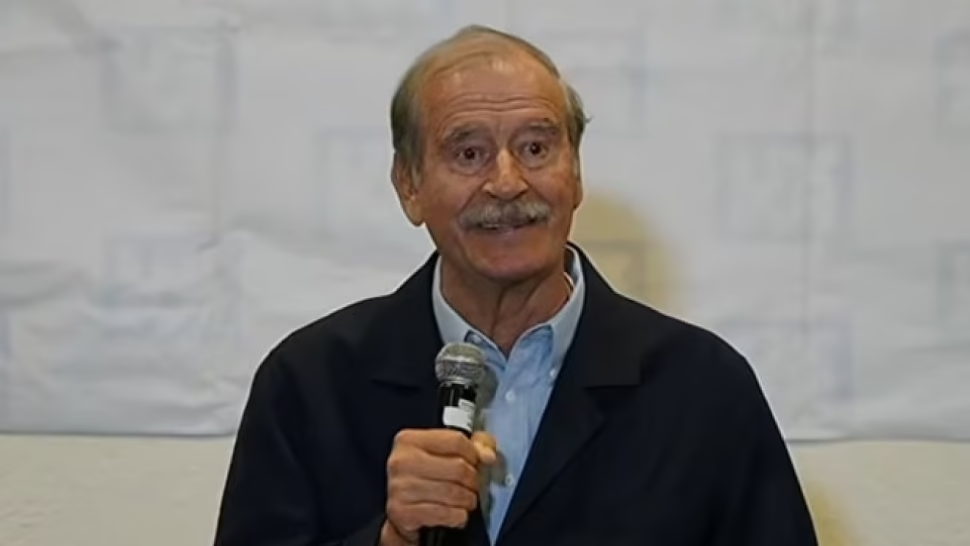
On the eve of the Generation Z rally called for Sunday, December 14 in Mexico City, former president Vicente Fox Quesada addressed an energetic call to citizens to actively get involved in national affairs. Through a video message broadcast on digital platforms, the former president (2000-2006) argued that the present requires citizen leaders and not mediocre rulers disconnected from social reality.

Fox Quesada was categorical in his diagnosis: “Mexico needs truth, it requires dignity and not daily propaganda.” His central invitation was to work for Mexico, placing direct responsibility on each individual: “The first star and actor is you.” This message is framed in a context of growing social mobilization and seeks to channel discontent into constructive participation.

RelatedFox supports the possible presidential candidacy of Salinas Pliego

The basis of the message: government lessons and current warnings

In the description that accompanied his publication, the former PAN president elaborated his position with a tone of urgency. “Mexico is not tired. It is awake,” he stated, characterizing his communication not as a nostalgic memory, but as a call to the present. Its narrative is built on a central premise: “When the citizen participates, Mexico advances… this country is not saved by a government, it is saved by its people.”

Depending on his experience, Fox shared three key learnings from his presidential administration. Firstly, he warned that “when a government stops listening, the country stagnates”, a situation that, according to him, is evident today in “decisions made from a desk without seeing the reality of the people.” Secondly, he pointed out that governing from fear reduces freedoms and that an informed citizenry is immune to control through speeches. Finally, he argued that the abandonment of fundamental values inevitably leads to social division.

Immediate context: the march and the call to action

The temporality of the message is not coincidental. His statements came hours before the youth rally in the capital, scheduled for 11:00 a.m. on Sunday, December 14, with a starting point at the Ángel de la Independencia and final destination at the Zócalo. This event, promoted by the younger generations, represents a phenomenon of citizen participation that the former president seeks to frame within a broader civic movement.

The impact of the message transcends the immediate situation. It resonates in a political scenario where the demand for transparency, dignity and efficiency in public management is central. Fox Quesada positions social mobilization not as a simple act of protest, but as the symptom of an awakened society that claims its leading role in the construction of a fairer Mexico. His technical-analytical discourse breaks down the risks of government disconnection and proposes informed and courageous participation as the antidote to stagnation and division.

In essence, the video message constitutes an analysis that links historical lessons of public administration with the current dynamics of social movements. It is not limited to supporting a march, but rather formulates a structured argument about democratic health: the sustainability of the nation depends on the ability of its citizens to organize, demand accountability and assume leadership from civil society, especially in moments where they perceive that their representative institutions are failing.

Do you share this vision about the power of citizenship to transform the national reality? Spread this analysis on your social networks and explore more content about social movements and civic leadership on our platform.
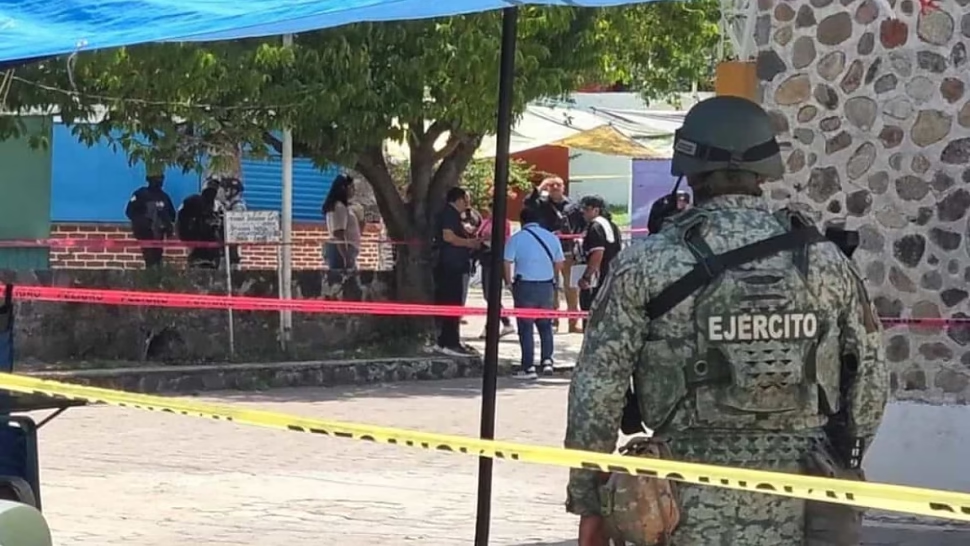
14 mayors deprived of their lives during Sheinbaum’s six-year term

The attack on the mayor of Temoac raises the number to 14; Oaxaca and Michoacán concentrate the cases.

The armed attack against Valentín Lavín Romero, mayor of Temoac, Morelos, which occurred inside the City Hall, raised to 14 the number of municipal presidents deprived of their lives during the current government. Specialists warn that this reflects the advance of organized crime in local governments.

A crisis that is growing in small municipalities

According to records from civil organizations and local media, Oaxaca tops the list with five councilors who were victims of homicide in the last year and a half, followed by Michoacán with four. The attacks against municipal authorities show, according to experts, a dispute between criminal groups for territorial control and political influence in communities.

  • Alejandro Arcos Catalán, from Chilpancingo, Guerrero (October 6)
  • Román Ruiz Bohórquez, from Candelaria Loxicha, Oaxaca (October 15)
  • Jesús Franco Lárraga, from Tancanhuitz, San Luis Potosí (December 15)
  • Mario Hernández García, from Santiago Amoltepec, Oaxaca (May 15)
  • Isaías Rojas Ramírez, from Metlatónoc, Guerrero (June 2)
  • Yolanda Sánchez Figueroa, from Cotija, Michoacán (June 3)
  • Salvador Bastida García, from Tacámbaro, Michoacán (June 5)
  • Lilia Gema García Soto, from San Mateo Piñas, Oaxaca (June 15)
  • Martha Laura Mendoza Mendoza, from Tepalcatepec, Michoacán (June 17)
  • Miguel Bahena Solórzano, from Pisaflores, Hidalgo (October 20)
  • Carlos Alberto Manzo Rodríguez, from Uruapan, Michoacán (November 1)
  • Joel Ángel Bravo Martínez, from San Miguel Amatitlán, Oaxaca (June 13)
  • Eduardo Saavedra López, from San Miguel Yogovana, Oaxaca (July 12)
  • Valentín Lavín Romero, from Temoac, Morelos (July 22)

Security specialists point out that small municipalities are the most vulnerable due to their limited institutional and security capacities. Víctor Sánchez, academic at the Autonomous University of Coahuila, explained:

The attacks against mayors represent a symptom of municipal capture by criminal organizations, which seek to influence local police, political decisions and territorial control.

The PAN senator, Mario Vázquez, stated that these homicides reflect the abandonment of municipal governments in the face of organized crime and accused a lack of federal support. Meanwhile, federal authorities have noted a reduction in high-impact crimes, although experts consider that the security strategy has not been able to uniformly strengthen local governments.

Continue reading

Fox and former PAN governors defend Ruffo Appel

Fox and former PAN governors demand a fair process for Ruffo Appel indicated by the FGR.

Former president Vicente Fox Quesada and four former governors of the National Action Party (PAN) formed a defense front for Ernesto Ruffo Appel, after the Attorney General’s Office (FGR) accused him of alleged crimes of organized crime and tax fraud.

At a press conference, Fox was accompanied by former governors Francisco Javier Ramírez Acuña and Alberto Cárdenas Jiménez, from Jalisco, as well as Juan Carlos Romero Hicks and Miguel Márquez Márquez, from Guanajuato. They demanded that the judicial process be carried out with transparency and adherence to the rule of law.

Fox stated that he “puts his hands in the fire” for who was the first opposition governor in the modern history of Mexico. He assured that the defense is not seeking privileges, but rather to guarantee that his constitutional rights are respected during the process.

The former president questioned the initial hearing against Ruffo Appel and pointed out that there are doubts about the impartiality of the procedure. He maintained that the accusations have a political background and recalled that large-scale fuel smuggling networks and tax fraud were previously reported.

Fox criticized the new Judiciary, which emerged from a popular election, which he described as a body without independence to guarantee fair processes. The former PAN governors insisted that the case must be resolved based on evidence and under the principles of legality and due process.

Continue reading

FDA false positive affects Mexican lettuce producers

The FDA withdrew its warning against Mexican lettuce after confirming an analysis error.

FDA Reporting and Correction

The United States Food and Drug Administration (FDA) initially linked a sample of lettuce from Taylor Fresh Foods, a company with operations in Guanajuato, with a gastrointestinal outbreak in that country. Days later, the authority retracted it: the result was a false positive. The case generated uncertainty in the export sector.

Reaction of Mexican producers and authorities

Given the accusation, the National Agri-Food Health, Safety and Quality Service (Senasica) analyzed 14 samples of lettuce and water from the producing areas. The results ruled out the presence of the Cyclospora cayetanensis parasite. The most affected entities were Guanajuato, Zacatecas, Puebla, Aguascalientes and Sonora, which concentrate a large part of lettuce exports to the United States.

Representatives of the agri-food sector requested to strengthen the budget for health and safety. They argue that more resources are required to ensure the safety of export products and prevent future incidents that damage buyers’ confidence.

The case exposes the fragility of the control processes and the dependence on external certifications. Producers are confident that the FDA’s rectification will help restore trade without further losses.

Continue reading