UNAM deploys a comprehensive security plan for the return to classes
Given the recent events of violence that have shocked the university community, the National Autonomous University of Mexico (UNAM) has activated a multidimensional action protocol to guarantee a safe and orderly return to face-to-face academic activities. The rector Leonardo Lomelí Vanegas has emphasized the institutional commitment to use all the resources at its disposal to safeguard the integrity of the students, after the unfortunate murder of a student in the facilities of the College of Sciences and Humanities (CCH) Campus South, an incident that involved another colleague from the same campus.
The strategy of the highest house of studies is not limited to a reactive response, but rather constitutes a broad-spectrum preventive and corrective scheme. Lomelí Vanegas, in an official statement, declared: “UNAM will do everything in its power to guarantee the students’ safety, so that they return to face-to-face activities.” This statement underlines the guiding principle of university administration: the protection of students as a fundamental requirement for the development of academic life.
A tripartite approach: operational security, mental health and legal action
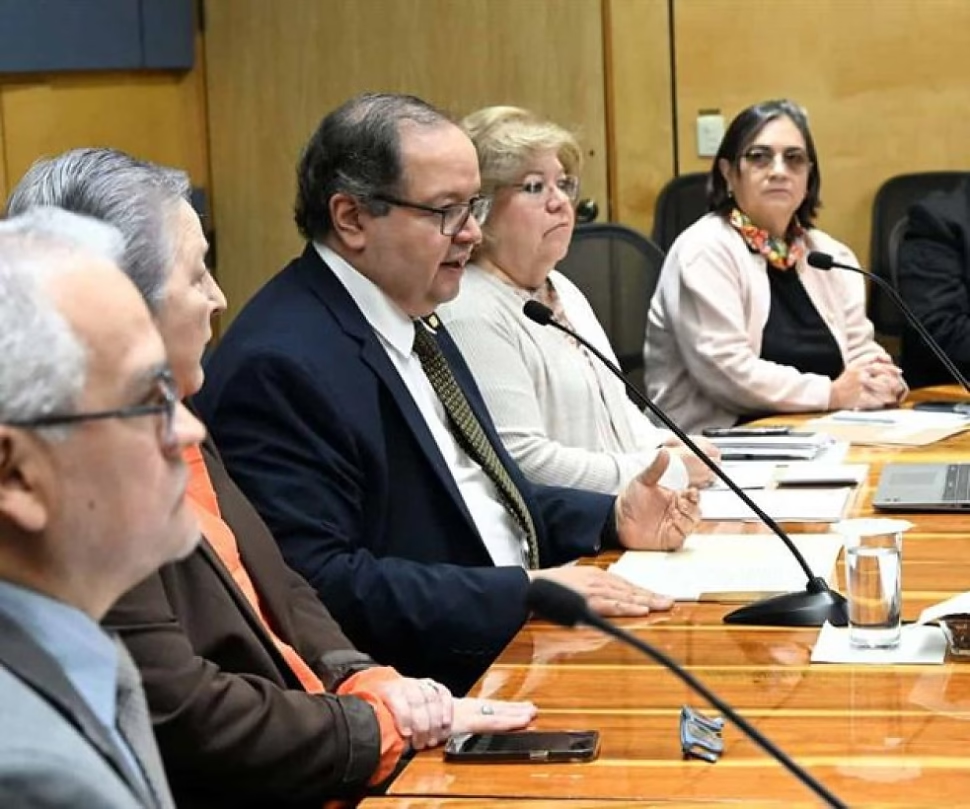
The contingency plan is based on three main axes. The first is the operational strengthening of security in all campuses and faculties. To this end, the rector, accompanied by the general secretary, Patricia Dávila Aranda, met with the Special Security Commission of the University Council. This body, chaired by José Luis Macías Vázquez, director of the Institute of Geophysics, and made up of key figures such as María Dolores Valle Martínez, director of the National Preparatory School, and Benjamín Barajas, director of the CCH, agreed on the urgent need to strengthen the protection conditions in the facilities.
The second pillar, of a psychosocial nature, focuses on attention to the mental health and emotional support of the student community. The university recognizes that traumatic events create a profound impact that requires specialized intervention. For this reason, it has committed to immediately expand its psychological support programs, understanding that emotional well-being is an inseparable component of comprehensive security. Perseverance in this line of action is considered a priority to promote a healthy educational environment.
The third axis implies a strong legal and disciplinary response. The rector’s office announced that it will proceed in accordance with the law and university statutes against those individuals who have sowed unrest on campuses, particularly by spreading threats directed at students who have demonstrated against violence within the UNAM. This measure seeks to discourage intimidation actions and reaffirm the rule of law within campuses.
Mechanisms of action and inter-institutional coordination
The operation of this plan rests on specific protocols and close inter-institutional coordination. Rector Lomelí detailed the established procedures: each identified threat is systematically reported to the University Prevention Secretariat. This agency serves as the central link to contact public security authorities, both federal and local, ensuring a coordinated response with police forces.
At the same time, each case is reported to the Office of the Attorney General, headed by Hugo Concha Cantú, who assumes the responsibility of filing the corresponding criminal complaints, thus formalizing the institutional position of zero tolerance for violence. To ensure effective implementation throughout the university geography, the directors of all faculties and schools have been instructed to convene their respective local security commissions. The objective is to adapt and reinforce protection measures according to the particularities of each campus.
This institutional deployment is framed in a context of mobilization and academic strikes at various UNAM campuses. These interruptions have their origin in the commemoration of cases such as that of Ayotzinapa and the massacre of October 2, 1968, to which a wave of solidarity with the CCH-Sur community has been added. The rector’s response seeks, therefore, not only to resolve the immediate security crisis, but also to generate the necessary trust for a gradual and orderly resumption of educational work, reestablishing academic normality in one of the most important higher education centers in Latin America.
The current situation represents an unprecedented challenge for university administration, which must balance the right to education with the obligation to provide a safe environment. The success of this comprehensive plan will depend on the coordinated execution of physical security measures, the effectiveness of emotional support programs and firmness in the application of university and criminal regulations. UNAM faces the task of rebuilding the trust of its community, demonstrating that the safety of its students is the pillar on which all its educational and research work is based.
Are you concerned about security in educational environments?Share this analysis on your social networks to raise awareness and help us make more people aware of the measures that are being taken. Explore more content related to educational policies and student well-being on our site.