UNAM expands enrollment and strengthens student support by 2026

The highest educational institution expands its national coverage with new schools and reinforces comprehensive support for its students through scholarships and wellness programs.

Strategic expansion of the national academic offering

The National Autonomous University of Mexico (UNAM) has outlined a structural growth plan after a complex period. Under the leadership ofDr. Leonardo Lomelí Vanegas, the institution has prioritized a substantial increase in its admission capacity and a geographical diversification of its programs. For the 2025-2026 school year, more than 1,500 additional spaces were enabled at the upper secondary level, achieving an enrollment of 35,195 new students in this segment. This movement brings the university’s total population to around 380,000 students, ranging from university initiation to graduate studies.

This quantitative growth has been complemented by significant territorial expansion. A key milestone was the inauguration of the National School of Higher Studies (ENES) Unidad Oaxaca, which began operations with five bachelor’s degrees. At the same time, the ENES in Morelia, León, Juriquilla and Mérida expanded their academic portfolio with new careers. This strategy consolidates the presence of UNAM in various regions of the country, decentralizing access to quality higher education and promoting local development.

RelatedGovernment begins payment of the Benito Juárez Scholarship in October

Pillars of comprehensive support: scholarships and emotional well-being

The comprehensive support for the student body stands as the central axis of university management. In 2025, the institution granted more than 170,000 financial aid. The creation of the Ifigenia Martínez Scholarship stands out, a food supplement designed for students in vulnerable situations. Additionally, 106,000 high school students are beneficiaries of the federal Benito Juárez Scholarship. In total, approximately 280,000 university students, from high school to graduate school, receive some type of scholarship, which underscores the commitment to equity and academic retention.

Recognizing contemporary psychosocial challenges, UNAM has institutionalized emotional well-being. The University Mental Health Care and Support Program was consolidated, which operates through initiatives such as “Psychological Spore” and Community Health. Together with the Culture of Peace University Program, these actions seek to build healthy, empathetic and safe educational environments, where students can fully develop their academic and personal potential.

Investment in infrastructure and vision of the future

In the field of physical infrastructure, decisive progress was made in the Space Rehabilitation Program. Efforts have focused on improving security and equipment, with priority interventions at the entrances and perimeters of the College of Sciences and Humanities South campus. Similar work is being coordinated with the communities of other secondary schools, ensuring that the material conditions are conducive to learning.

The vision for 2026 is based on responsibility, transparency and closeness to the university community. The administration is committed to responding with firmness and robust strategic planning to the challenges of the coming year. The final objective, as the institution has declared, is to continue training graduates and researchers who contribute decisively to the scientific, cultural and social development of Mexico. The combination of controlled expansion, financial support, mental health care and facility improvements forms a comprehensive model for strengthening public education.

Do you find this comprehensive UNAM strategy valuable? Share this news on your social networks to disseminate the projects of the highest educational institution and explore more content on educational innovation on our site.
Passenger trains: Mexico City-Querétaro and Pachuca would start in 2027

Federal government advances in six passenger train routes; two would begin operations in 2027.

Advances in the passenger and freight railway network

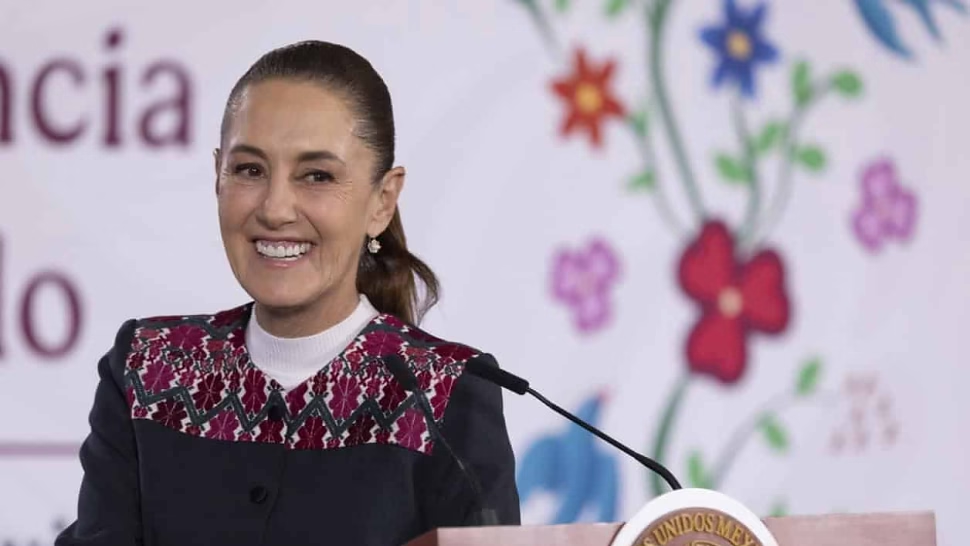
President Claudia Sheinbaum reported that the construction of passenger trains is advancing significantly. The Mexico City-Querétaro and Mexico City-Pachuca routes will be inaugurated in 2027, while other lines such as Saltillo-Nuevo Laredo and Querétaro-Irapuato continue to be developed.

“We are very advanced. The other sections to Guadalajara and Nuevo Laredo will be put out to tender this year or carried out by the Ministry of Defense,” he stated during the morning conference. The complete project includes an investment of 750 billion pesos.

Right of way and community work

Edna Elena Vega Rangel, Secretary of Agrarian Development, reported that 28 million 452 thousand 804 square meters of right of way have been released. Of that total, 72% corresponds to historical right of way, 14% to social property and 14% to private property. To serve the communities, 268 social tables were held, 95 assemblies with more than 4,500 attendees and 987 plots were acquired.

Andrés Lajous, head of the Train Agency, explained that clearings, embankments and drainage works are being carried out on the Querétaro-Irapuato and Saltillo-Nuevo Laredo sections. In Monterrey, 30 thousand tons of steel are already manufactured and 9-kilometer viaduct projects are being developed. In addition, the manufacturing of sleepers began: 330 thousand for Querétaro-Irapuato, 430 thousand for Saltillo-Monterrey and 490 thousand for Monterrey-Nuevo Laredo.

Tenders and first trains

Phase 2 of bidding for the Mexico City-Saltillo and San Luis Potosí-Saltillo sections began. Six stations, three auxiliary buildings and maintenance bases will be put out to tender. The first AIFA-Pachuca train will arrive in Mexico on July 25 and this month the construction of the first unit of the northern trains begins.

In the metropolitan area of ​​Querétaro, three vehicular underpasses, four overpasses and 11 pedestrian overpasses are considered, among other works.

Participation of the Sedena and progress by section

General Gustavo Ricardo Vallejo Suárez reported that 33,072 personnel participate in railway work, of which 6,380 are women, with 7,000 units of machinery. Nearly 800 kilometers of basic engineering have been developed in the first four sections.

The specific advances are: Mexico City-Pachuca at 37.06% (121 km of new roads, 10 km of viaducts, 10 work fronts); Mexico City-Querétaro at 19.22% (232.42 km, 14 fronts).

As for the Mayan cargo train, it reaches 54.05% progress. Intermodal complexes are built in Palenque, Mérida, Progreso and Cancún. A multimodal complex is planned for 2027 in Chetumal and five operations yards.

Néstor Núñez, from the SICT, indicated that the stations and auxiliary buildings are advancing, and 26 social attention tables and 36 techniques have been made to explain the coexistence of the train with the environment.

Continue reading

Roberto Lazzeri begins management as ambassador with call for cooperation

The diplomat participated in a Trump event where a 66% reduction in fentanyl was reported.

First public intervention

Roberto Lazzeri participated this Wednesday in his first public event as Mexican ambassador to the United States. It was during an event organized by Donald Trump on the National Mall for the 250th anniversary of American independence.

There he heard the message from President Trump, who highlighted a 66% reduction in the flow of fentanyl into his country. Lazzeri pointed out that these results strengthen bilateral security cooperation, promoted by President Claudia Sheinbaum based on respect for sovereignty and coordination.

A 35% decrease in overdose deaths in the United States was also mentioned, as well as the seizure of nearly 30,000 firearms. The ambassador attributed these figures to the joint work between both nations.

Trump used the event to refer to the 2026 FIFA World Cup, which will be played in North America. Lazzeri assured that Mexico contributes to the project with actions in security, connectivity and tourism, with an estimated economic benefit of more than 18 billion pesos.

Continue reading

New calendar for registration of mobile lines

More than 63 million lines already registered; new staggered term until December 2026.

The Telecommunications Regulatory Commission (CRT) postponed the mandatory registration of mobile lines. The deadline, scheduled for June 30, was extended to facilitate the process for millions of users.

New registration calendar

The new term applies only to unregistered prepaid lines. It will be staggered according to the last digit of the number. The dates range from August 15 to December 31, 2026.

So far, more than 63 million lines are registered: 40.2 million prepaid and 22.8 million postpaid. Millions are still missing.

Unregistered lines will be suspended by telephone companies within a period of up to 72 hours. During that time they will only be able to call emergencies, citizen services and their operator. Service is restored upon completion of registration.

Mexico closed 2025 with around 161.6 million active mobile lines, a penetration of more than 124% of the population. Additionally, if a line is used to commit a crime, authorities may request information directly from companies.

Continue reading