Tunnel sealed in Culiacán prison after violent confrontation

The dark web of violence and escape that shook the walls of the prison, leaving more questions than answers.

The dark secret under the cells

In the bowels of the Culiacán Detention Center, where the air smells of rusty iron and fear, a cursed tunnel was discovered… but not before tragedy and chaos erupted like a volcano of violence. The walls of the prison, mute witnesses to decades of sinister stories, trembled before the roar of automatic weapons and heart-rending screams. Twenty-five instruments of death, eleven of them capable of spreading terror in a matter of seconds, were torn from the hands of those who sought to defy order!

The night hell breathed

Verona Hernández Valenzuela, the voice that tries to calm the turbulent waters of public security, revealed with measured words that explosive devices, dormant like snakes ready to attack, were neutralized by expert hands. “Family visits, that fragile thread that unites inmates with humanity, were suspended until the danger ceased,” he declared with the gravity of someone who knows that every minute counts. Meanwhile, a man lay with his face marked by a treacherous shrapnel, a scar he would carry as a reminder of a battle he should never have fought.

Related600-meter tunnel discovered between Tijuana and San Diego

The confiscated arsenal seemed like something out of a catalogue of nightmares: AK-47 rifles with their shiny disc magazines, AR-15s ready to wreak havoc, pistols that whispered promises of death in 9mm and .45 calibers. Even a hand grenade, small but capable of turning silence into horror in the blink of an eye! And among so much destruction, the most chilling discovery: a tunnel dug with the patience of an ant, 5 meters into the darkness and 15 meters long, a passage to freedom… or to more blood.

But this doesn’t end here. The shadows of corruption and organized crime lengthen over the prison corridors. Communication equipment, doses of drugs that poison minds and bodies, and that tunnel that will now be sealed like a concrete coffin, are just pieces of a diabolical puzzle. The investigations progress, but each answer raises new questions: How many others were involved? Where did that tunnel lead to? Who financed this operation that smacks of betrayal and power?

The call to action: This story of iron, gunpowder and buried secrets deserves to be known. Share this story on your social networks and discover more about the mysteries that shake our prison system. The truth, like the Culiacán tunnel, waits to be illuminated.
Budget cut to agri-food health worries after false positive in the US

Agri-food sector asks for more budget for health after false positive in the US.

The false positive for Cyclospora in Mexican lettuce, reported by the FDA and later denied, revived the debate about the resources allocated to agri-food health in Mexico.

The budget of the National Agri-Food Health, Safety and Quality Service (Senasica) went from 6,884 million pesos in 2018 to 5,086 million in 2026. This represents a reduction of 26.1%, without considering inflation. The sector warns that this trend compromises the ability to respond to health alerts.

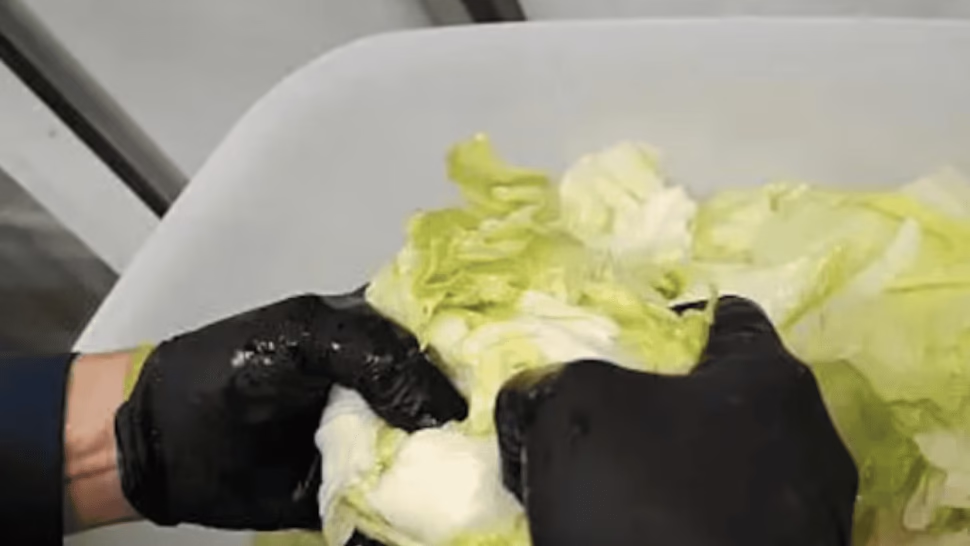
A week ago, the FDA flagged Taco Bell’s chopped lettuce, produced by Taylor Fresh Foods in Guanajuato, for allegedly containing Cyclospora. Hours later, he retracted it: the sample gave a false positive. Mexican lettuce exports—97% of 153 thousand tons annually go to the US—come mainly from Guanajuato, Zacatecas, Puebla, Aguascalientes and Sonora.

Authorities from the Ministry of Health and Senasica analyzed 14 samples of lettuce and water, and ruled out the presence of the parasite.

The Agricultural Market Consulting Group (GCMA) described the situation as worrying:

“While health risks, commercial exchange and international demands increase, the resources allocated to Senasica have been reduced.”

He added that health and safety should be treated as matters of national security, not subject to insufficient budgets.

Jorge Esteve, president of the National Agricultural Council, pointed out that in the last ten years the health budget was reduced by more than 50%, while agricultural and livestock production grew. “You cannot provide complete surveillance,” he stated.

The sector demands that health alerts be handled with rigor and proportionality to avoid harm to producers. Bilateral coordination based on scientific evidence made it possible to clarify this case, but the lack of resources remains a latent risk.

Continue reading

US General visits Veracruz to reinforce bilateral security

General Greg Guillot met with Mexican military commanders to discuss joint strategies.

Bilateral military cooperation in Veracruz

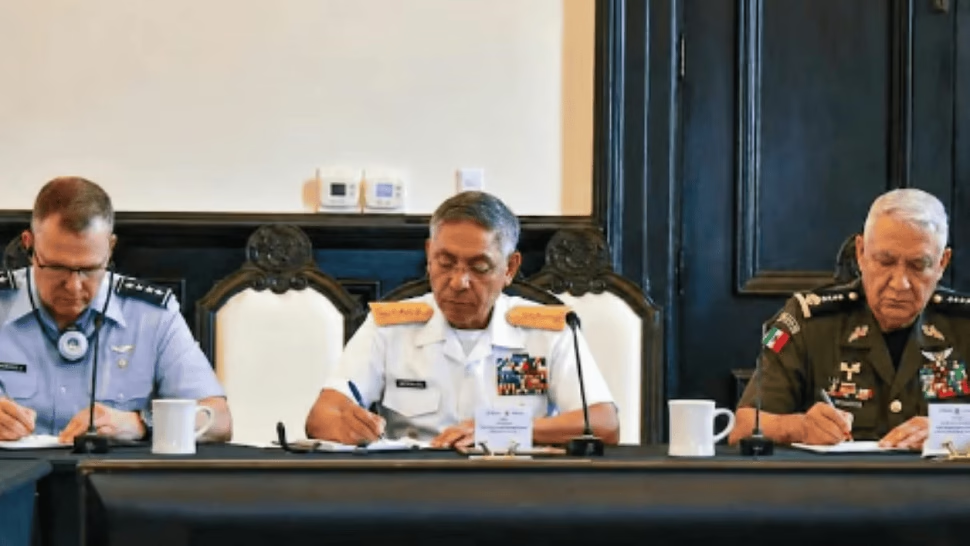
The US embassy confirmed that General Greg Guillot, commander of the North American Aerospace Defense Command and Northern Command, visited Veracruz on July 22. The objective of the meeting was to review strategic security issues.

During his stay, General Guillot met with the head of the Secretariat of National Defense, General Ricardo Trevilla, and with Admiral Raymundo Pedro Morales, Secretary of the Navy. Both sides hailed the meeting as a milestone in the bilateral defense relationship.

“The leaders addressed key strategic issues, such as specialized special operations and counter-cartel training, information sharing and force protection cooperation regarding unmanned aerial systems and the best ways to counter them,” the Northern Command said in a statement.

The North American Maritime Security Initiative and other regional initiatives were also reviewed. The Northern Command highlighted that senior commanders have transformed a professional collaboration into a personal bond that lays the foundation for expanding cooperation.

“The security of North America depends on the strength of alliances and our ability to operate with a common purpose,” declared General Guillot. “The meetings here in Veracruz demonstrate our deep mutual trust and our commitment to addressing complex regional challenges together with our Mexican partners.”

Both parties reiterated their commitment to strengthen cooperation to defend North America, with respect for sovereignty, territorial integrity, and shared and differentiated responsibility.

Continue reading

SLP search rescues lions, jaguars and Bengal tigers

Graciano Sánchez's operation in Soledad secures five live animals and four taxidermies.

Operation in Soledad of Graciano Sánchez

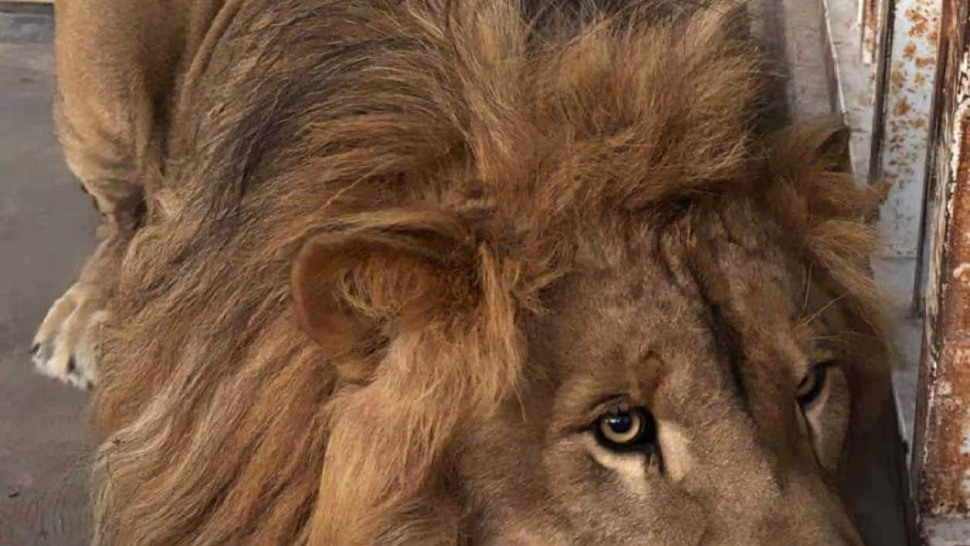
The Federal Attorney General’s Office for Environmental Protection (Profepa) and the Attorney General’s Office (FGR) carried out a search of a property in the municipality of Soledad de Graciano Sánchez, San Luis Potosí. During the investigation, they seized five live specimens of wildlife and four pieces of taxidermy.

Animals found include:

  • Two African lions: a one-year-old male and a six-year-old female.
  • A six-year-old male jaguar.
  • A Bengal tiger.
  • A one-year-old female coyote.

All of them appeared to be in good health, according to Profepa.

In addition, three full-body taxidermies were located: a Barbary goat, two black bears and a tanned black bear skin. The pieces remained under the protection of Profepa.

The live specimens were transferred to specialized centers: the jaguar and the coyote to San Luis Potosí; the lions to Nuevo León; and the Bengal tiger to Hidalgo.

The FGR began an investigation folder for the crime against biodiversity, typified in article 420 of the Federal Penal Code. Profepa collaborates in the investigations. It should be noted that the jaguar is listed as an endangered species, while the jaguar and the Bengal tiger appear in Appendix I of CITES; the African lion is in Appendix II.

Continue reading