Trump’s aimless war against Iran

Trump's offensive against Iran lacks clear objectives while its daily cost reaches one billion dollars.

The reality that Washington does not see

As bars in the US capital remain packed, the Trump administration faces uncomfortable questions about its military offensive against Iran. One week after the start of ‘Operation Epic Fury’, coordinated with Israel, there is still no clear justification or single objective.

A speech that changes every day

Officials have given so many different reasons that it’s hard to keep track. First they talked about regime change, then about dismantling dangerous networks, after the nuclear program… even Marco Rubio mentioned “imminent threats.”

“Trump assured that there were immediate risks coming from Tehran”

But here’s the problem: When explanations change every press conference, they lose credibility. I’ve seen this script before – grandiose promises that fade when the bills arrive.

RelatedThe United States carries out a military operation and captures Maduro in Venezuela

And speaking of bills…

The bill that no one wants to pay

The estimates from the Center for Strategic and International Studies are brutal: one billion dollars a day. Yes, you read that right. Diaries.

Meanwhile, the impact is already being felt at American gas stations. Prices are rising and analysts are warning of a possible economic slowdown if this continues.

The most worrying thing is the uncertain duration. First they said “a few days”, then “four or five weeks”, and now there are reports that speak of 100 days – which would take the intervention until September.

My teenage son asked me yesterday: “And what is this for?” I didn’t have a good answer. Because when a military operation does not have clear objectives, astronomical costs and indefinite deadlines, the only certainty is that someone will end up paying the price.

And they’re usually not the ones making the decisions in Washington.
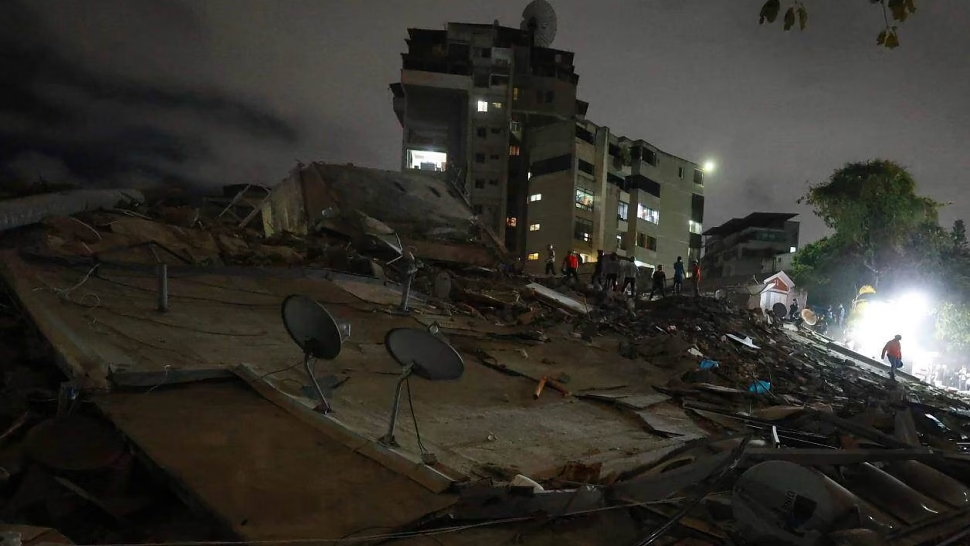
UN reports 6.8 million people affected by earthquakes in Venezuela

UN preliminary evaluation estimates 6.8 million people affected in Venezuela.

UN Evaluation

After the two strong earthquakes that shook Venezuela on Wednesday, the International Organization for Migration (IOM) estimates that up to 6.8 million people could have been affected. According to the UN, approximately two million people reside in the Caracas metropolitan area alone. This is a preliminary evaluation that will be updated as work continues in the affected areas.

The IOM notes that the collapse of buildings and damage to essential infrastructure limits access to basic services. The priority remains the search for survivors in the rubble. UN agencies warn that the number of displaced people will increase as new damage is detected and the hardest hit areas are evacuated.

Government actions and international response

During a press conference, UN agencies reported that around twenty emergency hospitals in the states of La Guaira, Miranda, Aragua, Carabobo, Falcón, Zulia, Yaracuy and Lara, as well as in the Capital District, suffered structural damage.

The government of interim president Delcy Rodríguez requested the United Nations to send three emergency medical teams with surgical capacity. One of them has already left from the United States. Caracas also requested medicines, equipment and medical supplies, which the UN is acquiring and preparing for transfer via Panama or directly to Venezuela.

Continue reading

Double earthquake shakes Venezuela: more than 200 victims

Two consecutive earthquakes of magnitude 7.2 and 7.5 left 235 dead and thousands injured in northern Venezuela.

Venezuela faces emergency after double earthquake

Two powerful consecutive earthquakes shook northern Venezuela on Wednesday night, leaving at least 235 people dead and more than 4,300 injured, according to Health Minister Carlos Alvarado. The number could rise as rescue teams search for survivors in the rubble.

The United States Geological Survey (USGS) reported a first earthquake of magnitude 7.2 with an epicenter west of Morón, 170 kilometers from Caracas. Barely a minute later, a second magnitude 7.5 earthquake struck at a shallow depth, amplifying the destruction. The combination of surface movements intensified the damage, explained geophysicist Marcos Ferreira.

“It’s like I’m screaming and then someone starts screaming too. That amplifies the vibration and increases the potential danger,” Ferreira said.

The coastal region of La Guaira, north of Caracas, suffered the worst damage. The country’s main airport closed due to damage, complicating the arrival of aid. Residents like Dayana Delgado, a mother of three, asked about heavy machinery that the government had promised. Neighbors dug with their own hands.

“I would like to know where my child is, if he is trapped there or is he hanging around in a shelter,” she said about her 8-year-old son, who is still missing.

The president in charge, Delcy Rodríguez, declared a state of emergency and announced a reconstruction fund of 200 million dollars. He requested heavy machinery from private companies for rescue efforts. Teams from the Dominican Republic were already arriving, and more international help was expected.

The United States, through Secretary of State Marco Rubio, offered search teams, medical resources and logistical assistance. The Treasury Department temporarily waived sanctions until Oct. 23 to facilitate aid transactions. Governments of Mexico, Brazil, Spain, Qatar and others also promised shipments.

In Caracas, hundreds of people spent the night in open spaces for fear of aftershocks. Classes were suspended and some school buildings were converted into shelters. Electricity and cell service failed in several areas. Families began publishing lists of the missing while rescuers continued their work.

Continue reading

France intercepts new ship from the Russian network that evades sanctions

France intercepts another oil tanker linked to the Russian network that evades sanctions in the Mediterranean.

The French Navy intercepted the Cameroonian-flagged oil tanker Deliver off the coast of Sicily on Tuesday. The vessel would be part of the fleet of unregistered vessels that Moscow uses to circumvent international restrictions on its crude oil exports.

“The French Navy carried out an inspection with boarding on the oil tanker Deliver while it was transiting in violation of international maritime law,” President Emmanuel Macron reported on his social networks.

Inspections on the rise

Since September, France has carried out four inspections of ships suspected of belonging to this network. The United Kingdom did the same in June with the oil tanker Smyrtos in the English Channel. Paris and London are leading a stricter application of European sanctions that Russia has until now managed to evade with relative ease.

This Friday, representatives of the 27 EU member states will analyze the twenty-first package of sanctions. Among the proposed measures are maintaining the cap on the price of Russian crude oil, expanding the list of vessels banned from European ports and restricting imports of Russian fishing products.

There is less consensus on prohibiting entry to Russian veterans who have fought in Ukraine. Italy and France expressed reservations about the difficulty of identifying them without generating a general ban on Russian citizens.

At the same time, Ukraine intensified its operations in Russian territory. kyiv claimed to have attacked two refineries in Ufa, 1,500 kilometers from the front. “We are implementing our long-range sanctions plan,” declared Volodymyr Zelensky before authorizing a 40-day operation led by the Ukrainian security services.

The Ukrainian president also obtained the first 3 billion euros of a 90 billion European loan. “It is clear that it is Russia that prolongs the war and ignores all diplomatic proposals,” Zelensky said in conversation with Ursula von der Leyen.

Continue reading