Trump attacks the Supreme Court after losing on tariffs

Trump reacts with fury to the ruling that knocks down his tariffs and announces new measures to circumvent the court decision.

The president does not accept the judicial setback

The news came this morning and Donald Trump wasted no time. Hours after the Supreme Court declared many of his trade tariffs unconstitutional, the president took the stage. And he did it with anger on the surface.

“It’s a shame,” he said of the judges who voted against, even accusing them of being influenced by “foreign interests.”

The atmosphere in the White House was electric. The press expected a reaction, but few anticipated this level of direct confrontation with the country’s highest court.

RelatedFederal court allows Trump to keep tariffs in place during appeal

The strategy to skip the failure

Trump did not stop at insults alone. He announced concrete measures to overcome the effects of the ruling. The move: immediately activate Section 122 of the Trade Act of 1974.

This maneuver would allow it to impose a global tax of 10%. In addition, it would keep other tariffs in force under the argument of national security and study new sectors under Section 301.

According to the White House, all of this seeks to “protect the American economy” against what they consider unfair trade practices. But the real message is clear: Trump is not going to give in.

What the Supreme Court really decided

The ruling was overwhelming: 6 votes to 3. The justices questioned the authority of the Executive to unilaterally apply these levies under the emergency powers law of 1977.

The most delicate thing: he left in the air what will happen to the 150,000 million dollars collected by tariffs during the last year. The ruling does not specify how to handle those funds, which will likely generate more litigation.

Trump took the opportunity to praise the three justices who were on his side, especially Brett Kavanaugh, whom he called a “genius” and a “great appointment.” But his criticism of the dissidents was so personal that it even reached their families.

The pattern repeats

Despite the judicial setback, Trump maintained his usual narrative: economic success and international strength. He insisted that his plan will allow the US to “stay financially protected.”

But here’s the worrying thing: he repeatedly questioned the independence of the Supreme Court and described the ruling as “deeply disappointing.” This is not the first time he has attacked institutions when decisions do not favor him.

What comes next is an even more complex legal battle. Trump will try to apply his new measures while the courts decide if they are constitutional. It’s a cycle we’ve seen before, but this time with direct economic consequences for millions.

Sheinbaum receives Felipe VI at the National Palace on June 25

Sheinbaum will meet with King Felipe VI amid previous diplomatic tensions.

Bilateral meeting at the National Palace

President Claudia Sheinbaum confirmed that next Thursday, June 25, she will meet with King Felipe VI of Spain. The event is scheduled for 4:00 p.m. at the National Palace, taking advantage of the monarch’s visit to Mexico for the 2026 World Cup. The following Friday, the king will attend the Spain-Uruguay match in Guadalajara.

The meeting occurs after years of diplomatic tensions. During the six-year term of Andrés Manuel López Obrador, the relationship cooled due to the demand for a public apology for the grievances of the Conquest. This generated distance with the Royal House and the Spanish government.

Approach signs

With the new government, efforts have been made to maintain institutional dialogue. Sheinbaum had already taken steps in that direction: at the end of April he carried out official activities in Barcelona and expressed his willingness to build a relationship based on mutual respect.

The meeting with Felipe VI reinforces that line. Both leaders will address issues of common interest, without a specific agenda having been leaked. The meeting is seen as a gesture of diplomatic normalization between both nations.

Continue reading

Vance reports progress in negotiations with Iran in Switzerland

Progress in dialogue between Washington and Tehran due to crisis in the Middle East.

Diplomatic advances in Switzerland

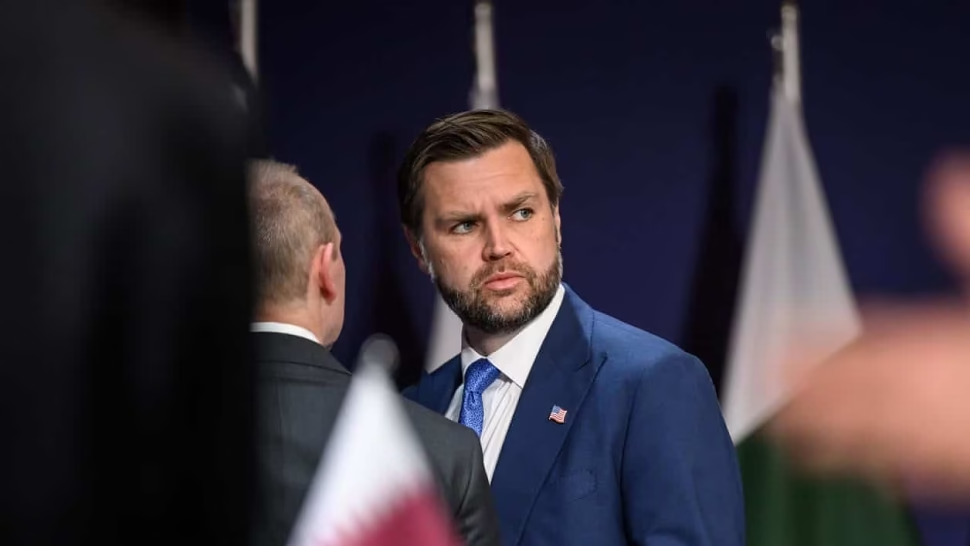
The Vice President of the United States, JD Vance, affirmed that the talks with Iranian representatives in the Bürgenstock complex, Switzerland, achieved relevant progress. According to Vance, the foundations were laid for an agreement that would reduce tensions in the Middle East.

During the meeting – which also included mediators from Pakistan and Qatar – two key issues were addressed: the reopening of the Strait of Hormuz and the conflict between Israel and Hezbollah in southern Lebanon.

The Strait of Hormuz, a strategic route for global oil transportation, had been closed by Iran after attacks by the United States and Israel. This skyrocketed international fuel prices. Although some ships have resumed transit, the main route still faces safety risks.

As part of the process, the US Treasury Department issued a temporary license allowing exceptions to sanctions related to Iranian oil. Technical talks will continue over the next 60 days.

The mediators indicated that there was progress in maintaining a ceasefire in Lebanon, but differences persist over the Iranian nuclear program and other key points of the agreement that Washington and Tehran seek to finalize.

Continue reading

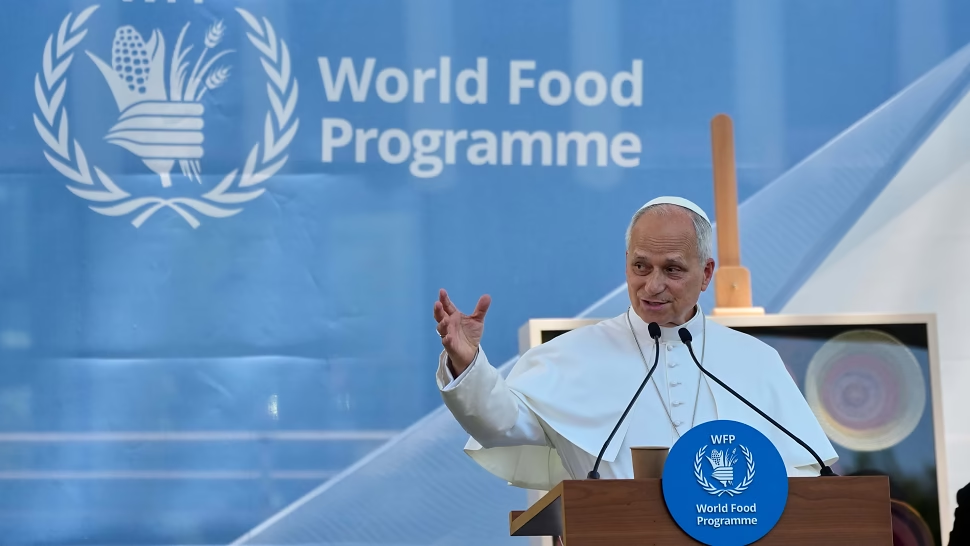
Leo XIV criticizes the ease of financing wars and not hunger

The pontiff warned about the drop in financing for food assistance from 2022.

Call from the pontiff in the face of the food crisis

Pope Leo XIV urged governments to allocate more resources to combat hunger. During a meeting in Rome with the UN World Food Program (WFP), he pointed out that it is easier to finance armed conflicts than to guarantee food for millions of people in vulnerable situations.

The pontiff warned that political and administrative obstacles delay humanitarian aid. In contrast, military spending is advancing with fewer obstacles. This paradox reflects a serious inequality in global priorities.

Leo XIV indicated that funding for food assistance has decreased considerably since 2022. Although needs increased due to conflicts, climate crises and economic problems, funds did not grow at the same pace.

He highlighted that recent international contributions, such as the one announced by the United States for the WFP, will benefit millions of people. However, he stressed that there is still a significant gap to cover the necessary resources.

Before the UN body, the pope called on world leaders to place human dignity at the center of their decisions. Strengthening international cooperation is key to confronting hunger and inequality.

Continue reading