A Shadow Over the Fragile Peace: The Warning that Shook the World
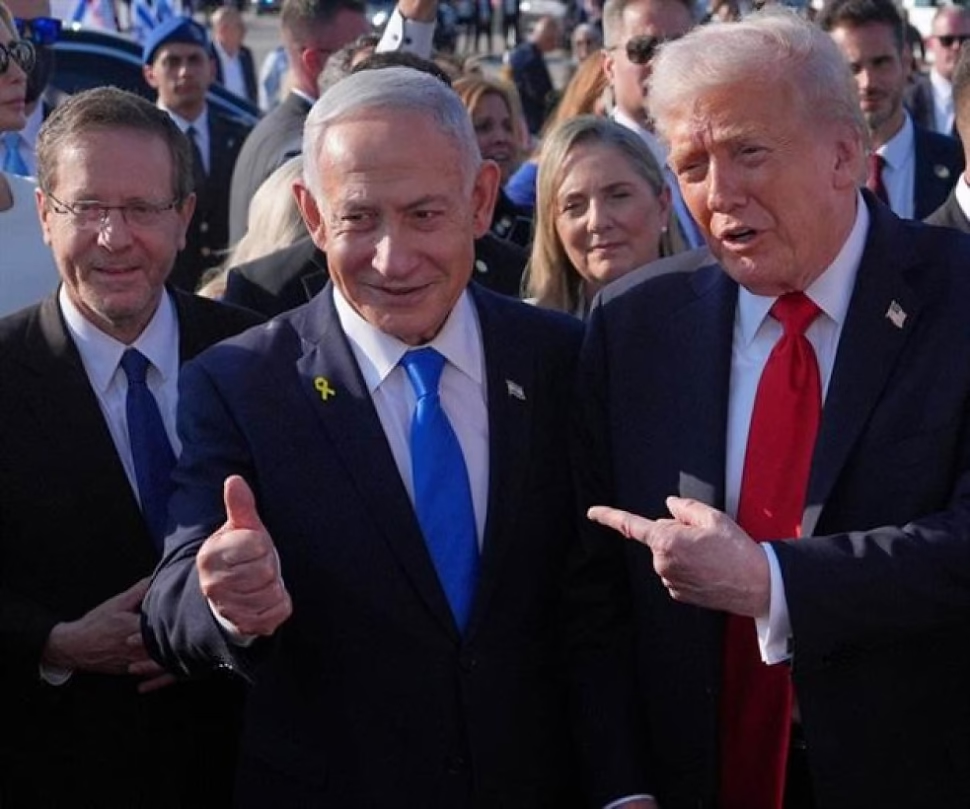
In a turn that froze the blood in the veins of the international community, US President Donald Trump issued a warning as grim as it was a harbinger of war. On Thursday, with words loaded with lethal steel, he threatened the militant group Hamas with a terrifying sentence: “we will have no choice but to go in and kill them” if internal violence persists in the devastated Gaza Strip. This statement, a thunderclap in the middle of a seemingly clear sky, came just after the president had minimized the upheaval in the territory, where a ceasefire and a delicate hostage agreement between Israel and the Palestinian faction had raised a faint ray of hope.
The heart of the world stopped for a moment, wondering if this was the spark that would rekindle hell. However, in a move that added more layers to the mystery, Trump was quick to clarify that it would not be US troops who would set foot on Gazan soil. His words, laced with a dangerous secrecy, painted an even more disturbing scenario. “It won’t be us,” he declared to the press, like a director who reveals only part of his plan. “We won’t have to do it. There are people very close, very close who will come in and do the job very easily, but under our auspices.” A phrase that resonated like the echo of a dark pact, leaving the entire planet speculating about the identity of these mysterious executors and the true scope of American sponsorship.
A Bloodthirsty Game Board and Running Out Patience
The backdrop of this epic confrontation is a territory torn by internal struggles. The Republican leader’s warning did not come out of nowhere; It was the climax of growing impatience with the brutal murders that Hamas was perpetrating its rival factions. Just two days earlier, Trump had made a statement that perplexed many, admitting that the militant group’s takedown of “a couple of bands that were very bad”“didn’t bother me much, to be honest.” It was a confession that revealed a pragmatic and ruthless morality, where certain violence seemed to be tolerable within its geopolitical calculation.
But all patience has a limit. With the ferocity of an Olympian god launching his lightning bolt, Trump made it clear that the time for warnings is running out. “They will disarm, and if they don’t, we will disarm them, and it will happen quickly and perhaps violently,” he stated. This proclamation, published on his Truth Social platform, remained an enigma, since not even the president himself explained the mechanisms to comply with it, and the White House maintained a stony silence, refusing to offer any clarification.
Meanwhile, in Gaza, the social fabric is disintegrating. The Hamas-controlled police, which for 18 years imposed tight control and repressed dissent, have vanished like a ghost under the relentless advance of Israeli forces and their targeted bombings. In this power vacuum, sinister actors have emerged: powerful local families and armed gangs, some of them anti-Hamas factions backed by Israel. These groups, accused of hijacking precious humanitarian aid to sell it for profit, have become the architects of a hunger crisis that threatens to devour the most vulnerable, adding another layer of tragedy to an already heartbreaking drama.
The Fragile Agreement and the Sinister Dispute over the Dead
At the heart of this whirlwind lies the ceasefire agreement presented by Trump, a pact whose failure to comply could unleash chaos. The plan called for the delivery of all hostages, both alive and deceased, before a fatal deadline that expired on Monday. In the face of noncompliance, Hamas’s obligation was transformed into the macabre task of sharing information about the deceased hostages and attempting to repatriate their remains as soon as possible. Israeli Prime Minister Benjamin Netanyahu, with the firmness of a rock, declared that Israel “will not make concessions”, demanding that the Palestinian faction scrupulously comply with the requirements of the agreement, especially in the return of the bodies.
The armed wing of Hamas, for its part, defends itself. In a statement, he claimed to have complied with the terms of the ceasefire, stating that he had delivered the remains of the captives to whom he had access. However, Israeli officials seethe with frustration at the slow pace of this return. The pact stipulated the delivery of 28 bodies, in addition to the release of 20 live hostages who had already been released. In this tense exchange of accusations, two high-ranking American advisers, speaking under the cloak of anonymity, revealed that Hamas has assured the United States, through intermediaries, that it is working to return the deceased. These same advisors, in a twist that adds further intrigue, expressed their belief that the militant group has not violated the agreement.
While diplomacy dances on a tightrope, the military deployment adds another level of suspense. The United States announced the sending of approximately 200 soldiers to Israel, not as a combat force, but as part of an international team to support and monitor compliance with the ceasefire. However, officials have been adamant: US Marine boots will not set foot in Gaza. This decision delimits an invisible border, but Trump’s threat hangs over the territory like a sword of Damocles, promising an external intervention that, although not direct, could be just as devastating.
The world holds its breath, trapped in this drama where every word can be the trigger, every movement a point of no return. Peace is as fragile as glass, and the shadow of violence hangs over Gaza, awaiting the next act of this epic tragedy.
Do you think this tension will mark a turning point in the conflict? Share this analysis on your social networks and stay informed with our continuous coverage of the geopolitical situation.