Tragedy in Huascarán, a Japanese mountaineer dies and another survives

A heroic rescue in the icy heights of Huascarán reveals a story of survival and loss.

The drama in the frozen peaks of Peru

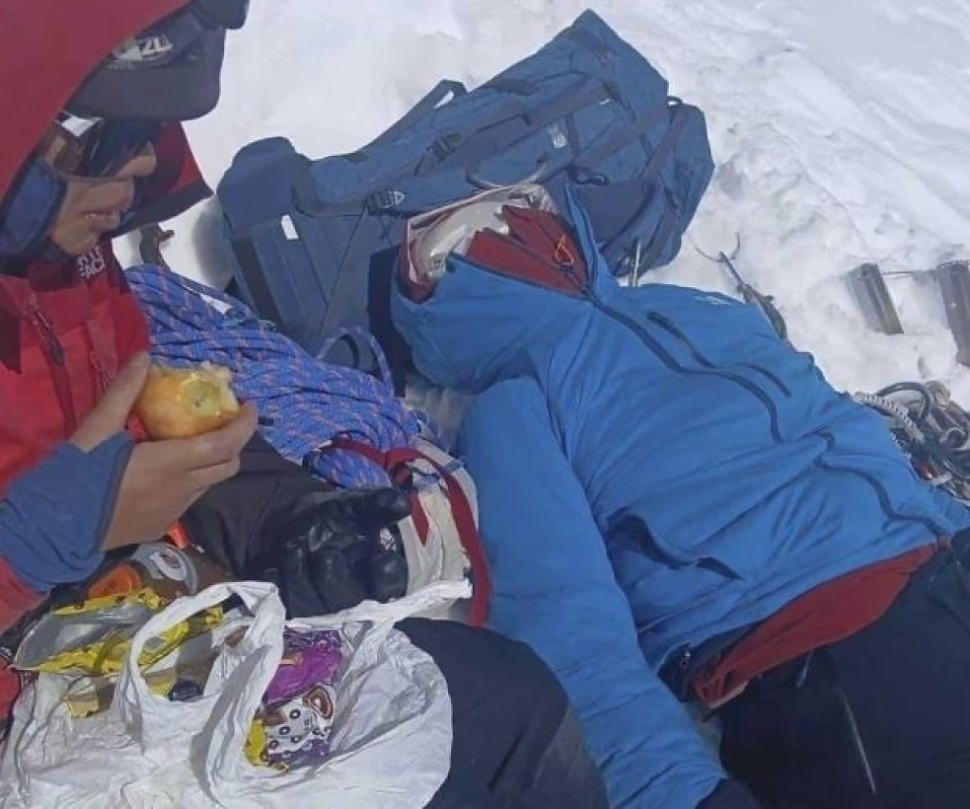
In the bowels of the imposing snow-capped Huascarán, where the air is so thin that it steals your breath and the cold cuts like steel blades, an epic battle between life and death took place. Two brave Japanese mountaineers, Saki Terada and Chiaki Inada, undertook a feat that would end in tragedy, writing another chapter in the history of this Andean colossus, known for devouring dreams and lives with equal ferocity.

A fight against the elements

On Tuesday morning, a cry for help crossed the satellite waves. The climbers, trapped at 6,600 meters of altitude, where temperatures drop to -30°C, faced a white hell. The High Mountain Division of the Peruvian police mobilized helicopters, rescuers and even a hyperbaric chamber in a race against time. But Huascarán, that titan of ice and rock, had already decided his sentence.

RelatedNew organic compounds reinforce the habitability of Enceladus

When the Socorro Andino teams managed to avoid the treacherous crevices that guard their slopes, they found Terada, miraculously conscious, clinging to life with tooth and nail. Inada, however, lay in a death grip with hypothermia, her body surrendered to the relentless hostility of the mountain. “In critical condition, unconscious,” were the words that sealed his fate.

Patricia Milla, police agent, revealed with a voice broken by the rawness of the story: “It wasn’t just the cold… it was the mountain demanding its tribute.” Dr. Inada, affiliated with the prestigious Wilderness Medical Associates, had dedicated her life to saving others in extreme environments. Ironies of fate, the mountain he loved was the one that took everything from him.

A scenario of shadows and losses

This is not the first time that Huascarán writes tragedies with blood and snow. Just days before, three climbers—two Peruvians and a Brazilian—were found dead in the snowy Artesonraju, their bodies turned into ice statues after missing for 30 days. And in 2024, glacial melt returned the mummified body of an American, victim of an avalanche in 2002, as if the mountain were spitting out the secrets it kept for decades.

Climate change is stalking this mountain range, devouring 27% of its ice in half a century. Every crack that opens is an omen, every avalanche a reminder: here, man is not in charge. Between May and September, when climbers from all over the world challenge its summits, Huascarán continues to be a magnet of passion and danger, a giant that grants glory… or grave.

Are you moved by this story of survival and loss? Share it and honor the memory of those who challenge the impossible. Explore more stories of extreme adventures where nature writes the endings.
Navy ships arrive in Venezuela with humanitarian aid

Mexico delivers 388 tons of aid to Venezuela after earthquakes in June.

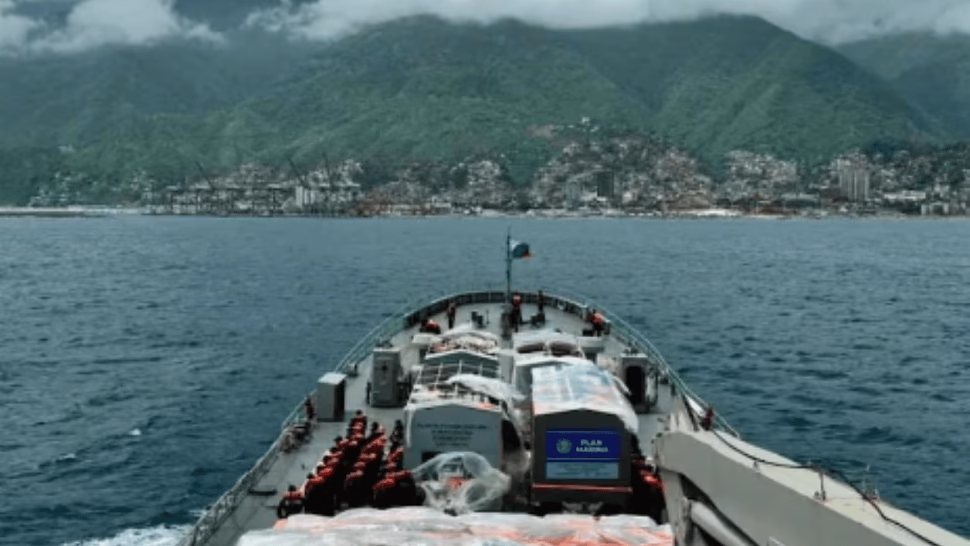
The ARM Isla Holbox and ARM Huasteco ships docked at the port of La Guaira, Venezuela, after eight days of navigation. The mission, ordered by President Claudia Sheinbaum, aims to deliver humanitarian assistance to the Venezuelan people affected by the earthquakes of June 24.

Load and capacity

The journey of 1,969 nautical miles (more than 3,600 kilometers) transported 388.4 tons of supplies. It includes food, bottled water, hygiene items, medicines and four water treatment plants capable of producing a thousand liters of purified water per hour each.

Personnel and coordination

One hundred elements of the Navy’s Emergency Response Brigades (BRE) will participate in the landing, installation and operation of the plants. They will also support the organization and distribution of aid, in coordination with Venezuelan authorities.

The Secretary of the Navy (Semar) indicated that, although the immediate care phase has already been overcome, recovery efforts continue to restore essential services. The help sent seeks to strengthen that stage.

This operation was possible thanks to the joint work between Semar, the Foreign Ministry, institutions, companies, foundations and civil organizations. The federal government reiterated its commitment to international solidarity and the construction of a more resilient region in the face of natural disasters.

Continue reading

Venezuela raises the death toll from the June earthquakes to 4,561

Official figure amounts to 4,561 deaths after the June earthquakes in Venezuela.

The Venezuelan authorities updated this Monday the death toll after the two earthquakes on June 24. The new report, released by Jorge Rodríguez, president of the National Assembly, indicates that 4,561 fatalities have been recorded. The number of injured has remained at 16,740 for a week.

Disaster data

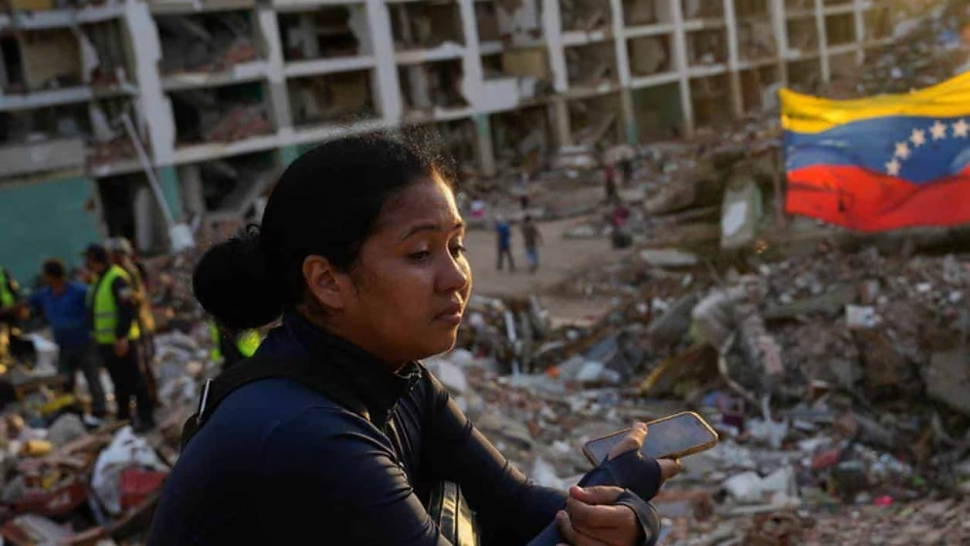
Most of the deaths occurred in the coastal state of La Guaira, 20 kilometers north of Caracas. After the 7.2 and 7.5 magnitude earthquakes, which occurred 39 seconds apart, 1,254 aftershocks have been recorded, according to the United States Geological Survey. They were the strongest earthquakes in the country in more than a century.

The report details that 856 buildings were damaged and 190 completely collapsed. More than 1,600 additional structures — bridges, roads — were also affected. The government estimates that tens of thousands of people lost their homes. Currently, more than 20 thousand remain in 107 temporary shelters installed in Caracas, La Guaira and the state of Miranda.

Continue reading

Lindsey Graham, Trump ally, dies at 71

Senator Lindsey Graham died at age 71 from an aortic dissection. Trump expressed his regret.

A loss in Congress

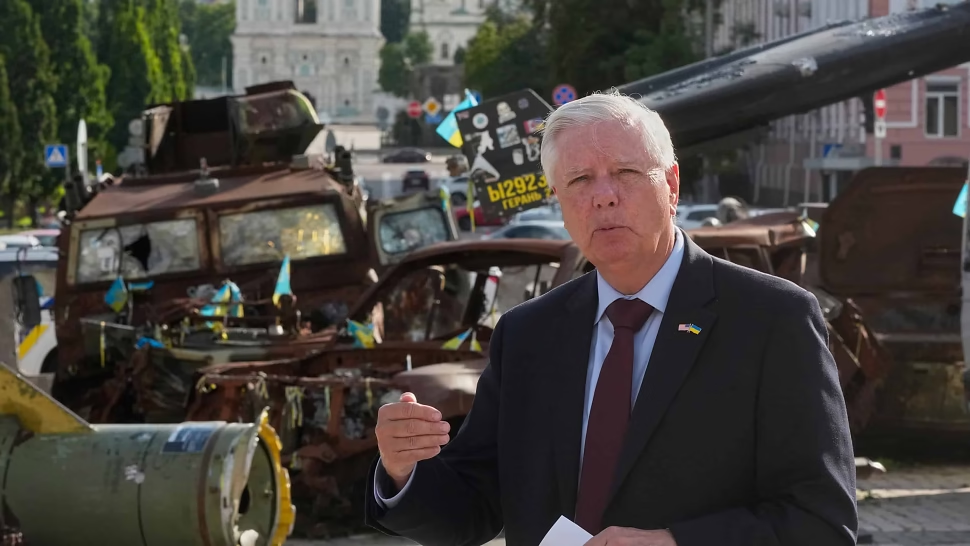
Republican Senator Lindsey Graham, a close ally of President Donald Trump, died Saturday night after a brief and sudden illness. He was 71 years old. His office confirmed the news in a statement posted on social media.

“The family appreciates the prayers and asks for privacy at this difficult time,” the text stated. No further details were immediately given.

Hours later, a second statement revealed the preliminary cause: an aortic dissection resulting from arteriosclerotic cardiovascular disease, according to the District of Columbia Medical Examiner. This is a rupture of the aorta due to hardening of the arteries.

Trump, who spoke frequently with Graham, told NBC’s “Meet the Press” that the senator called him on Saturday after returning from a trip to Ukraine. “It sounded a little tired, but perfect,” he said. The president ordered flags to fly at half-mast until next Saturday.

Graham, a former Air Force attorney, served three decades in Congress. He was a foreign policy hawk and advised Trump on issues such as Iran and Russia. On Friday he had announced an agreement to advance sanctions against Russia. As chairman of the Senate Budget Committee, he was key in Trump’s second term, when Republicans pushed laws with a slim 53-47 majority in the House.

Continue reading