Tlayacapan police officer killed in attack and attacker killed in pursuit

An armed attacker confronts authorities after a fatal attack in Morelos, revealing security challenges.

A Day that Changed Everything in Tlayacapan

The tranquility of the Magical Town of Tlayacapan was cut short this morning when a brave member of the Morelos Police lost his life in a cowardly attack. The attacker, who was traveling on a motorcycle, shot at the officer in the Santa Ana neighborhood around 7:50 a.m., leaving a community in shock and a police team heartbroken but determined to do justice.

The Pursuit That Ended in Clash

The murdered police officer’s colleagues did not hesitate to act. They tracked the murderer to the Totolapan-Tlayacapan highway, where he opened fire on the officers. In an intense exchange of fire, the aggressor was neutralized. The authorities recovered a new 9-millimeter caliber handgun, which has raised questions about its origin and possible links to criminal groups.

RelatedVehicle attack and stabbing at Manchester synagogue leaves two dead

The Secretary of Public Security, Miguel Ángel Urrutia Lozano, highlighted the urgency of strengthening control mechanisms: “Five municipal security secretaries are missing because they did not pass the confidence exams”. This tragedy is added to the death of four police officers so far in the administration, three of them in Yautepec, where connections with organized crime are being investigated.

This incident is not only a wound for Morelos, but a call to reflect on the risks faced by those who protect our streets. Every bullet fired at a uniformed officer is an attack on the peace that we all deserve.

A Call to Unity and Action

Today more than ever, it is time to support our security forces and demand concrete measures. Violence cannot be the norm in our towns and cities. Share this story to make visible the human cost of insecurity and explore more content on how to build safer communities. Together, we can be part of the change.

Will you join the conversation? Share this article on your networks and let’s help honor the memory of the heroes who give their lives for our safety. #MoreUnitedThanEver

Public health receives historic investment of 20 billion pesos in technology

Mexican government allocates 20 thousand million pesos to new teams in IMSS, ISSSTE and IMSS Bienestar.

Public health receives historic investment of 20 billion pesos in technology

President Claudia Sheinbaum announced an investment of 20 billion pesos in medical equipment for IMSS, ISSSTE and IMSS Bienestar. Seeks to modernize services and reduce waiting times.

“To give you an idea, the investment we are making in equipment is around 20 billion pesos,” he declared at the morning conference.

What do you buy?

IMSS: 17 state-of-the-art magnetic resonators for 11 states. Each undergoes 80 to 150 studies per week, with less helium and wider tunnels. Results in 10 to 15 minutes.

ISSSTE: 2,275 new beds (205 million pesos); 1,075 already installed in 33 hospitals. They are electric, waterproof and antibacterial. In addition, reconstruction of three operating rooms in Monterrey (93 million pesos) with 85 pieces of equipment, including monitors and an anesthesia unit.

IMSS Bienestar: First public National Fetal Surgery Unit in Villahermosa. Three procedures have already been performed and seven more are being studied. They also incorporated 174 highly specialized equipment (more than 4 billion pesos): five linear accelerators, 117 AI-enabled mammograms, five resonators and 47 tomographs.

Sheinbaum added that these teams arrive with specialists. The legacy is that images travel, not patients.

Trust in the Government

Sheinbaum highlighted that the OECD places Mexico among the five countries with the greatest confidence in their Federal Government: 53% reported high or moderate confidence, above the average of 40.1%. It surpasses Sweden, France and Finland.

“There are some who are not going to like this, but no way,” he commented. Switzerland, Iceland, Norway and Luxembourg lead the list, all with smaller populations than Mexico.

Continue reading

The US sanctions two Mexicans for fuel smuggling linked to the CJNG

New US sanctions target a tax huachicol network linked to the CJNG.

US sanctions against huachicol network

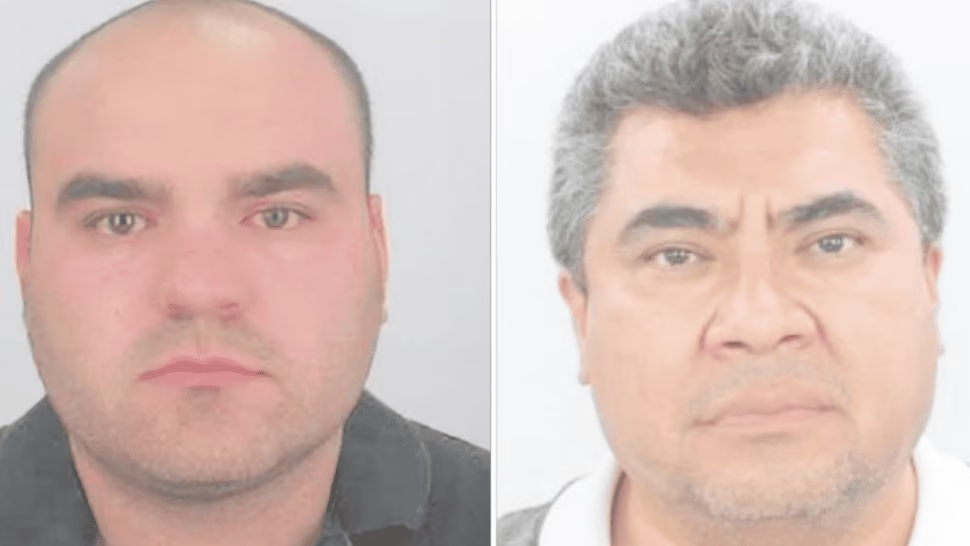
The United States Department of the Treasury sanctioned two Mexicans and their nine companies for their links to a fuel smuggling network of the Jalisco Nueva Generación Cartel (CJNG). They are Oscar Guillermo Juraidini Silva, 41 years old, and J. Refugio Ruiz Villagómez, 65.

The practice known as huachicol fiscal consists of introducing refined fuel into Mexico by evading taxes, declaring it as another commodity. The US alert indicates that in the last year, 160 suspicious activities worth 7 billion dollars were recorded.

Network details

Juraidini Silva is described as “a key operator” and “the mastermind” behind the cartel’s financial operations. He is accused of creating shell companies and falsifying customs documents to traffic fuel and evade IEPS, generating tens of millions of dollars annually for the organization. Ruiz Villagómez, for his part, “is known for smuggling fuel from the United States to Mexico,” paying fees to the cartels to clear customs.

“Mexican cartels, including Jalisco Nueva Generación and Sinaloa, use Mexican companies with permits to buy fuel from sellers in the United States, who take advantage of their relationships with refineries to divert it to networks of ghost companies,” the alert describes.

The sanctions immobilize all assets, accounts and interests under US jurisdiction of these people and companies such as Centro Cambiario La Peseta, OJ Living Trust and Jomadi Logistics & Cargo. The latter was already investigated in 2020 for violating sanctions against PDVSA.

Impact on the economy

The network operates mainly in customs in Reynosa, Matamoros and Nuevo Laredo. FinCEN, the US financial watchdog network, issued guidelines for banks to identify suspicious activity. US companies “launder illegal funds” by purchasing luxury cars, jewelry and real estate. In Mexico, cartels use that money for cash payments to “political campaigns and media outlets,” according to the document.

“Institutions have to be vigilant, since the cartels, their huachicoleros and financiers adapt to the efforts of the law and regulators,” the document states.

After the arrest of the Jensen family in April 2025, smuggling of Mexican crude oil into the United States decreased. But the reverse flow continues: FinCEN has received 160 reports of suspicious activities for $7 billion originating in Texas and Florida.

Continue reading

National Guard: 125 thousand elements and decrease in homicides

Sheinbaum led the National Guard's seventh anniversary with deployment numbers and results.

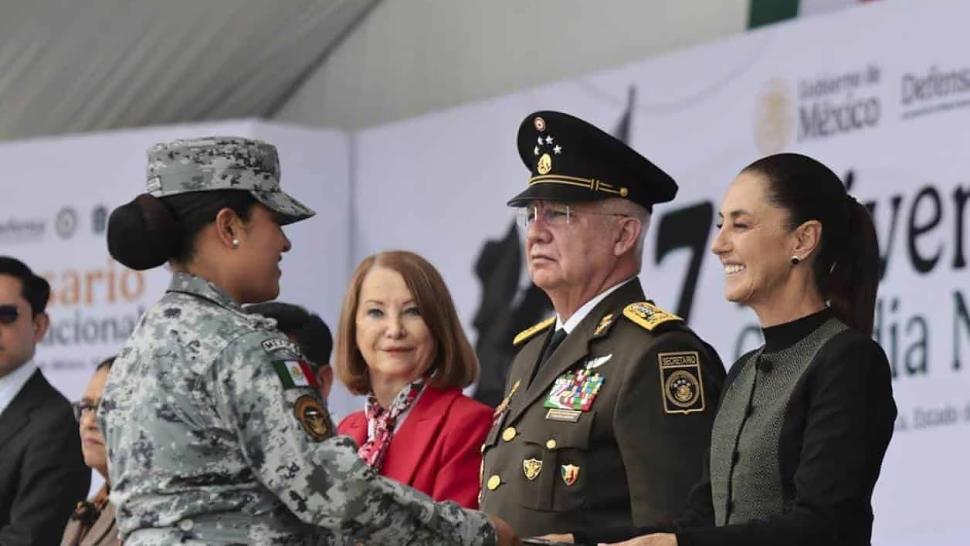
In Huehuetoca, State of Mexico, President Claudia Sheinbaum led the ceremony for the seventh anniversary of the National Guard, created in 2019.

Sheinbaum reported that the corporation has 125 thousand elements deployed in 53 coordinations and 590 barracks built by the Army. He highlighted that intentional homicide decreased 46% since October 2024, as part of the National Security Strategy.

Operating figures

Commander Guillermo Briseño Lobera explained that in the current six-year term, 45 thousand people have been arrested for crimes, 23 thousand firearms have been seized, more than 213 tons of drugs have been seized and two thousand clandestine laboratories have been dismantled.

He announced that Sedena is promoting a plan to reach 170,000 troops and 886 facilities by the end of the six-year term.

The president presented decorations to the personnel outstanding in security, training and confiscations, with special recognition to the elements of the Teotihuacan archaeological zone for their performance last April.

Continue reading