The US supports the end of the alliance between Aeroméxico and Delta

American justice takes sides in a battle that redefines the skies between Mexico and the United States, with workers in its sights.

A Drama in the Heavens that Not Even Netflix Would Have Done Better

It seems that the plot of the season is not on Netflix, but in the world of aviation, and the United States Department of Justice has just released the biggest spoiler: it supports with all its might an end to the antitrust alliance between Delta Air Lines and Grupo Aeroméxico. The reason? A reason that sounds like a user complaint on Twitter: according to them, the policies of the Government of Mexico are so restrictive and potentially discriminatory that they have turned competition in the airline market into something more fictional than the end of *How I Met Your Mother*.

In a move that we all saw coming (but that still gives us a bit of drama), the agency released an official comment to the Department of Transportation (DOT) supporting its decision not to renew that pact that gave them immunity. Basically, they said, “Yes, DOT, you did the right thing. Don’t renew their pact.” And be careful, it’s not a whim. The evidence suggests—and here comes the juicy part—that Mexican practices have limited other airlines from entering or expanding in the country. In other words, they closed the door in the face of the competition as if they were an influencer in an exclusive club.

RelatedThe United States supports the end of the alliance between Aeroméxico and Delta

When Competition Matters… Or So They Say

It turns out that for Uncle Sam, competition is like avocado at brunch: simply indispensable. According to the Department of Justice, a competitive market benefits American consumers—whether they travel for work or pleasure—because it translates into lower prices and better services. Kind of like when there are two taco stands facing each other: you win. But in this case, they feel that the Mexico-US air market is more rigged than a soap opera beauty contest.

And of course, not everything is a trail of tears. On the other side of the ring, the Aviator Pilots Union Association (ASPA) came out with an argument that seems taken from a speech about personal improvement. They stated that the approval and antitrust immunity for the Joint Cooperation Agreement (JCA) between Delta and Aeroméxico is fair, equitable and beneficial for everyone: workers, travelers and even the cross-border market. In other words, according to them, this agreement is like that friend who organizes group vacations: everyone wins.

ASPA did not stay with its arms crossed. He argued that since the 2015 Air Transport Agreement, this alliance has generated operational efficiency, economic growth and—oh yes!—job creation in both countries. Furthermore, it improved connectivity and market depth in the air corridor, benefiting even non-affiliated airlines and regional players. In other words, according to the pilots, this is a win-win with extra guacamole.

But here comes the plot twist: revoking the alliance without proportional alternatives could be chaos. According to ASPA, schedule coordination, fleet allocation, load factors and even profit margins would be reduced. Basically, it would be like taking away a millennial’s cell phone: everything goes to hell. Towns, regional airports, ground services and outsourced operations would suffer the consequences. And if that were not enough, uncertainty could slow down investments in joint terminals, training centers and shared MRO infrastructure. Come on, a domino effect that no one wants to see.

In summary, ASPa opposes unilateral measures that weaken bilateral commitments and considers that eliminating antitrust immunity contradicts the principles of the air agreement between the US and Mexico. In other words, for them, this is like breaking a friendship pact due to a misunderstanding. And believe us, in the era of cancellations, that hurts more than a blow to the ego.

So here we are, watching this aeronautical drama unfold that has more chapters than a history book. Will the fierce competition win or will the alliance that some say maintains order prevail? Stay tuned, because this promises more twists than an HBO series.

Did you like this analysis with an irreverent touch? Share it on your social networks and tag that friend who always travels. And don’t forget to explore more content related to the world of aviation and the policies that drive it!
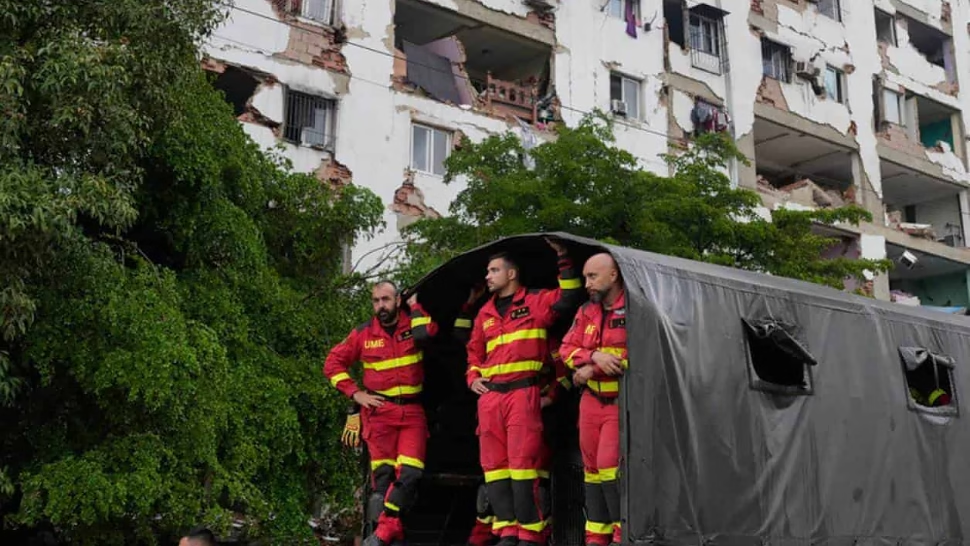
Earthquakes in Venezuela: health system on the limit and rescues decrease

The Venezuelan health system collapses after the earthquakes; diseases grow and disappear.

Health system under pressure

Almost a week after two powerful earthquakes, Venezuela’s fragile public health system is on the brink of collapse. The WHO reported that damaged and understaffed hospitals are facing a wave of injuries.

According to the government, the earthquakes damaged or put 38 hospitals at risk. The WHO evaluated 21 facilities: three are no longer operating, six were damaged and the rest are overflowing. “The findings reveal chaos in service provision, overcrowding and breakdown of biosafety measures,” said Christian Lindmeier, WHO spokesperson.

In addition, specialist doctors, including maternal care in La Guaira, are missing. This worsens the crisis in a country from which eight million people, many health professionals, have fled in recent years.

Humanitarian crisis and rescues

The government reports 1,943 deaths and 10,571 injuries. However, experts believe that the real figure is higher. NASA estimates that 59,000 buildings were damaged or destroyed.

The main rescue period of 48 to 72 hours has already passed. As of Tuesday, only four people were found alive by authorities. A minor rescued after six days under rubble was the exception.

UN agencies estimate 1.2 million tons of debris. Some 680,000 children require humanitarian assistance. Displaced people sleep in overcrowded cars or shelters, without access to toilets or soap, raising the risk of measles, dengue and malaria outbreaks.

In the absence of an official count of the missing, Venezuelans turn to WhatsApp groups. A non-governmental list registers at least 43,220 missing people.

“The health system, already stressed by decades of underinvestment, is now operating beyond its capacity,” Lindmeier warned. Humanitarian aid arrives late: the Red Cross and the World Food Program set up tents in La Guaira, where people line up for food, medicine and masks.

Continue reading

Merz defends the German team; Nagelsmann will remain in charge

Merz's support for the German team after its defeat sparks political criticism.

Merz’s support and the political storm

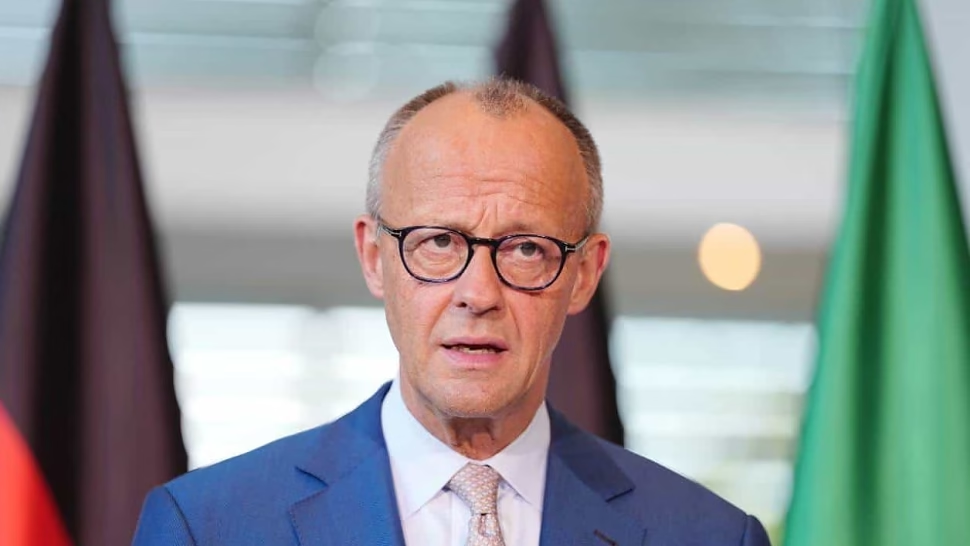
German Chancellor Friedrich Merz ignited the political and sporting debate by posting on social media his support for the national team, eliminated on penalties by Paraguay in the round of 32 of the 2026 World Cup. “Although the elimination hurts: What a game! With your commitment and team spirit, you moved our country. We are proud of you,” he wrote.

The reaction was immediate. MEP Marie-Agnes Strack-Zimmermann and opposition member Sevim Dagdelen accused him of losing touch with reality. The daily Tagesspiegel suggested that the publication was a mistake by an employee of the Federal Press Office.

The federation analyzes the performance

Bernd Neuendorf, president of the DFB, acknowledged the disappointment and held a workshop with coach Julian Nagelsmann and directors Andreas Rettig and Rudi Voeller to evaluate the team’s performance.

Despite rumors about his departure, Nagelsmann made it clear that he will not resign. “If the DFB wants me to continue, I will. And if not, they can tell me. I know how football works,” he said. Voeller backed him up: “He’s the right person in the right place.”

Klopp, meanwhile, ruled out any return. From the United States, where he works as a commentator, he said he was satisfied as Red Bull’s global football director. The German team thus begins an analysis process without immediate changes on the bench.

Continue reading

Mexican moles receive global recognition in Venezuela

Mexican rescue brigades are applauded online for their work in earthquakes in Venezuela.

Devastating earthquakes of magnitude 7.2 and 7.5 shook central Venezuela last Wednesday, June 24. Almost five days after the earthquake, which left thousands dead, the South American country remains in a state of emergency.

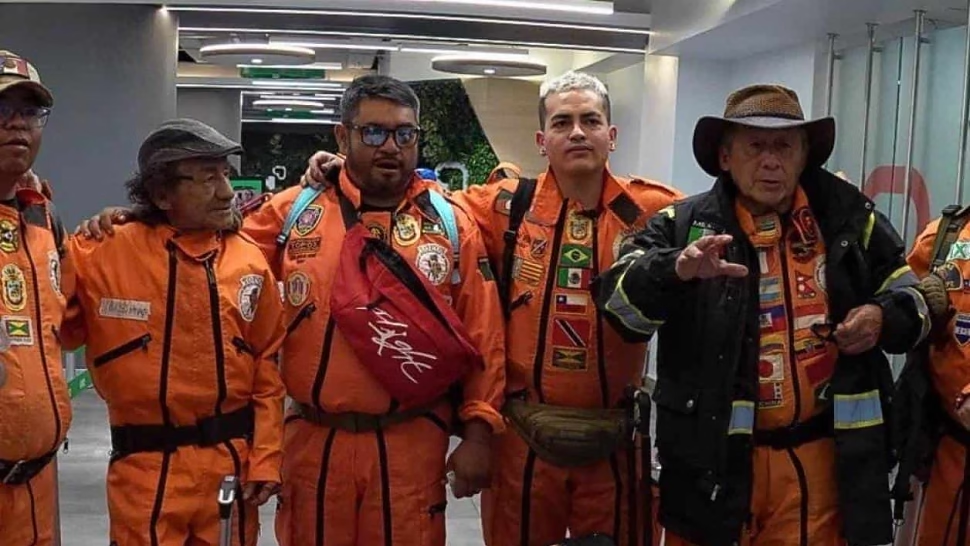
Rescuers from various nations are working tirelessly among the rubble to locate survivors. In this task, the Mexican Topos brigades have stood out for their dedication and vocation for service. His work has been recognized by millions of people around the world.

Recognition on social networks

Users of digital platforms like X have shared dozens of videos and images of the Moles’ work in Venezuela. The messages celebrate not only the rescues of people, but also animals. Some of the most replicated thank yous include:

“The Topos of Mexico are surreal! Forever great.”

“If ever, in the face of a natural disaster, you get trapped in the rubble and you hear that the Moles from Mexico have arrived, resist a little longer because you are about to be rescued, they will find you no matter what. The Mexican Moles have won heaven!”

“The Mexican Topos continue to carry out extraordinary work in Venezuela, working tirelessly among the rubble to save lives and provide hope in the midst of tragedy. Their bravery, solidarity and commitment have once again demonstrated why they are a source of pride for Mexico and an example for the world.”

The wave of publications reflects the global impact of the work of these emergency bodies. Their performance in Venezuela has reinforced the image of the Topos as a symbol of international solidarity.

Continue reading