The UN defends climate science in the face of the global crisis

The highest representative of the UN defends the crucial role of scientific data for survival in the face of extreme weather events.

The Defense of Climate Science in a Context of Denialism

United Nations Secretary-General Antonio Guterres made a strong defense of scientific research and meteorology during a speech delivered this Wednesday at the headquarters of the World Meteorological Organization (WMO) in Geneva. In his speech, he praised the fundamental work of this specialized agency, highlighting its vital contribution to saving countless lives through continuous monitoring of extreme weather events on a planetary scale.

The context of this statement is particularly relevant, given the growing climate skepticism promoted by influential political figures. Guterres addressed WMO delegates at a time when the international scientific community faces significant challenges, especially from the United States, where the previous administration of President Donald Trump promoted an agenda openly contrary to scientific consensus, going so far as to publicly call global warming “a hoax.”

RelatedThe Hurricane Naming System and Its Historical Significance

Early Warning Systems: A Vital Tool for Adaptation

Guterres, a long-time advocate for climate action, spoke at a special WMO meeting designed to boost the development and implementation of early warning systems. These technological infrastructures are essential so that all nations, regardless of their level of economic development, can effectively prepare for threats such as catastrophic floods, high-intensity storms, devastating wildfires and extreme heat events.

During his speech, the UN leader was forceful when he stated: “Without their long-term monitoring, we would not benefit from the warnings and guidance that protect communities and save millions of lives and billions of dollars each year.” This statement was framed by an explicit reference to what he called “the dangerous and existential threat of climate change”, underlining the urgency of the situation.

The scientific basis for this urgency was reinforced by a report from the meteorological agency itself, published the week before the event. This document revealed that atmospheric levels of carbon dioxide, the main greenhouse gas, experienced the most pronounced year-on-year increase since records began. This concentration reached an unprecedented maximum in the era of human civilization, a factor directly linked to the greater frequency and intensity of adverse climate events.

In recognition of the work of the technical staff, Guterres referred to the WMO professionals as the “silent force that illuminates all the rational climate decisions we make.” Furthermore, he sent a message of unwavering support to the research community, adding: “Scientists and researchers should never be afraid to tell the truth.” This statement takes on a crucial political dimension when contrasted with the actions of the Trump administration, which executed deep budget cuts at the National Weather Service and proceeded to lay off hundreds of meteorological specialists and other key employees within the National Oceanic and Atmospheric Administration (NOAA), significantly weakening the ability to predict and respond to emergencies.

The synergy between weather surveillance, climate data science and risk management is therefore positioned as an indispensable pillar for global security. The work of organizations like the WMO transcends the technical to become a matter of civil protection and collective resilience. On a planet where climate patterns are increasingly unpredictable and severe, the ability to anticipate and mitigate impacts critically depends on the maintenance of robust observation networks and an unwavering political commitment to validated scientific knowledge. Investment in monitoring infrastructure and the human capital that supports it is not an expense, but an essential safeguard for sustainable development and the protection of human lives in the face of the growing climate crisis.

Does this topic seem crucial to you? Share this analysis on your social networks to help raise awareness of the importance of climate science and explore more content related to sustainability and environmental action on our website.
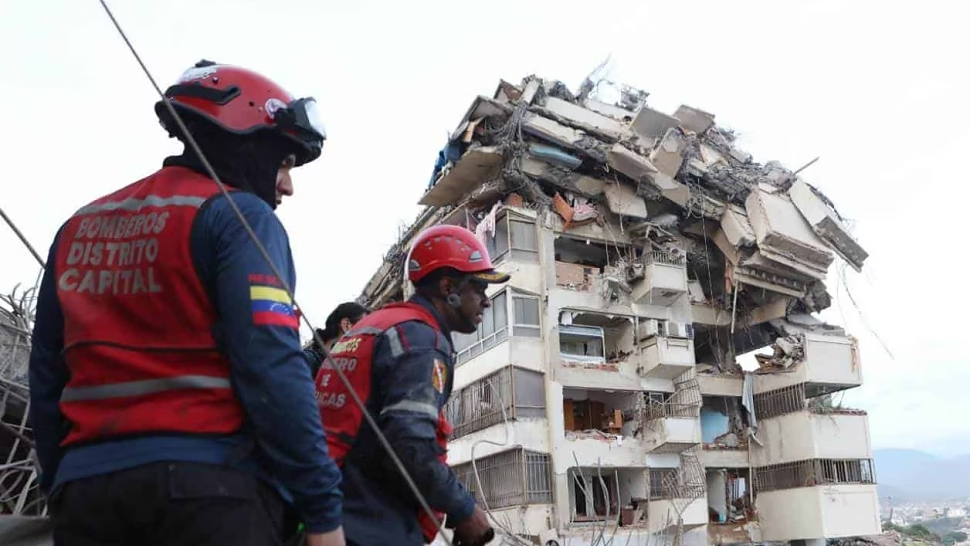
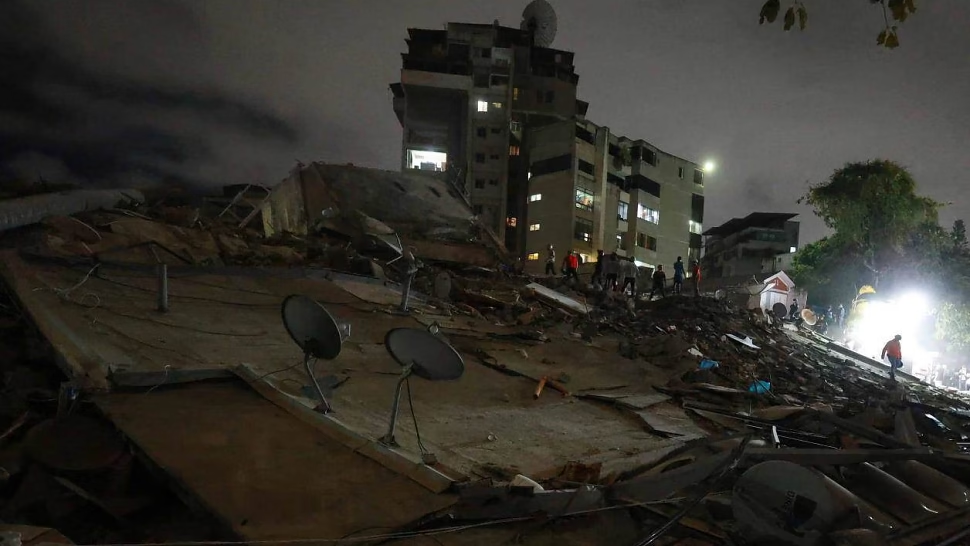
Rescuers improvise due to lack of equipment in La Guaira

Neighbors dig with their hands to rescue those trapped after the earthquake.

Freehand rescue in La Guaira

Twenty-seven hours after the earthquake, desperation is growing among the relatives of those still under the rubble. Rescue teams are scarce and lack machinery to move the mountains of concrete. In various parts of the city, the residents themselves dig with their bare hands, together with firefighters and volunteers.

Many of them maintained communication with their trapped loved ones, speaking to them to keep them conscious. As the hours passed, the voices became weaker until they died out forever.

“My wife couldn’t get there. She was bathing when the tremors hit. We tried to escape. I managed to get out of the building, but she fell, hit her head and was trapped. I know she was left naked, I would like to reach her, at least to cover her body,” said a visibly affected man through tears.

Urgent call

The situation is critical. Rescuers urgently need tools, heavy machinery and logistical support to continue their work. Meanwhile, the community organizes as best it can, moving debris with their own hands, in a race against time to find survivors.

Continue reading

UN reports 6.8 million people affected by earthquakes in Venezuela

UN preliminary evaluation estimates 6.8 million people affected in Venezuela.

UN Evaluation

After the two strong earthquakes that shook Venezuela on Wednesday, the International Organization for Migration (IOM) estimates that up to 6.8 million people could have been affected. According to the UN, approximately two million people reside in the Caracas metropolitan area alone. This is a preliminary evaluation that will be updated as work continues in the affected areas.

The IOM notes that the collapse of buildings and damage to essential infrastructure limits access to basic services. The priority remains the search for survivors in the rubble. UN agencies warn that the number of displaced people will increase as new damage is detected and the hardest hit areas are evacuated.

Government actions and international response

During a press conference, UN agencies reported that around twenty emergency hospitals in the states of La Guaira, Miranda, Aragua, Carabobo, Falcón, Zulia, Yaracuy and Lara, as well as in the Capital District, suffered structural damage.

The government of interim president Delcy Rodríguez requested the United Nations to send three emergency medical teams with surgical capacity. One of them has already left from the United States. Caracas also requested medicines, equipment and medical supplies, which the UN is acquiring and preparing for transfer via Panama or directly to Venezuela.

Continue reading

Double earthquake shakes Venezuela: more than 200 victims

Two consecutive earthquakes of magnitude 7.2 and 7.5 left 235 dead and thousands injured in northern Venezuela.

Venezuela faces emergency after double earthquake

Two powerful consecutive earthquakes shook northern Venezuela on Wednesday night, leaving at least 235 people dead and more than 4,300 injured, according to Health Minister Carlos Alvarado. The number could rise as rescue teams search for survivors in the rubble.

The United States Geological Survey (USGS) reported a first earthquake of magnitude 7.2 with an epicenter west of Morón, 170 kilometers from Caracas. Barely a minute later, a second magnitude 7.5 earthquake struck at a shallow depth, amplifying the destruction. The combination of surface movements intensified the damage, explained geophysicist Marcos Ferreira.

“It’s like I’m screaming and then someone starts screaming too. That amplifies the vibration and increases the potential danger,” Ferreira said.

The coastal region of La Guaira, north of Caracas, suffered the worst damage. The country’s main airport closed due to damage, complicating the arrival of aid. Residents like Dayana Delgado, a mother of three, asked about heavy machinery that the government had promised. Neighbors dug with their own hands.

“I would like to know where my child is, if he is trapped there or is he hanging around in a shelter,” she said about her 8-year-old son, who is still missing.

The president in charge, Delcy Rodríguez, declared a state of emergency and announced a reconstruction fund of 200 million dollars. He requested heavy machinery from private companies for rescue efforts. Teams from the Dominican Republic were already arriving, and more international help was expected.

The United States, through Secretary of State Marco Rubio, offered search teams, medical resources and logistical assistance. The Treasury Department temporarily waived sanctions until Oct. 23 to facilitate aid transactions. Governments of Mexico, Brazil, Spain, Qatar and others also promised shipments.

In Caracas, hundreds of people spent the night in open spaces for fear of aftershocks. Classes were suspended and some school buildings were converted into shelters. Electricity and cell service failed in several areas. Families began publishing lists of the missing while rescuers continued their work.

Continue reading