The UIF launches a format to spy on suspicious transfers

The financial bureaucracy is updated with a new format to monitor the flow of capital, just when it is needed most.

Because nothing says “trust” like a new form to report your money

Starting this glorious December 1, our beloved and always transparent financial institutions will have the honor of filling out another tedious form. Their mission, if they decide to accept it (and they have no other choice), is to send to the Financial Intelligence Unit (UIF) the reports of international transfers of funds with a new and improved design. Because, clearly, what was missing in the fight against organized crime was a better spreadsheet.

We are talking, of course, about the famous FTI reports, the same ones that played such a good role when the Financial Crimes Enforcement Network (FinCen) of the United States pointed out Intercam, CI Banco and the Vector brokerage house for their alleged and perhaps too creative maneuvers with cash. What a coincidence that the format is being renewed just now, right? It’s like changing the locks after the banker has fled, but with more acronyms.

RelatedThree financial institutions are transformed after international sanctions

Bureaucracy at its finest

In a show of regulatory compassion, the authorities have decided that a single provision, 3.1.7 (because naming them with complete sentences would be too humane), wait until March 1, 2026 to come into force. This regulatory gem refers to filling out the field where the name of the countries or jurisdictions involved must be entered. Apparently, automated banking systems need three more months to learn basic geography. You would think that with what they charge in commissions, they could afford a faster update, but what do we know.

Every month, banks and brokerage houses, among other privileged members of the financial club, must prepare a report for each transfer equal to or greater than one thousand dollars. Because, as everyone knows, sophisticated criminals always send exactly $999 to remain undetected. The report reaches the FIU through the National Banking and Securities Commission, in what is undoubtedly a very efficient process of exchanging PDFs with passwords that are impossible to remember.

But the paperwork party would not be complete without the busy attendance of exchange houses, Popular Financial Companies, money transmitters and Financial Technology Institutions. Because when it comes to slowing down the system, the more hands-on, the better.

Global migration, or how to justify a software update

According to the Secretariat of Finance and Public Credit (SHCP), this exciting change is due to the “global migration” towards harmonized payment standards. Translation: It turns out that the entire world is upgrading their SWIFT messaging systems (that retro-sounding MT format) to the shiny new ISO 20022 messages. The deadline for this epic migration was November 22, 2025, which explains why the new format appears now, right on time… or a little late, depending on your level of cynicism.

So, with the noble purpose of having information on the countries involved in international fund transfers and aligning the types of SWIFT messages with the ISO 20022 certification, it was absolutely essential to modify the official format for the International Fund Transfer Report. Because we all know that what really stops professional money launderers is a change in the reporting format. Surely the bosses will now scratch their heads in confusion at the new fields to fill, wondering if their dirty money goes in “observations” or in “payment concept.”

In short, while you prepare for the holidays, the Mexican financial system is dressing up with a new form that promises… well, it promises to be a form. Perhaps more colorful, perhaps with more modern typography, but at the end of the day, another procedure in the fascinating world of anti-money laundering regulation. Because if there is something that moves slower than dirty money, it is the bureaucracy that tries to chase it.

Do you know someone who loves bureaucratic formats? Share this regulatory gem on your social networks and surprise them with the latest in financial entertainment! Explore more content about the curious ways the system tries to stay one step ahead… or at least, tries to appear that way.
Sheinbaum describes meeting with US trade representative as positive

Progress in review of the T-MEC without new tariffs, affirms the president.

Meeting at the National Palace

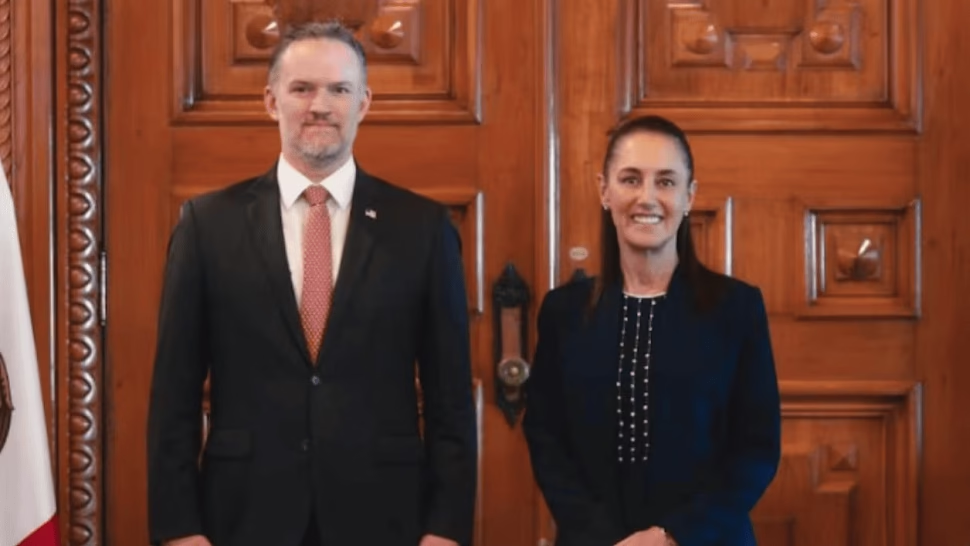
President Claudia Sheinbaum described as “very good” the meeting she held this Thursday with the United States trade representative, Jamieson Greer, at the National Palace. The meeting focused on the review of the T-MEC and bilateral agreements.

From Cuernavaca, Morelos, in his morning conference this Friday, Sheinbaum explained that the review of the treaty occurs in the context of a “new vision” of Donald Trump’s administration, focused on protecting its economy and applying tariffs to the rest of the world, including Mexico.

“It was a very good meeting. Different topics are advancing. It must be said that the review that is being carried out on a new vision that the United States government has of protecting its economy and imposing tariffs on the rest of the world, including Mexico. That is its vision,” he declared.

No new tariffs

Sheinbaum clarified that there is no new tariff beyond what has already been established. Mexico remains in the same conditions. “We are working with the United States to be able to reach a long-term agreement on this new vision that the United States government has,” he added.

The president explained that the United States seeks greater rules of origin. He recalled that Trump proposed an increase in tariffs on all countries from the beginning, a unilateral decision. However, the outlook for Mexico did not change.

“Mexico remains the same as it was. All products that are exported within the Free Trade Agreement have zero tariffs, with the exception of vehicles and steel. And the products that are exported outside the Free Trade Agreement have a tariff of 10%, which is what we already had before; that is, Mexico remains exactly the same as we were a week ago,” he explained.

Sheinbaum reaffirmed his commitment to working with the United States to ensure that Mexico maintains its position in the USMCA and continues to benefit from current trade agreements.

Continue reading

Bienestar Pensions: last day of deposits in July

Deposits for last names with R end this Friday. Find out amounts and recommendations.

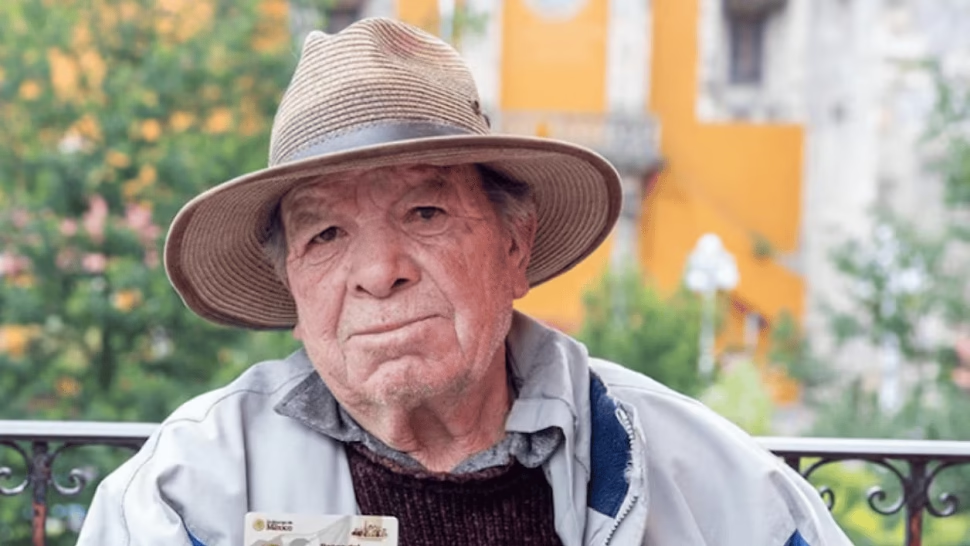
The Welfare Secretariat concludes this Friday, July 24, the third week of deposits corresponding to the July-August two-month period. Payment is made in alphabetical order. Today is the second day for people whose last name begins with R. This modality seeks to avoid crowds in branches.

There is no need to withdraw the cash immediately. The resource remains on the Bienestar card and can be used for purchases, services or withdrawals without commission.

Amounts for the fourth quarter
The authorized quantities remain unchanged:

  • Pension for Seniors: 6,400 pesos.
  • Women’s Wellness Pension: 3,100 pesos.
  • Pension for People with Disabilities: 3,300 pesos.
  • Children of Working Mothers Program: 1,650 pesos per child.

Sembrando Vida received its monthly payment on July 9 (6,450 pesos). The total investment in Pensions amounts to 378,817 million pesos, benefiting more than 16.5 million people.

Precautions against fraud
The authorities recommend not sharing the PIN or personal documents with supposed managers. Check balance only through official channels of Banco del Bienestar. If the deposit does not appear, wait until the end of the day.

Continue reading

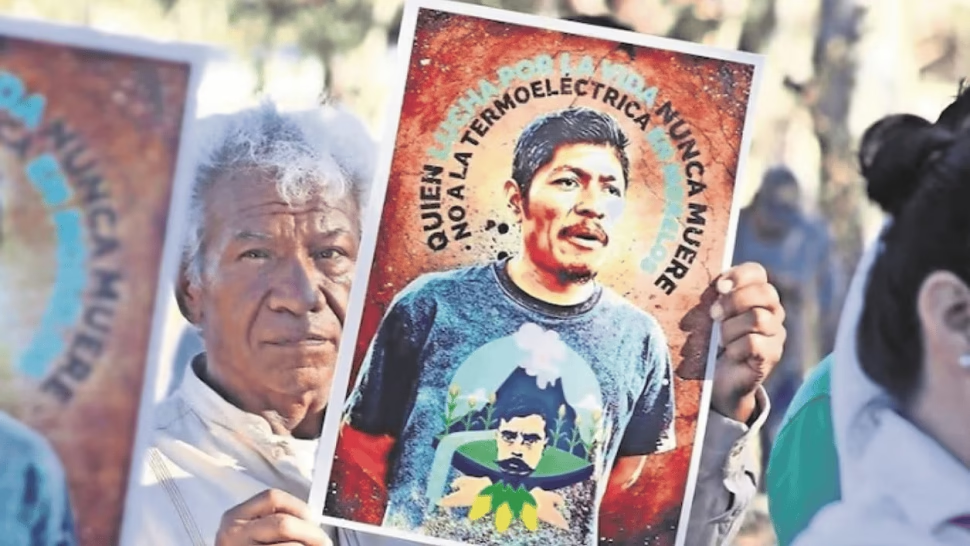
Mayor of Temoac linked to homicides of activists

The Secretary of Security revealed a line of investigation that points to the former mayor.

Omar García Harfuch, head of the Secretariat of Security and Citizen Protection (SSPC), reported that the deprived mayor of Temoac, Valentín Lavín Romero, was related to the murders of activists Samir Flores and Sandra Rosa Camacho Flores.

During the morning conference of President Claudia Sheinbaum in Cuernavaca, Morelos, García Harfuch explained that the line of investigation into the Samir Flores case is in charge of the Attorney General’s Office (FGR).

Investigation in progress

When asked about the number of people involved in the murder of the activist in 2019, the secretary pointed out:

“The line of investigation, specifically of these homicides, is carried out by the local Prosecutor’s Office.”

And he added:

“We, with the State Prosecutor’s Office and FGR, together with the National Intelligence Center, this was one of the lines and one of the crimes for which the mayor was being investigated, specifically for these two homicides.”

García Harfuch concluded that the local Prosecutor’s Office will provide more details in due course. The federal investigation focused on the former mayor as the alleged perpetrator.

Continue reading