The Sturgeon Moon lights up the sky with a planetary extra

A celestial spectacle that combines the August full moon with a planetary dance before dawn. Get ready for a night of astrophotography.

The Sturgeon Moon: Because prehistoric fish dictate our lunar calendar

Oh, joy. The early morning of this Saturday gives us the privilege of witnessing an event that occurs every month, but with a much more pompous name: the Full Moon or, for connoisseurs of celestial marketing, the Sturgeon Moon. The reason? A group of tribes, with an evident obsession with ichthyology, decided to name the August moon that way because it coincided with their favorite season of fishing for the gigantic and, it must be said, quite ugly, sturgeon. Of course, nothing says “cosmic spectacle” like naming it after a fish that looks like a swimming fossil.

This incredible one – and it would be even if it were called the Pufferfish Moon – is not content with being a shiny sphere. According to those in the know, it has reactions to the behavior of the sea, which sounds tremendously scientific and not at all like an excuse to blame it for our bad beach decisions. Plus, as if one moonfish wasn’t enough, it comes with a free planetary alignment show, perfect for those who like to align things before dawn.

RelatedThe Sturgeon Moon will light up the sky with a planetary spectacle

The big moment: Set your clock so you don’t miss what happens every night

According to the modern oracle “Star Walk“, this spectacular celestial function (repetition number 4,723 million) will reach its climax at 07:55 GTM next Saturday. For earthlings in Mexico, that translates into the pleasant hour of 1:00 in the morning, ideal for those who had no plans to sleep anyway. The reassuring note – or one that reveals that this is all a bit of hype – is that the moon “will appear all night before and after.” Wow, almost like it does… every night.

Capturing the Essence of the Sunfish: A Photography Guide for Mortals

To immortalize this event that occurs monthly but this month has a cool name, you will need stable support. A tripod is recommended, mainly to prevent your photos from being as blurry as the explanation of why this moon is so special. For your cell phone, the revolutionary tip is to activate night mode or the mysterious professional camera mode (usually hidden behind an icon that looks like a magician’s hat).

The next step: focus on the moon and decrease exposure. Basically, tell your phone “hey, that thing is shiny, don’t treat it like you’re photographing a charcoal.” If you’re in the club of serious photographers with a DSLR or mirrorless camera, this is your time to shine. Use a telephoto lens to capture fascinating details like craters and shadows (which have been there for eons, but are trendy tonight). The magic recipe: a low ISO (100–400), a medium aperture (f/8) and a shutter speed of 1/125 seconds. Or, do like everyone else and just look up the settings on a YouTube tutorial at 1:05 a.m.

The final tip, and perhaps the most important: activate the timer. This will prevent your phone from shaking in the sheer panic of getting the perfect photo for Instagram, ruining everything by touching the screen with a trembling finger.

Apps to avoid getting lost in the cosmos (or in the application store)

To monitor this and other events that will make you feel small and insignificant, here is a list of applications:
Sky Live: Heavens Above Viewer. Star Walk 2. Guide to the night sky. Sky Tonight: AR Constellations. Constellation Map mobile.
Basically, any app that lets you point your phone at the sky and tells you “yes, that’s a bright spot, that’s a planet” or “that’s a plane, that’s not a UFO.”

Ready to celebrate the fishing heritage of Native American tribes by looking at a giant rock in space? Don’t forget your coat and your sense of irony! And if you get a good photo, share it with the world. After all, what’s the point of witnessing an astronomical event named after a fish if you don’t get likes for it? Share your best captures on social networks and tag us. And if you were left wanting more celestial absurdities, explore our astronomical phenomena section to discover what else they have named it.
AI becomes a dating coach, but divides opinions

Users turn to chatbots to start romantic conversations, but doubts persist about authenticity.

The role of AI in modern romance

Marie Lansley recently arrived in San Francisco and, while looking for a partner, decided to try artificial intelligence. “I’ve tried everything,” says the 36-year-old engineer, who consults chatbots like ChatGPT and Claude to help her start conversations on dating apps. “I’m open to AI finding the love of my life, but I’m not totally convinced,” she says. “Chemistry is always going to be analog.”

More and more people are using chatbots to compose messages or interpret responses. Dating coach Carey Gaynes compares him to Cyrano de Bergerac: “You’re using a voice that’s not your own.” He worries about overdependence, although he recognizes that it can be useful.

Mason Naung, a 25-year-old student in Los Angeles, only turns to AI to break the initial ice. “If the messages go further, it would be a small warning sign,” he says. San Diego businesswoman Dani Cohen prefers an AI-written farewell message to being ghosted. “Anything that gets people to communicate in a friendly way is great,” he says.

Other voices are more critical. Clara Sullivan, a 22-year-old student, would not respond to a profile that uses AI. “It’s scary how dependent people are. It’s taken away the ability to think creatively,” he says. A Pew Research Center survey reveals that 53% of US adults believe AI will worsen creativity, and half think it will affect meaningful relationships.

Dating apps already integrate AI. Tinder has Chemistry, Hinge uses AI launchers, and Bumble plans to eliminate swipe to prioritize automated matching. Its CEO, Whitney Wolfe Herd, says that technology “should make love feel more human, not less.”

Mohammed Nizami, 23, does not use AI for dating. “We all crave authentic connection. If there’s a filter, it’s not a good way to start,” he says. Jake Clay, a content creator in New York, calls the situation a “vicious cycle” that bypasses sacred processes of life. “It’s sad to delegate something so fundamental to an AI that doesn’t understand emotions,” he laments.

Despite reservations, the merger between AI and dating seems inevitable. Efficiency gains ground, but authenticity remains the challenge.

Continue reading

NASA takes the 2026 World Cup ball into space and plays it on the ISS

NASA sent an official 2026 World Cup ball into space and opened an exhibition in Houston.

World Cup ball arrives at the International Space Station

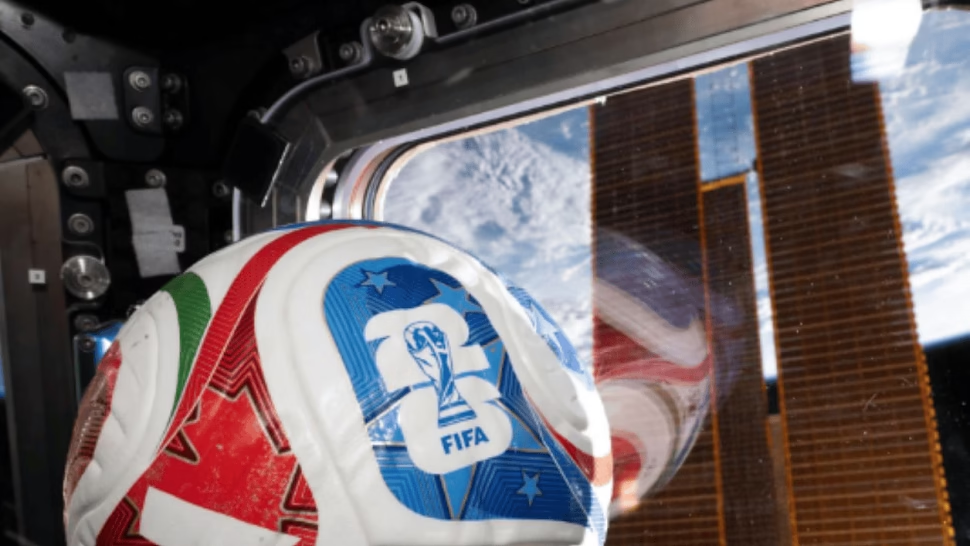
The fever of the 2026 World Cup permeated the atmosphere. NASA sent an official World Cup ball to the International Space Station (ISS). In a video shared on social networks, four astronauts are seen playing with the ball in microgravity. The message: “We work to inspire the next generation by showing how space exploration drives innovation in sports science.”

The agency seeks to disseminate how research on the ISS generates advances in science, technology and human health. Benefits that even reach the soccer field.

Exhibition at the FIFA Fan Fest in Houston

NASA set up an exhibit at the FIFA Fan Fest in Houston, Texas. It opened on June 11 at the start of the World Cup and will be available until July 19. Visitors can discover how space research improves life on Earth and learn about the Artemis program missions.

The exhibition explains how more than 25 years of studies on the ISS have helped understand the aerodynamics of the ball. According to a statement from the Johnson Space Center, previous research analyzed how internal mass, sensors and seam texture affect stability and rotation under real-play conditions.

Science applied to sports

As part of the project, NASA and Adidas present the “STEMonstration” demo. They compare how balls spin with different balance in microgravity. The objective: to show that space discoveries benefit athletes and fans of the most popular sport in the world.

Continue reading

Users report massive drop in X this Monday

Users report problems accessing social network X this Monday, June 22.

Cuts in X during Monday

Users of the social network X, formerly Twitter, reported this Monday, June 22, difficulties accessing and browsing the platform. According to data from DownDetector, a site that monitors digital failures, 1,131 people have reported problems with the application, loading the main feed and connecting to servers.

The most common issues include the inability to refresh the home page, errors when displaying posts, and crashes when using basic functions. When trying to log in, some see messages like “Something went wrong. Try loading again,” without the platform recovering.

So far, X has not issued an official statement on the origin of the failures or the estimated time to restore service.

Continue reading