The SSC Condors celebrate 54 years flying and saving lives

Half a century in the air saving lives and chasing criminals with technology and passion.

When heroes have propellers (and not capes)

Imagine an action movie where the protagonists are not superheroes in tight suits, but rather pilots and paramedics who literally dive from the air to save lives. This is the Cóndores, the SSC air group that this year celebrates 54 years of flying, rescuing and bringing order from above. And no, they don’t wear capes… although their helicopters definitely should.

From two helicopters to a fleet that makes you envious

It all started in 1971 with two helicopters (yes, TWO, like those projects that you start in January and abandon in February). Today they have 10 aircraft, five of them certified as air ambulances. In other words, they are Uber Eats of organs and rescues, but with better aim. Francisco Tamés, its director (and 43-year veteran of the team), sums it up like this: “Here we are police officers, rescuers, firefighters and even deliverers of hope.” Your motivation? “Be useful to society”. Millennial translation: “Do something that doesn’t involve likes on Instagram.”.

RelatedThe government endorses foreign pilots and the locals stage their own aerial drama

Between air chases (yes, like in GTA but with happy endings), flood rescues and organ transfers, these guys have served 14,667 missions. That’s thousands of lives saved and zero time to get bored. The most rewarding thing? “See positive results… like capturing criminals or pulling someone out of a fire”. Basically, they are guardian angels… but with fuel and rotors.

Own workshop, saving resources and zero excuses

As if that were not enough, these stars not only fly, but maintain their own aircraft. No “call the technician”: they trained themselves to repair their helicopters, saving resources (and avoiding those “the system crashed” typical of other agencies). Now there are 113 people including pilots, paramedics and… kitchen staff? Yes, because even heroes need their morning coffee.

And in case you thought they only operated in CDMX, their expertise is so sought-after that they give courses at a national and international level. “It means that things are going well,” says Tamés with the modesty of someone who knows that his work speaks for itself. Conclusion? These guys are the real equivalent of those series characters who always arrive at the right moment… but without special effects.

Can you imagine flying with them? Share this story and celebrate those who put the sky at the service of people. And if you want more stories of real heroes (without capes, but with propellers), explore our content!
World Cup 2026: piracy floods the streets of Mexico City

Piracy of 2026 World Cup items skyrockets in CDMX due to high prices and impunity.

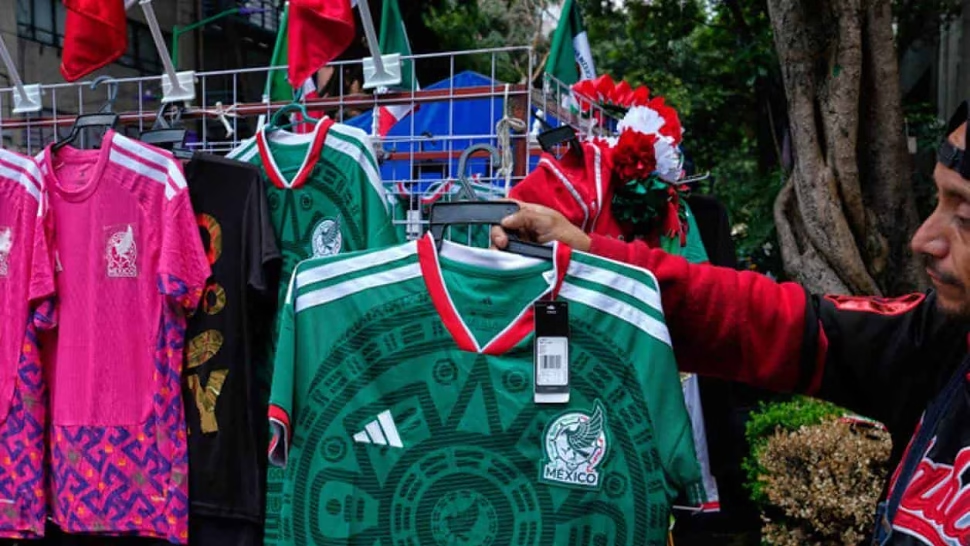
The furor for the 2026 World Cup has overflowed the stadiums. In Mexico City, the sidewalks are filled with vendors selling unofficial t-shirts, trophies and mascots. The phenomenon, although not new, has intensified. Specialists attribute this to impunity, corruption in customs and the high prices of original products.

“We have more and more problems related to piracy,” said Francisco Rivas, general director of the National Citizen Observatory. According to Rivas, the progress is also due to the fact that organized crime forces formal merchants through extortion.

Alarming figures

Mexico is the seventh largest buyer of unauthorized copies worldwide, according to a report by the OECD and the EUIPO. An official Mexican national team jersey costs more than 2,000 pesos ($117), equivalent to a week’s minimum wage. In the informal market, the price is around 250 pesos (14 dollars).

“People leave because of the economy,” said Lizeth Herrera, a 26-year-old physical education teacher, while looking for T-shirts at a stall in the historic center.

Insufficient official actions

Claudia Sheinbaum’s government has made million-dollar seizures and approved a regulation to accelerate patents. But Rivas considers that these measures are not enough due to the complexity of the phenomenon and corruption. In the La Lagunilla market, in Tepito, the police circulate without intervening due to the massive sale of unofficial items.

Mariana Villalobos, an online seller, commented: “This World Cup has gone very well for me.” His sales of pirate t-shirts multiplied after Mexico’s triumphs. Faced with criticism, he responded: “There are tastes of everything and there is economy for everyone.”

The cultural challenge

The informal sector represents more than half of the economically active population in Mexico. Companies like the B2B corporation have had to strengthen their digital communication to compete. Gabriela Valdés, deputy general director, pointed out that the problem must be addressed as a cultural issue: “It is sad to know that behind a design and sewing effort it is not given the deserved value.”

Continue reading

Sheinbaum orders to review FBI donation of small plane used in capture

Sheinbaum asks to review the FBI's donation of the aircraft used in the transfer of Zambada and Guzmán López.

Official review after FBI donation

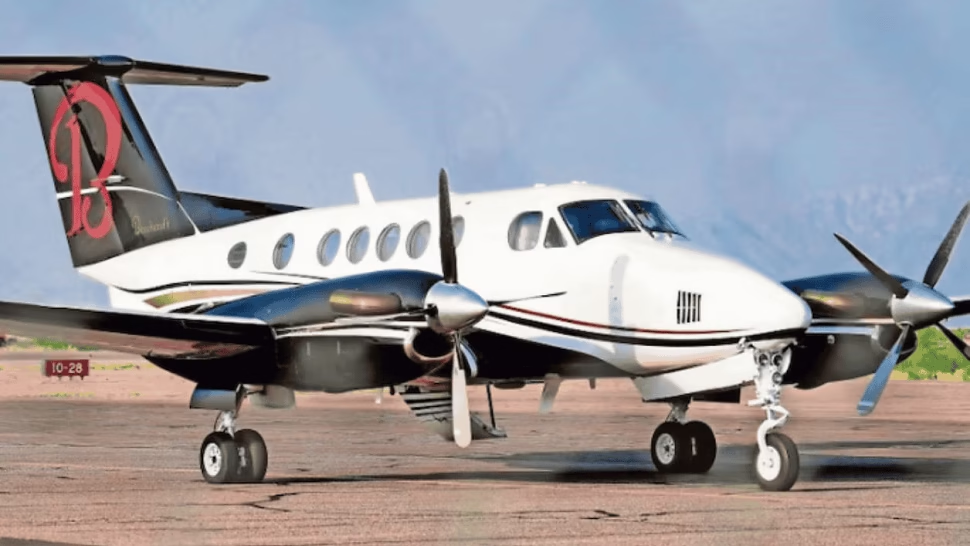
President Claudia Sheinbaum instructed the Ministry of Foreign Affairs (SRE) and the Security Cabinet to analyze the case of the small plane that the FBI donated to a museum in New Mexico. The aircraft transported Ismael “El Mayo” Zambada and Joaquín Guzmán López from Mexico to the United States in July, where they were detained.

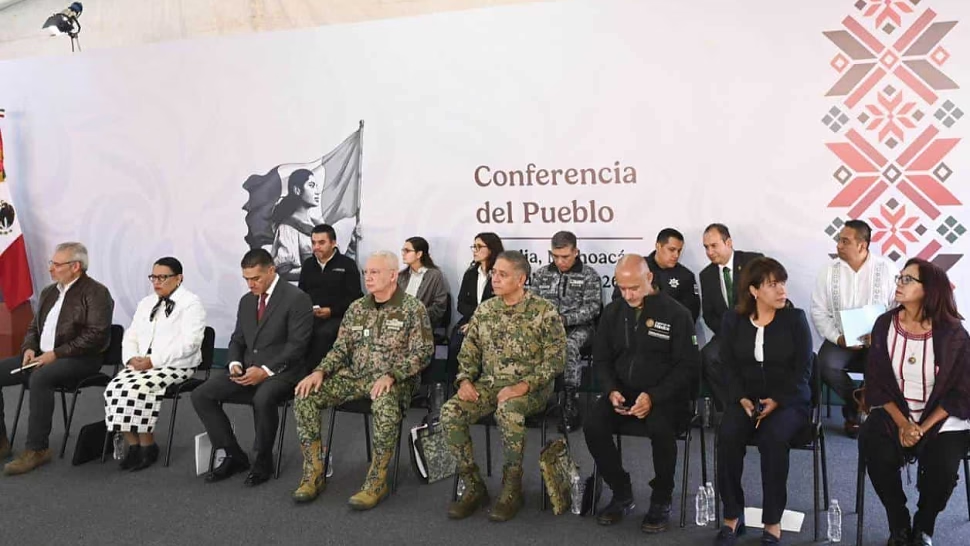
During his morning conference in Morelia, Michoacán, Sheinbaum indicated that he will speak on the issue next week. “I asked the SRE and the Security Cabinet to carry out this review and, if they agree, we will comment next week,” he said.

Questions about FBI involvement

Given the insistence of the press on whether the donation confirms the FBI’s participation in the operation, the president avoided advancing conclusions. “Let’s review. Yesterday we saw the Pie de Nota report,” he added.

The plane was delivered by the US agency to a cultural venue, which has generated debate about the role of US authorities in the capture of the kingpins. Sheinbaum did not provide more details until the requested analysis was available.

Continue reading

Sheinbaum details Plan Michoacán: 54 billion and 850 thousand services

Sheinbaum presents progress of the Michoacán Plan with 54 billion in investments and more than 850 thousand services.

Sheinbaum heads the evaluation of the Michoacán Plan

President Claudia Sheinbaum led the presentation of progress of the Michoacán Plan for Peace and Justice in Morelia. The federal deployment seeks to consolidate the development of the state hand in hand with the Justice Plan of the P’urhépecha People.

“We are going to continue looking at Michoacán with the objective of advancing peace and justice for the people of Michoacán,” he stressed.

More than 850 thousand services at Wellness Fairs

The Secretary of the Interior, Rosa Icela Rodríguez, reported that from November 19, 2025 to July 2, 2026, 850,679 services and procedures were granted in 68 municipalities, with 77 federal and state agencies.

He also detailed that the Welfare Markets delivered more than 2 million basic necessities to 27,050 families.

Million dollar investment in infrastructure

The global investment is around 54 billion pesos, of which 16 billion correspond to 2026. They are allocated to the conservation and modernization of 411 kilometers of highways, artisanal roads and the “MegaBachetón” program.

In education, the “Rita Cetina”, “Benito Juárez” and “Gertrudis Bocanegra” scholarship programs provide 5.7 billion pesos for 842 thousand students.

In addition, 1,627 million pesos were dispersed in favor of 166,000 agricultural and fishing producers through Production for Wellbeing and Free Fertilizers.

Indigenous development in the P’urhépecha region

The construction of the National Guard barracks in Cherán, the construction of hospitals, credits for artisans and the publication in the Official Gazette of the geographical indication of the avocado to protect its value stand out.

Continue reading