Mexico faces a critical gap in organ donation

Detailed analysis reveals the critical gap between organ demand and donor availability, with thousands of lives at stake.

National Panorama of Donation and Transplants

The health system in Mexico faces a challenge of critical proportions: approximately 20 thousand individuals are waiting for a transplant procedure. The shortage of organ donors represents a 75 percent deficit, which means that, in practice, only around five thousand recipients are able to access the intervention they need annually. This alarming disparity leaves the vast majority of patients on the waiting list in a situation of extreme vulnerability, depending on an act of solidarity that does not occur on the required scale.

Eduardo Tapia Alcalá, Hospital Coordinator of Organ and Tissue Donation of the Old Civil Hospital of Guadalajara “Fray Antonio Alcalde”, provided an eloquent numerical context: “If we consult the official record, in Mexico there are almost 20 thousand patients waiting, and nearly five thousand interventions have been performed. transplant. This translates into a accumulated delay of 15 thousand people. The percentage of deficit remains at approximately 75 percent, which shows the prevailing need to intensify efforts to promote this culture of donation. It is for this reason that the National Transplant Center (CENATRA) has adopted the motto ‘For a Mexico without a waiting list.’

RelatedTransplants in Mexico go from being ‘heroic’ to routine procedures

Demand Distribution and Progress in Jalisco

According to the most recent data from the National Transplant Registry, as of July 30 of the current year, 19,199 people required an organ or tissue to improve their quality of life or simply to survive. The distribution of this need is overwhelming: 16,511 patients are waiting for a kidney graft, 2,424 need a cornea transplant and 226 are waiting for a liver. These three indications concentrate the greatest demand within the system.

A focus of hope and analysis is found in the state of Jalisco. During the previous year, this federal entity performed a total of 996 transplant procedures. Of this figure, 424 were made possible thanks to living donation, while 482 were possible through cadaveric donation. This year has shown an encouraging trend, since in the period from January to July 597 transplants have been achieved, of which 276 came from a living donor.

Benjamín Gómez Navarro, General Director of the State Center for Organ and Tissue Transplants of the State of Jalisco (Cetrajal), highlighted a significant evolution in procurement patterns. “In 2010, donation in Jalisco was made up of ten percent of cadaver origin and ninety percent of living donors. Fifteen years later, the proportion is 25 percent of cadaver and 75 percent of living donors. Last year we were at twenty percent, today we have increased five points additional percentages. This statistic reflects that we are achieving a greater number of effective procurements, more concretized donations and a higher rate of family acceptance.”

Persistence of the Lag and the Imperative of Awareness

Despite these quantifiable advances, the state reality is no less challenging than the national one. In Jalisco, a considerable delay persists, with an active waiting list that includes six thousand 674 patients, whose ages range between 4 and 76 years. Of this conglomerate, 90 percent, that is, the overwhelming majority, require a kidney organ. The rest of the patients wait for a cornea, a liver, a pancreas, a combined liver and kidney transplant, or even a heart.

José Antonio Hernández Robles, Organ and Tissue Donation Coordinator of the New Guadalajara Civil Hospital “Dr. Juan I. Menchaca”, underlined the essence of the problem and its possible solution. “We continue to experience a significant lag in donation. This situation makes it imperative to provide massive and constant dissemination, as well as raise awareness among the population about these processes. It is essential to convey that, despite the grief and intrinsic difficulty that a family experiences after the loss of a loved one, there is the transcendent possibility of giving life to others. Organ donation represents a legacy of hope in the midst of personal tragedy.”

The commemoration of National Organ and Tissue Donation Day, on September 26, serves as an annual reminder of this urgent collective need. The road ahead is long, and closing the 75 percent gap requires a multifaceted effort that involves health institutions, the media, and society as a whole. The goal of a Mexico without a waiting list is ambitious, but each new family conversation about donation, each registration as a donor and each acceptance in a moment of pain, constitutes a fundamental step towards its achievement.

Help close the gap: Share this analysis on your social networks to amplify the message and explore more content on how to foster a strong culture of organ donation in our community.

Pato Merlín achieves trademark registration with the IMPI

Merlin Duck receives official trademark registration in Mexico.

Official record of Merlin Duck

Merlin Duck, a well-known social media character, already has a trademark registration in Mexico. The Ministry of Economy and the Mexican Institute of Industrial Property (IMPI) granted protection to its owner, Karla Ivette Gómez López.

The application was submitted on June 22 through the Marcanet system. The registration numbers are 3646513 and 3646554. The trademark protects education, training, entertainment, sports and cultural activities services.

The Secretary of Economy, Marcelo Ebrard, and the general director of IMPI, Vidal Llerenas, delivered the certificate to the Gómez López family. During the event, Ebrard noted:

All trademark registration applications are subject to a technical and legal analysis procedure, with the aim of guaranteeing certainty, legality and transparency in the protection of industrial property rights in Mexico.

For his part, Llerenas explained that it is a public fact that Merlin Duck is the pet of the family of Karla Ivette Gómez, to whom the brand belongs.

The registration was granted after a person from Yucatán also submitted an application for the same name. The authority intervened to protect the rights of the owner family.

With this action, the Ministry of Economy and the IMPI reaffirm their commitment to providing legal certainty and protecting creativity and intangible assets in the country.

Continue reading

Earthquakes in Venezuela leave 920 dead

After earthquakes of 7.5 and 7.2, Mexico deploys humanitarian aid and collection centers in CDMX.

Two earthquakes of magnitude 7.5 and 7.2 shook central Venezuela last Wednesday. Authorities declared a state of emergency due to widespread material damage.

The hardest hit states are Miranda and La Guaira, although Aragua, Carabobo and Falcón also report severe damage. So far there are 920 deaths and more than 3,360 injuries, according to the BBC. Thousands of people remain missing and rescue teams are working against the clock.

International and Mexican support

President Claudia Sheinbaum reported that the first convoy with 250 soldiers, 18 search dogs, medical supplies and tools has already arrived in Venezuela. The United States, Chile, Brazil, Ecuador, El Salvador, France and the Netherlands have also sent aid.

Mexican solidarity has translated into collection centers. The Topos Tlatelolco Rescue Brigade collects items in Magistrates 75, Amp neighborhood. El Sifón, Iztapalapa, CDMX. They accept bottled water, tents, tarps, repellents, sunscreen, sanitary towels, soap, alcohol, gauze, bandages, powdered milk, non-perishable food and tools for rescuers (helmets, gloves, boots, shovels).

The Venezuelan restaurant Pasticho Express, in Parques Polanco Shopping Center, also receives donations: medicines such as paracetamol and ibuprofen, antiseptics, dressing materials, saline solution, antibiotic creams, burn ointments, rehydration salts, antidiarrheals, thermometers, gloves, face masks and antibacterial gel.

The Mexican Red Cross maintains its USAR Task Force and canine pairs active. Financial donations can be made at www.cruzrojamexicana.org.mx. CENACED, through its “United for Them” campaign, offers pantry, cleaning and hygiene kits at Unidosporellxs.org.mx, where there are also bank accounts for transfers.

Organizations ask to verify the legitimacy of campaigns before donating.

Continue reading

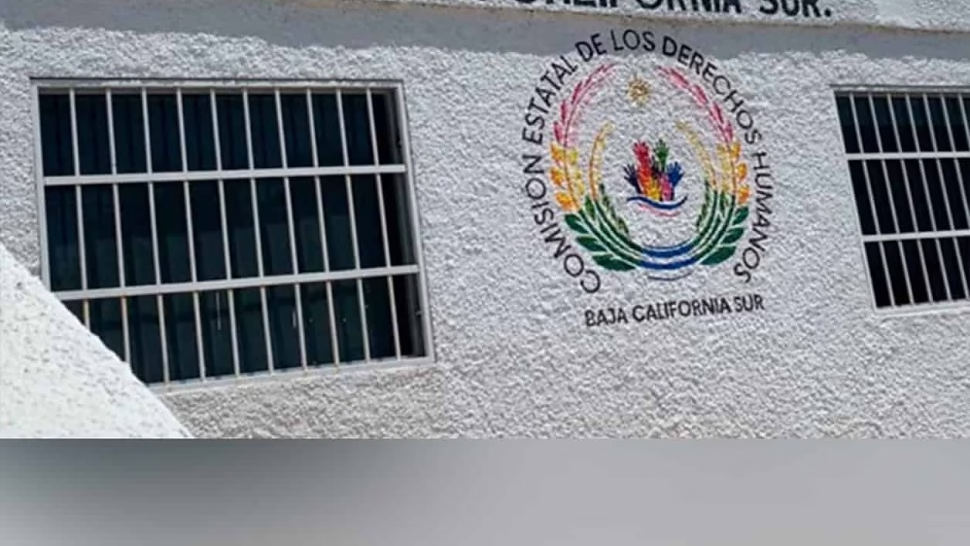
CEDH reviews official action after car accident in Cabo

The ECHR opened an ex officio complaint for a collision during the 2026 World Cup celebrations.

Incident in Cabo San Lucas

The State Human Rights Commission (CEDH) of Baja California Sur initiated an ex officio complaint for the accident that occurred Wednesday night in Cabo San Lucas. The event occurred during the celebrations for the victory of the Mexican National Team in the 2026 World Cup.

The agency seeks to determine if there were violations of human rights derived from actions or omissions of the authorities before, during and after the incident. The investigation is carried out in parallel with that of the State Attorney General’s Office (PGJE).

“The analysis will be carried out independently, objectively and impartially,” the ECHR said in a statement.

In addition, the commission invited anyone who believes their rights have been violated to file a formal complaint to receive guidance and support.

The facts

The accident occurred on Lázaro Cárdenas Boulevard, the main tourist corridor in Cabo San Lucas. Hundreds of people celebrated Mexico’s victory against the Czech Republic. According to official municipal information, a vehicle was surrounded by attendees and then moved forward, hitting several pedestrians.

The balance was 17 people injured, two in serious condition. Among the injured is the driver, who was beaten by fans after the incident. The PGJE maintains an open investigation folder to clarify the mechanics of the events.

The ECHR called for investigations to respect due process, the presumption of innocence and the rights of all people involved. It also followed up to ensure that the victims receive care and that the case is resolved legally and transparently.

Continue reading