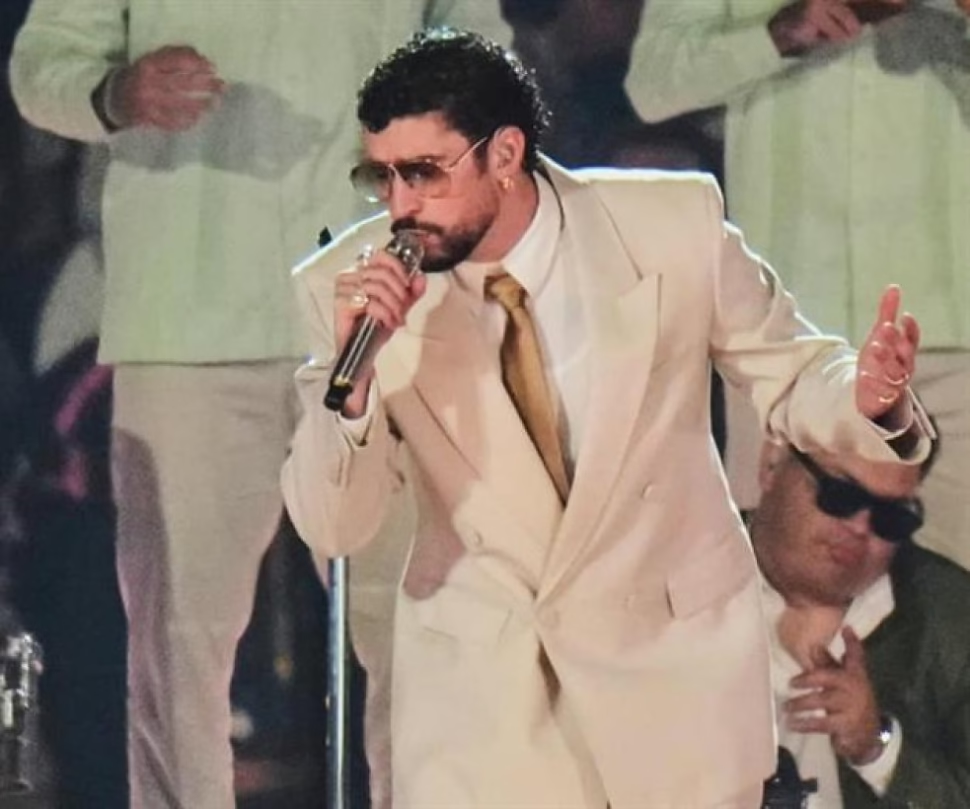
Bad Bunny turns halftime into a massive Spanish class
The news is here: Bad Bunny will perform this Sunday at the Super Bowl completely in Spanish. And no, it is not a minor detail. It has sparked a race among its fans to learn the language before the first note is played.
“If you didn’t understand what I just said, you have four months to learn,” the artist said on Saturday Night Live last October.
Well, the deadline expires this Sunday. And the internet is full of tutorials, threads explaining Puerto Rican slang, and people documenting their linguistic journey. It is a social phenomenon with a reggaeton flavor.
A learning that sounds like a protest
Niklaus Miller, 29, has been trying to decipher letters for months as if they were secret codes. “I’m deluded enough to think ‘this would be easy,'” he confesses. But for him and many others, this transcends music.
“It felt like a form of protest,” Miller says of his decision to learn. “It just feels good.”
Your effort does not go unnoticed. Receive messages from people, especially Latinos, who feel seen and appreciated seeing someone strive to understand their culture from within.
O’Neil Thomas, a New York content creator, started his music marathon the day the lineup was announced. “Given where we are now with the state of the country, I think he’s the perfect person,” he reflects. Her TikTok videos learning topics like “NUEVAYoL” have received waves of support.
The political context (because there always is one)
Of course, nothing with Bad Bunny is just a party. His clear message against immigration policies has inflamed certain sectors. Trump called his choice “ridiculous.” Conservative groups even organize a “100% American” alternative show.
All this while ICE raids target Hispanic communities. In this climate, the visibility of the artist is a political act in itself.
Vanessa Díaz, co-author of a book about the Bad Bunny phenomenon, is clear: “The Super Bowl is an additional boost for a trend that was already happening.” Spanish was already the second most spoken language in American homes. Now, he aspires to be the coolest.
The Puerto Rican challenge
Learning Spanish for Sunday is not an easy task. Miller explains it perfectly: the Puerto Rican dialect cuts words and goes a mile an hour. You forget the pronunciation if you don’t practice for a day.
“It’s fun, but then stressful because I’m a type A person,” he admits with a laugh. “I’m working on the whole machine.”
Thomas agrees: Casual listening is one thing; learning each syllable to sing it well is quite another. Repetition becomes your best friend and your worst nightmare.
For the NFL and Apple Music, this halftime is a delicate balancing act: celebrating diversity without scaring away advertisers. Commissioner Roger Goodell defends the choice citing the artist’s brutal popularity.
Petra Rivera-Rideau, another expert co-author of the book, recalls the long history of criminalization of Spanish in the US. Bad Bunny is doing something radical: making it cool to know the language.
Díaz doesn’t believe that one show alone will change how Latinos are perceived. But it will create a necessary conversation about “how people are going to deal with the magnitude” of having a figure like this on the biggest stage.
At a time when Latinos and migrants are being targeted like never before, their simple presence there, singing in their language, is already a powerful message. And half the country is doing its homework to understand it.