The NFL returns to Mexico in 2026

The NFL confirms its return to the Azteca Stadium in 2026, after four years of absence, expanding its global presence.

The wait is over! The NFL returns to the Azteca

After four long years, the news that all fans wanted to hear arrived. Roger Goodell, the league’s commissioner, took advantage of the Super Bowl preview in San Francisco to announce: the NFL will play again in Mexico in December 2026.

The stage will be the renovated Coloso de Santa Úrsula, now called Banorte Stadium. The improvements made for the 26 World Cup were key to making this dream come true.

“The dream of millions of Mexican fans was fulfilled and the stars of the NFL will play in the Coloso de Santa Úrsula”,

A story that continues to grow

This will be the sixth regular season game we have hosted. The relationship with the league is long: it began with exhibition games in 1978 and made the leap to official matches in 2005. Remember that one? It was San Francisco vs Arizona, the first official NFL game outside the United States.

RelatedCelebrities say goodbye to Pope Francis with emotional messages

The last one we experienced was in 2022, with a resounding victory for the 49ers over the Cardinals (38-10). Now, the countdown to the next show has already begun.

The league does not stop its global expansion. For next season they plan up to nine international matches. In addition to Mexico, there will be action for the second time at the Santiago Bernabéu in Madrid and, for the first time, in Melbourne (Australia) and Paris (France).

A look at the past:

  • From 1978 to 2001 we had seven preseason games.
  • From 2005 to date, five exciting regular season games, all at Azteca.

The passion for American football in our country has a confirmed appointment. We just need to know which teams we will have the honor of receiving. Let’s get ready!

The World Cup sensation goalkeeper arrives in Colo Colo

The 40-year-old Cape Verdean goalkeeper joins the Chilean club after his great World Cup.

Vozinha, the goalkeeper who won the World Cup, arrives in Chile

The president of Blanco y Negro, Aníbal Mosa, confirmed the signing of the Cape Verdean goalkeeper Vozinha for Colo Colo. “In the next few days he will travel to Chile for the rigorous exams and then he will be presented at the Monumental Stadium,” he declared to the press.

Mosa stressed that the 40-year-old goalkeeper “meets the conditions” for the team and acknowledged that the operation “has marketing additives.” However, he stressed that Vozinha “has just had a very good World Cup” and that his arrival helps “place our club in the global orbit.”

Vozinha, whose real name is Josimar Dias, became a global figure on June 15, when Cape Verde drew 0-0 against Spain, the current European champion. It was the first World Cup match in the history of his team. They then tied 2-2 with Uruguay and 0-0 with Saudi Arabia. In the round of 32, they took Argentina to extra time.

The goalkeeper made his professional debut at the age of 25 with Progreso de Angola. Since then, he played in Moldova, Cyprus, Slovakia and Portugal. His last club was Chaves in the Portuguese second division, where he spent two years and retired with the pass in his possession.

In the national team since 2012, Vozinha confessed that he thought about leaving the national team, but “continued with this dream” of the World Cup. His nickname, which means “granny” in Portuguese, was given to him by older boys who bullied him on the field. Later he adopted it to differentiate himself from another player named Josimar.

After his performance against Spain, his followers on Instagram went from 50,000 to more than 2.4 million in a few days. Currently, the number exceeds 29.5 million.

Continue reading

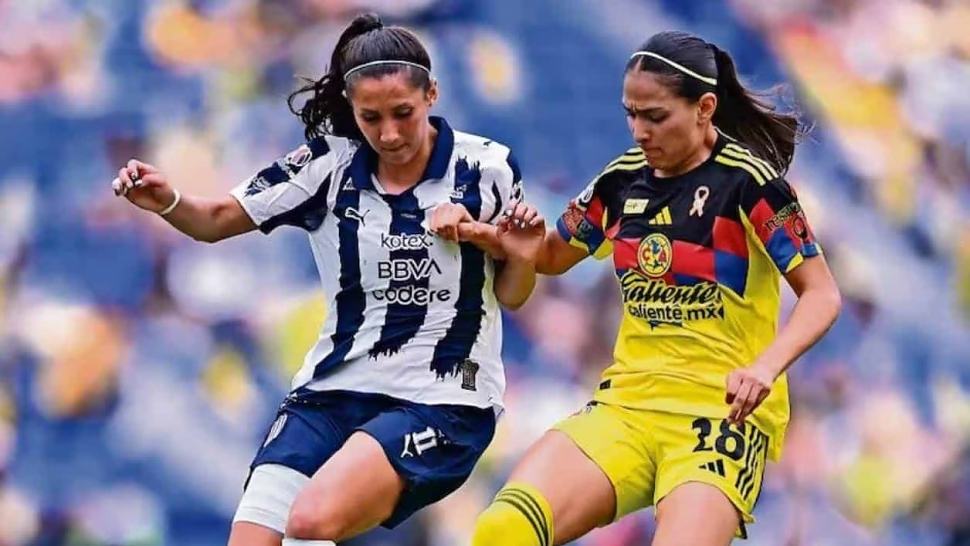
Liga MX Femenil changes its tournament: two groups and fewer dates

The Liga MX Femenil implements a two-group format to alleviate the calendar and optimize FIFA dates.

The Liga MX Femenil is preparing for Apertura 2026 with a restructuring that modifies the traditional format. The new distribution seeks to reduce the load of matches and better adapt to international commitments.

New competition scheme

The 18 clubs will be divided into two groups of nine teams. Each squad will play 14 games: eight against rivals from the same sector and six against clubs from the opposite group. This eliminates double days and optimizes FIFA dates.

“We are making a reform, we are eliminating double days and connecting better with the fans,” declared Mikel Arriola, president commissioner of the FMF and Executive President of Liga MX.

Group distribution

  • Group A: Tigres, Rayadas, Toluca, Cruz Azul, FC Juárez, Atlético de San Luis, Querétaro, Atlante and Santos.
  • Group B: América, Chivas, Pachuca, Pumas, Tijuana, León, Atlas, Puebla and Necaxa.

The design seeks to balance the competition and facilitate the physical management of the soccer players. The board trusts that this model will benefit both the show and the players’ performance.

Continue reading

Mexico U-20 debuts against Antigua and Barbuda in the Concacaf Championship

Mexico begins its journey in the Concacaf U-20 Championship with its sights on the World Cup and Los Angeles 2028.

Debut with an obligation to win

The Mexican U-20 National Team begins its participation in the Concacaf Championship this Friday. The tournament, which is held between Puebla and Mexico City, not only grants tickets for the World Cup of the category, but also for the 2028 Los Angeles Olympic Games.

Under the direction of Alex Diego, the Tricolor faces Antigua and Barbuda at the Cuauhtémoc stadium. The team arrives with the label of favorite, backed by its history and the quality of its squad. The match is scheduled for 5:00 p.m. and will be broadcast on ESPN 3.

Mexico is in Group B along with Guatemala, Costa Rica and Antigua and Barbuda. One of its key figures is Hugo Camberos, a Chivas forward with experience in Liga MX. He is expected to be an offensive leader in the pursuit of international goals.

The national team has the obligation to start with a victory to advance to the next round. The contest represents an opportunity to measure the development of Mexican youth soccer against rivals in the region.

Continue reading