The Attorney General’s Office carries out extradition processes
The Attorney General’s Office (FGR) has formally handed over to the authorities of the United States Government two Mexican citizens subject to international arrest warrants for the commission of serious crimes. This procedure, based on the international legal cooperation treaties in force between both nations, represents a significant episode in bilateral collaboration in criminal justice matters. The execution of these extraditions underlines the institutional commitment to act in accordance with the legal frameworks established to combat impunity for high-impact crimes that transcend national borders.
Analysis of individual cases and their criminal contexts
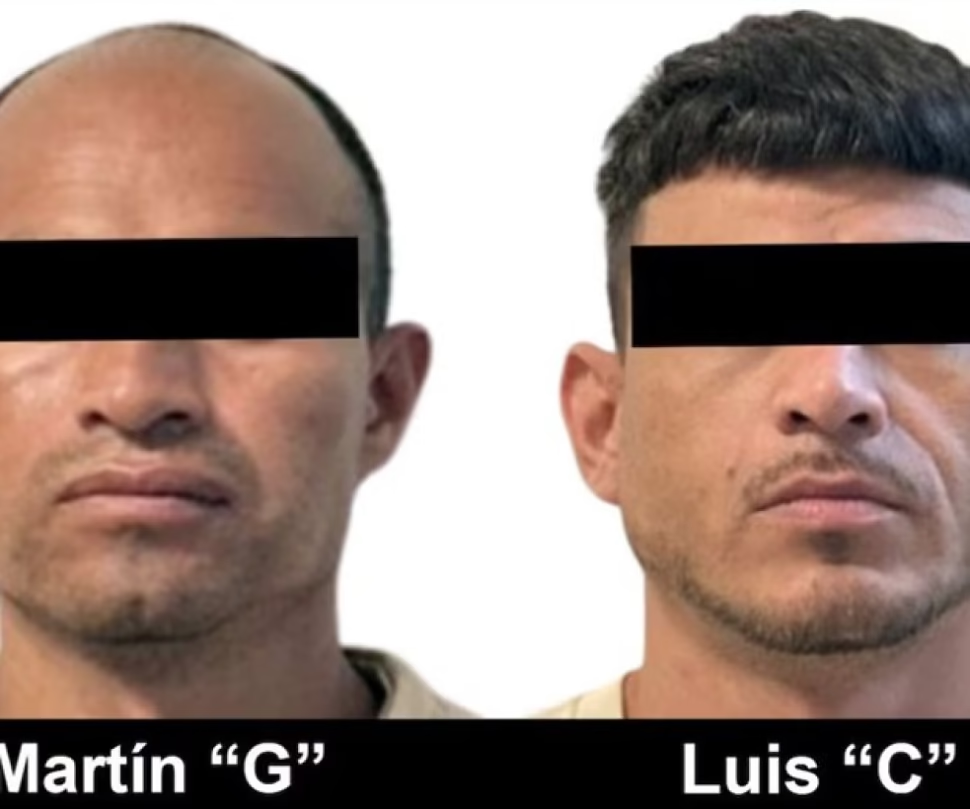
The first case corresponds to an individual identified as Martín “N”, who was formally requested by the General Sessions Court of the Thirteenth Judicial Circuit of Greenville County, located in South Carolina. The accusation against him arises from his alleged responsibility in the commission of sexual crimes, specifically for having sexually abused a minor. The seriousness of these crimes, which constitute one of the most severe forms of victimization, motivated an exhaustive search and location of the accused. His physical arrest was achieved in the municipality of Ixmiquilpan, in the state of Hidalgo, during the month of June 2025, thus beginning the administrative and judicial process for his eventual surrender.
In a second file, there is the case of Luis “N”, claimed by the Judicial District Court of Harris County, Texas. The extradition request for this subject is based on his alleged participation in a criminal act classified as homicide. According to court documents, the accused fired a firearm at another person, causing his death. The arrest of this individual took place in the border city of Matamoros, Tamaulipas, in April 2024, highlighting the operation of the security forces in areas of high criminal complexity.
The legal procedure and the physical delivery of those extraditable
After the arrests, the legal mechanisms provided for in the bilateral treaty were activated. The Federal Government of Mexico, after analyzing the requirements and verifying compliance with all formal and substantive requirements, granted the extradition of both defendants. This act of sovereignty reflects the principle of reciprocity and the political will to collaborate in the prosecution of crimes that, such as sexual crimes against minors and homicide, are considered universal in nature due to their extreme seriousness. The final point of this complex administrative and diplomatic process took place at the facilities of the Mexico City International Airport (AICM), where the two Mexicans were placed at the disposal of US agents expressly designated for their transfer and subsequent presentation before the corresponding courts in the United States.
From an international criminal law perspective, these cases illustrate the growing interdependence of judicial systems in addressing transnational crime. The effectiveness of an extradition process depends on a meticulous chain of legal custody, which includes the review of double criminality (that the act is considered a crime in both countries), the guarantee that the individual will not be tried for crimes other than those that motivated the extradition, and the certainty that its fundamental procedural guarantees will be respected. The surrender of these two individuals not only closes a search and capture stage, but also opens the procedural chapter in which they will have to face the accusations in the US justice system, under the standards and procedures of that country.
Does this information about international cooperation in justice seem relevant to you? Share this analysis on your social networks and visit our section to explore more content related to legal processes and security.