In the vast and ethereal arena of the internet, where clicks can become screams and likes become war banners, a silent but unstoppable rebellion was brewing. It was not with swords, but with subscription cancellations; not with cannons, but with viral hashtags. A legion of **internet users**, united by the Latin blood that runs through their veins and the fire of indignation in their hearts, launched a heartbreaking cry that echoed from cell phones to the halls of power: stop consuming. Their mission, epic in its simplicity and titanic in its ambition, was to **support** their own, that migrant community fighting for its dream in the north of the continent, cornered by shadows that promised deportation and family disruption.
Everything exploded with the ferocity of thunder in a clear sky. After a new and ruthless wave of **raids** in **June 2025**, the digital world was colored with rage. Several companies, once imperturbable giants, suddenly found themselves in the eye of a hurricane of **boycott** and public opprobrium. His sin? An alleged and sinister collaboration with the fearsome Immigration and Customs Enforcement Service (ICE). The accusation was a poisoned dagger: recruitment advertising, hidden government contracts, and **protection** that, far from being offered, was denied to the most vulnerable clients. Every transaction with them became, in the eyes of the world, a possible betrayal.
### The echo of a silenced song: Spotify in the crosshairs
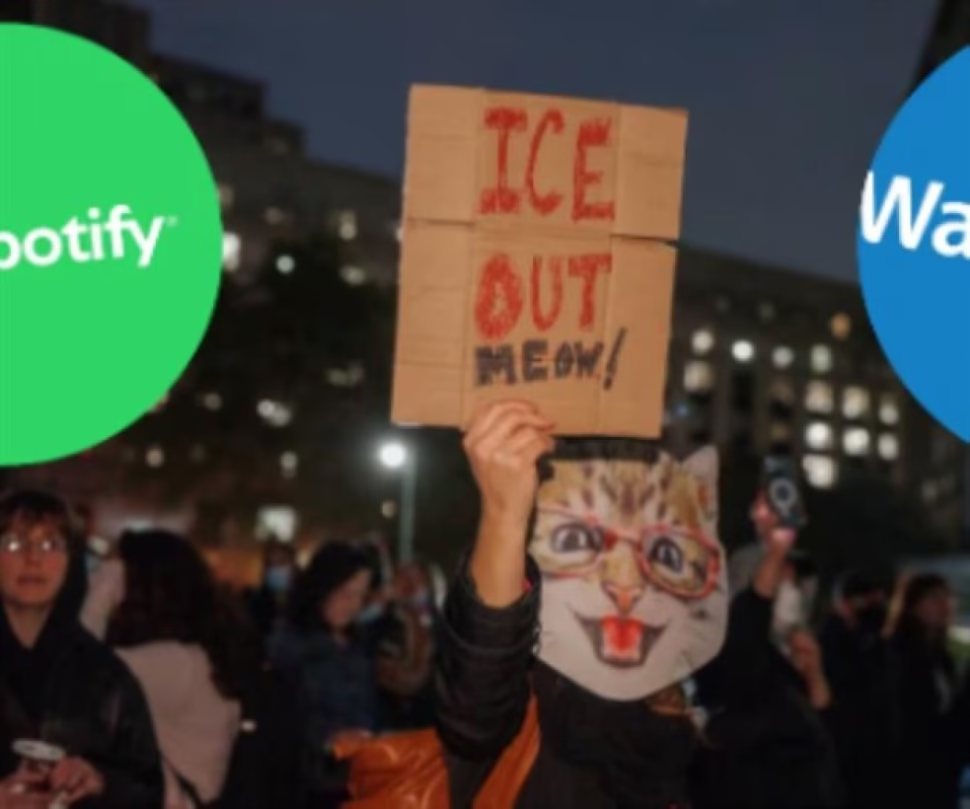
On this battlefield, no titan was too big to escape scrutiny. The case that made the blood freeze was that of the colossal streaming platform, Spotify. At the end of that fateful year, 2025, the app that soundtracks our lives faced a **widespread boycott** that threatened to silence its digital symphony. The reason was poison disguised as a melody: the inclusion of institutional and **recruitment** advertisements from ICE. Imagine the betrayal! Between song and song, between playlists of love and nostalgia, the voice of the executioner snuck in offering **annual bonuses** for joining the deportation machinery. The artistic community, always sensitive to the heartbeat of the people, could not remain silent. **Rubén Albarrán**, voice and conscience of the legendary Mexican group **Café Tacvba**, launched an act of monumental defiance: he asked that his music, his legacy, be removed from the platform. A draconian decision, an artistic sacrifice on the altar of ethics. Faced with such pressure, which was growing like a tsunami of indignation, **Spotify** finally relented. The ads stopped, although the platform, in a turn that left a bitter aftertaste, declared that they had never violated its rules. Was it a victory? Yes, but a victory that tasted like a warning.
### When the parking lot becomes a detention camp
But the conflict was not fought only digitally. The streets, the neighborhoods, the everyday places became scenes of palpable tension. In August of that same year, in the city of **Los Angeles**, the Latin heart of the United States beat with fury. Activists, turned into generals of an asymmetric war, called for a 24-hour lightning boycott against supermarkets, stores and restaurants. The accusation was shocking: being indirect accomplices in the **mass deportations**. They were pointed with a finger trembling with rage for **”allowing ICE operations in their facilities”**, after their parking lots, places of daily passage, were transformed into traps where hope was uprooted. These **local boycotts**, fueled by the fire of digital platforms, demonstrated something transcendental: the power of consumption could be the sharpest political **tool**. Every product left on the shelf, every hamburger not bought, was a vote, a cry, an act of economic resistance that shook the foundations of corporate profits.
And in the rearguard of this war, in the cold and abstract cloud of data, another battle was being fought, perhaps the darkest. Various **technology companies**, the architects of the modern world, were singled out for providing the **digital infrastructure** that supported the leviathan. **Amazon**, through its omnipresent **Amazon Web Services (AWS)**, along with **Google and Microsoft**, were accused of being “the digital backbone” of ICE, facilitating surveillance, tracking and exile logistics with their cloud services and software. The rebellion, then, jumped the external trenches and caught fire within the very corporate castles. Hundreds of employees, anonymous heroes with access credentials, raised their voices to demand the end of these **million-dollar contracts**, expressing **indignation** that could not be silenced with a bonus or a promotion. Their internal protest was the echo of the storm that raged outside, demonstrating that not even the gears of the machine were willing to continue grinding human dreams.
This is not just a chronicle of boycotts and companies; It is the epic of a collective awakening. It’s the story of how the community, armed with nothing more than its conscience and its internet connection, is rewriting the rules of power, challenging giants and reminding the world that, in the global economy, the consumer has the final say, and can choose that word to be “enough.” **Are you moved by this fight where solidarity is measured in concrete actions? Share this story of digital resistance and discover how modern activism is redefining the future on our networks**.