The Recipe (That Did Work) Against Poverty
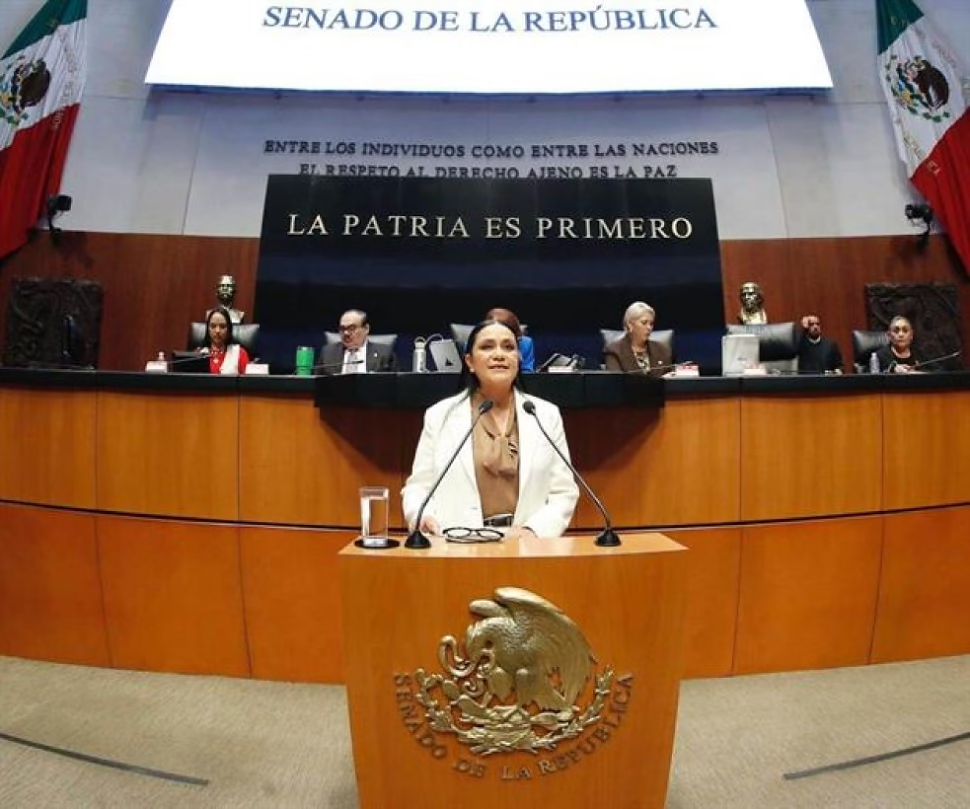
Imagine this: a government official arrives at the Senate, but instead of the usual speech full of technicalities that make us want to scroll infinitely, she releases data that, it must be admitted, makes us blink. Ariadna Montiel Reyes, the head of the Ministry of Welfare (yes, the one that has become a trending topic for reasons that are not a meme), stood in front of the plenary session and basically said: “things are working.”
Its central thesis, which reached us more than a reel at 3 in the morning, is that the historical reduction in poverty is neither an accident nor an Instagram filter. According to her, it is the result of a successful formula applied by the administration of President Claudia Sheinbaum. I mean, someone finally found the instruction manual that the rest of the world seems to have lost.
The Numbers That Make Everyone Say “Wait, What?”
This is where things get interesting, because the data he released is not typical to keep in a drawer. Mrs. inequality, the one that has us all in trouble when traveling, was reduced in a way that almost asks for a “it can’t be.” It turns out that, in this parallel universe that we call Mexico, the income of the poorest households increased by 35% between 2018 and 2024. Meanwhile, that of the richest households only grew by 4%. The difference is so huge that it almost seems like a typo, but she confirmed it.
And the star data, the one that deserves to be saved in favorites: 13.4 million people escaped poverty. To give you an idea, it is as if the entire population of a huge city collectively decided that its economic situation was going to take a 180 degree turn. Currently, a whopping 32 million souls receive the support of some Wellness Program, with a social investment that is around 850 billion pesos. A figure that hurts even trying to pronounce it.
And how did they do it? Montiel, with the tranquility of someone who has the results in his favor, attributes it to governing with honesty and republican austerity (terms that, let’s be honest, we do not hear together very often). That combination, apparently, frees up resources to invest in people. An idea as revolutionary as finding a streaming series that is truly worth it.
The Catalog of Programs That Sound Like a Seasonal Hit
For those who think this is pure theory, the secretary deployed the arsenal of social programs as if it were her favorite playlist. There were the heavy hitters: the Women’s Welfare Pension, the Pension for the Welfare of the Elderly (our grandparents deserve the best), and the Pension for the Welfare of People with Disabilities.
But it didn’t stop there. The reinforcements also arrived: House to House Health (like delivery, but for well-being), the Support Program for the Well-being of Girls and Boys, Children of Working Mothers (a title so long that it almost needs its own budget), the “Rita Cetina” scholarship, and Young People Writing the Future. Basically, a social protection strategy that tries to cover all the bases, from the cradle to adulthood.
The magic formula, according to the official narrative, combines three main ingredients: the social protection system (the safety net), the historic salary improvement (more money in people’s pockets), and a public investment that generates decent jobs (because a job should be for living, not for surviving).
Montiel’s final message was so optimistic that it almost shines: “The best is coming for Mexico. We move forward with the strength of the people, building justice and well-being for future generations.” A statement that, in the chaotic world in which we live, sounds almost like an act of collective faith. We’ll see if the algorithm of life likes this prediction.
Are you surprised by these figures on poverty reduction? Share this note on your social networks and get your community to give their opinion. And if you want to continue exploring the real impact of social policies, discover more analyzes like this on our site.