Slim wins million-dollar tender for railway section with controversy

A parade of million-dollar offers where the experience outweighed the price, leaving doubts about the coexistence of roads.

The tycoon who has everything… now also has 111 km of roads

It seems that the universe, in its infinite wisdom, has decided that the only thing missing from Carlos Slim‘s vast collection was a new little train. That’s right, the consortium of the man who probably has a hundred peso bill with his own face on it (we speculate, but it wouldn’t surprise us) has been awarded the juicy task of building a 111 kilometer stretch of the passenger train that will connect Saltillo, Coahuila, with Santa Catarina, Nuevo León. Because clearly, what the region needed was another way for the richest man in Mexico to get a little richer.

The companies Operadora CICSA and FCC Construction, part of Slim’s empire, won the work with a bid of 31,843 million pesos. A figure so astronomical that it makes buying a coffee at Starbucks sound like bartering for seeds. The most curious thing about the matter is that, from the moment the quotes were presented to the Railway Transport Regulatory Agency (ARTF), they were the clear favorites. Chance? Or does the mere fact that Slim is behind an offer automatically make it the winner? Rhetorical questions that we probably all ask ourselves.

RelatedCarlos Slim’s group will build key section of the Saltillo-Monterrey train

The tender of absurdities: where cheap is expensive… for others

In this fascinating contest of “Who wants to be a millionaire?… more”, there was one offer that stood out for its, ahem, “daring”. The group of Construcciones Ferroviarias del Noroeste and Moven Construcciones had the audacity to ask for only 18,201 million pesos. How naive! Didn’t they know that in the big leagues of Mexican public works the important thing is not to be the cheapest, but to have the right friends? They were disqualified for inexperience, a reason so vague and subjective that it could very well be applied to a teenager trying to make his first omelette. Of course, because in this country, experience is measured by the size of the portfolio, not the portfolio.

The other participants also did not fall short in the festival of surreal numbers. Azvindi, from the Mexican Grupo INDI and the Spanish company Azvi, together with ICA (veterans in the endless saga of the Mayan Train), asked for more than 40 billion pesos. Meanwhile, the CAABSA and OHL consortium, which already know what it’s like to deal with the Mexico-Toluca Interurban Train, raised an offer of 34,697 million pesos. Come on, a true price bazaar where he who has the most, offers the most… and sometimes wins with the middle one.

The works have a execution period of 32 months, which in colloquial Spanish translates as “a couple of years, if there are no setbacks… which there always are.” But here comes the best: CICSA will have to prepare from the executive project. Translation? They are building the plane as it takes off. And if this wasn’t fun enough, during the bidding, the ARTF politely refused to clarify multiple doubts about how the new passenger track will coexist with the freight track that already exists and operates. Is it like asking how you will fit one more elephant into your 40 m² apartment? Don’t be a party pooper! That is a technical detail that is resolved on the fly, probably with a lot of faith and a couple of hammer blows.

In short, we are facing another monumental work that promises to revolutionize transportation… or become the next coffee table novel full of cost overruns, delays and creative explanations. But hey, at least we’ll have a new train. Or so we hope. Meanwhile, we mere mortals will continue traveling in trucks that look like sardine cans on wheels, dreaming of the day when we can board the irony express.

Are you intrigued to see how this railway epic unfolds? Share this gem of news on your social networks and join the spectators’ club! And be sure to explore more content about the great feats of national infrastructure on our site.


AICM taxi drivers refuse to apply discounts agreed for the World Cup

Three AICM taxi drivers groups refuse to apply discounts of up to 18% during the World Cup.

Three groups of taxi drivers that operate at the Mexico City International Airport (AICM) refused to apply discounts of up to 18% on their rates during the World Cup. The measure contradicts previous agreements announced by airport authorities and part of the union.

The companies Nueva Imagen, Porto Taxi and Sitio 300 issued a statement to clarify their position. They argued that they have no contractual relationship with the Grupo Aeroportuario Marina (GAM), the entity that promoted the benefits for airport users.

According to permit holders, the announced discounts do not represent a direct reduction in rates. They are, they say, adjustments derived from compensation for improper charges and administrative processes for maintenance work at the AICM.

They demand transparency

The taxi drivers asked the AICM authorities to make public the documents that support these measures. They also called on the GAM to make transparent the minutes and contracts where the application of discounts had been agreed upon. They questioned the legal validity of the obligations attributed to them.

The refusal could affect users who expected more affordable rates during the sporting event. Until now, there is no certainty about the real cost of service at the AICM during the World Cup.

Continue reading

Morena opens the door to a coalition with the PVEM in San Luis Potosí

Morena conditions alliance on PVEM ruling out Ruth González for the governorship.

Morena-PVEM Coalition for 2027?

The state leadership of Morena in San Luis Potosí left open the possibility of an alliance with the Green Ecologist Party (PVEM) for the local elections of 2027. The condition: that the PVEM present a different profile from that of Senator Ruth González.

Rita Ozalia Rodríguez Velázquez, state president of Morena, explained that if the PVEM discards Ruth González—wife of Governor Ricardo Gallardo—the green party could lead the coalition, which would also integrate the Labor Party (PT).

The leader clarified that the relationship with the PVEM at the local level does not face a conflict, although she admitted that there is no direct communication between both state leaders. Decisions about alliances, he said, are made by national leaders.

The possible agreement arises in the midst of the debate about nepotism, after Ruth González’s intention to succeed her husband in the state government was questioned. Morena looks for profiles that avoid that controversy.

Rodríguez Velázquez stressed that there is coordination between the party leadership to define the electoral strategy. For now, the panorama in San Luis Potosí remains open.

Continue reading

Morena accuses INE advisors of being ‘ill-wishers’

The Morena leader accuses INE advisors of being 'ill-wishers' and defends her affiliation system.

Morena questions the impartiality of the INE

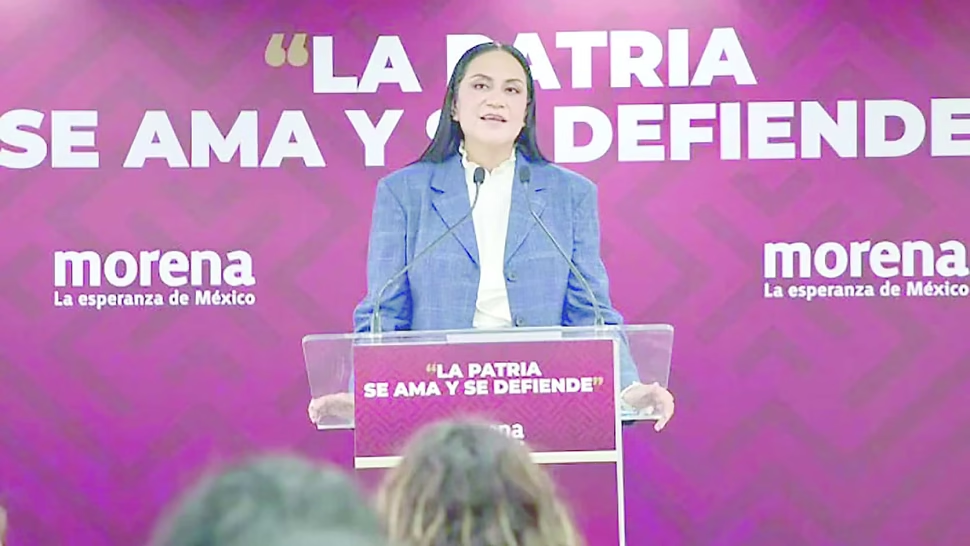
The national leader of Morena, Ariadna Montiel Reyes, pointed out that within the INE there are advisors with critical positions towards her party. He described them as “Morena haters” during a press conference where he addressed recent resolutions on duplicate affiliations.

Montiel affirmed that his party abides by the determinations of the Electoral Court. The authority ordered the elimination of more than 93 thousand affiliate records and leave under review about 19 thousand cases that the INE must verify.

The leader demanded that the institute adhere to the resolutions of the General Council and not to individual opinions. He accused that there are figures close to past electoral administrations who maintain a critical stance towards the movement.

Regarding the affiliation system, Montiel defended that Morena’s application is efficient. He assured that it surpasses that of the INE in functionality, since it allows duplications in the records to be detected.

He also proposed that the INE should have real-time verification mechanisms to cross-check affiliation data. However, he acknowledged that there are different processes between parties and the electoral authority.

Continue reading