Sheinbaum supervises support for victims in Hidalgo

The federal president continues her tour of states affected by extreme rainfall, while the director of the ISSSTE reports hundreds of people treated.

The Solidarity Caravan (with cameras) arrives in Hidalgo

It seems that the itinerary of the president Claudia Sheinbaum Pardo is tighter than the schedule of a delivery person on sale day. After marking her assistance card in Tamaulipas, our tireless leader appeared this Saturday, October 18 in Hidalgo, because what better plan for a weekend than to personally supervise the support for the affected families? One can almost imagine the logistics: “Okay, team, today it’s time to smile for the photo and show that the government is in the game, literally, against the floods.”

There, in the picturesque Acopio Center of the Juan Guillermo Villasana Airport, the meeting that we all expected took place: the protocol hug and the look of serious concern with Governor Julio Menchaca. The setting was so perfect that you could almost hear a community manager whisper in the background: “Make sure the aid boxes are in the shot, please.” It was then that the state president, with the solemnity of someone announcing the trailer for a superhero movie, declared: “We began another day of supervision and work in support of Hidalgo families.” One wonders if “journey” is the new euphemism for “lightning tour with high photogenic value.”

RelatedFederal government supervises support in Hidalgo after rains

The ISSSTE also marks a presence (and keeps score)

But the supporting cast could not be missing. To give a touch of medical drama to the situation, Martí Batres

Not content with this meticulous examination, Mr. Batres proceeded to release a piece of information that sounded more like a quarterly sales report than a humanitarian report: “In the ISSSTE hospitals of Hidalgo, Puebla, Veracruz, San Luis Potosí and Querétaro, 194 affected people have been received and treated.'” 194! A number so specific that it inspires absolute confidence, or perhaps makes us wonder if someone had to make a spreadsheet at midnight to get the figure ready for the photo. It’s comforting to know that, amid the chaos of extreme rainfall and natural disasters, hospital bureaucracy keeps its records impeccable. Will there be a special stamp for the file that says “Rain Damage, Seen by Principal”?

The entire scene is simply moving. While ordinary citizens fight to save their belongings from the mud and water, the government leadership walks through the assistance centers for victims as if they were on a tourist route of the calamity. “And to your left, you can see a family that lost their home; to the right, the bags of aid that will arrive…eventually. Don’t forget your photos for the press release.” It is the eternal ballet of politics in the face of climatological emergencies, where the perception of action is as crucial as the action itself, or perhaps a little more.

You cannot deny the work of the rescue teams and the health professionals who are on the front line, doing the heavy and anonymous work. But one can’t help but smile cynically at the spectacle of senior officials arriving, supervising and reporting with a numerical precision that would make an accountant blanch. It’s almost as if they believe that our capacity for wonder is so low that we settle for seeing them appear at the scene of the event, like bureaucratic superheroes who resolve crises with the magical appearance of their presence and a couple of statistics.

In the end, the message is clear: the federal government and its allies are “on the ground.” And what better way to demonstrate it than with a careful choreography of meetings, statements and numbers that, we hope, will translate into tangible and effective help for all those who have seen their lives altered by the fury of nature. Because, at the end of the day, what it is about is reconstruction and resilience, not just filling albums with official press clippings.

Did you find it an irreverent look at current events? Don’t be left with the irony, share this article on your social networks and help us make a different perspective viral. And of course, explore more content related to national politics and climate events on our site.
Imports of Mexican cattle to the US resume

Following a health agreement, the US will reopen the port of Douglas, Arizona, for Mexican cattle.

President Claudia Sheinbaum reported that the United States will resume importing Mexican cattle starting the last week of August. The decision came after an official communication from the US Secretary of Agriculture, Brooke Rollins.

Reopening schedule

The reopening will begin at the border port of Agua Prieta, Sonora, linked to the Douglas crossing, Arizona. August 24 will be the first date of operation. Later, two additional points will be enabled in Chihuahua, subject to compliance with the Joint Action Plan against screwworm.

Sheinbaum instructed federal agencies to accelerate coordination with US authorities. He highlighted the work of the Secretary of Agriculture, Julio Berdegué, and the director of Senasica, Columba López, to strengthen health measures.

  • The animals will enter with complete inspections to verify that they do not show signs of the plague.
  • Later, the opening of the ports of Santa Teresa and Columbus, in New Mexico, will be evaluated.

The president described the news as positive for Mexican ranchers, who for months contained the spread of the screwworm. He appreciated Rollins’ willingness to maintain an institutional relationship.

Rollins, for his part, stated that the protection of the US livestock industry remains a priority and that the temporary closure of crossings was necessary to reduce risks. The reopening is possible thanks to binational collaboration.

Continue reading

More than eight million apocryphal cigarettes seized in Manzanillo

Joint operation in Manzanillo detected shipment of counterfeit cigarettes.

Operational in the port of Manzanillo

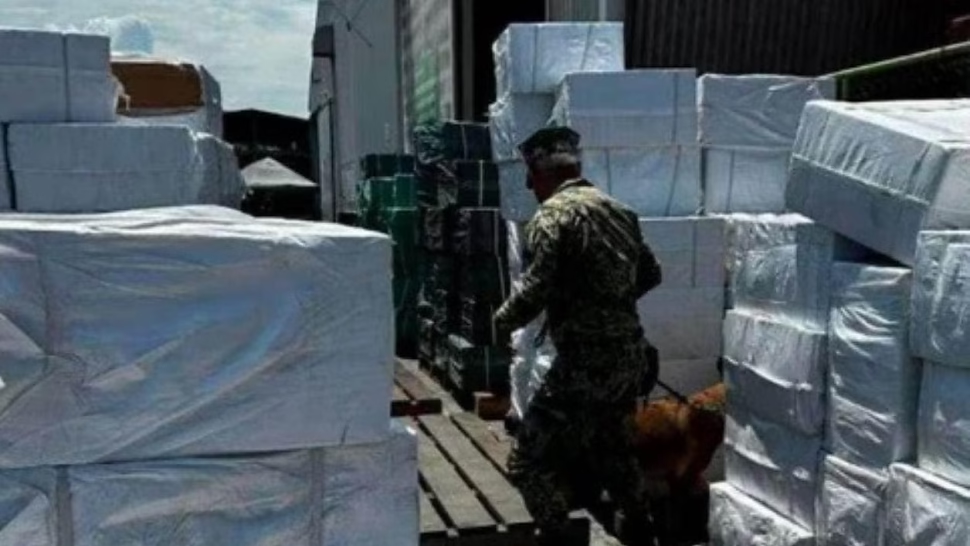
Federal authorities seized more than eight million allegedly apocryphal cigarettes in the port of Manzanillo, Colima. The operation was coordinated by agencies of the security cabinet and the National Customs Agency of Mexico (ANAM).

Personnel from the ANAM and the Administrative Unit of the Manzanillo Customs detected inconsistencies in an operation to import cigarettes from abroad. This led to a specialized review.

As a result of the inspections, the authorities located 8 million 436 presumably counterfeit cigarettes. The merchandise was insured with the support of the Secretary of the Navy (Semar).

The ANAM reported that this type of operations are part of the permanent mechanisms of operational intelligence, risk management and strategic analysis. The objective is to strengthen security in foreign trade operations and detect documentary irregularities or goods of illicit origin.

The comprehensive analysis of the operation made it possible to reinforce documentary traceability, operational review and validation of commercial profiles. The authorities maintain surveillance at entry points into the country to combat illegal trade.

Continue reading

Perception of insecurity drops to 59.8%: Sheinbaum

Perception of insecurity in Mexico drops to 59.8%, the lowest figure since 2018.

ENSU results

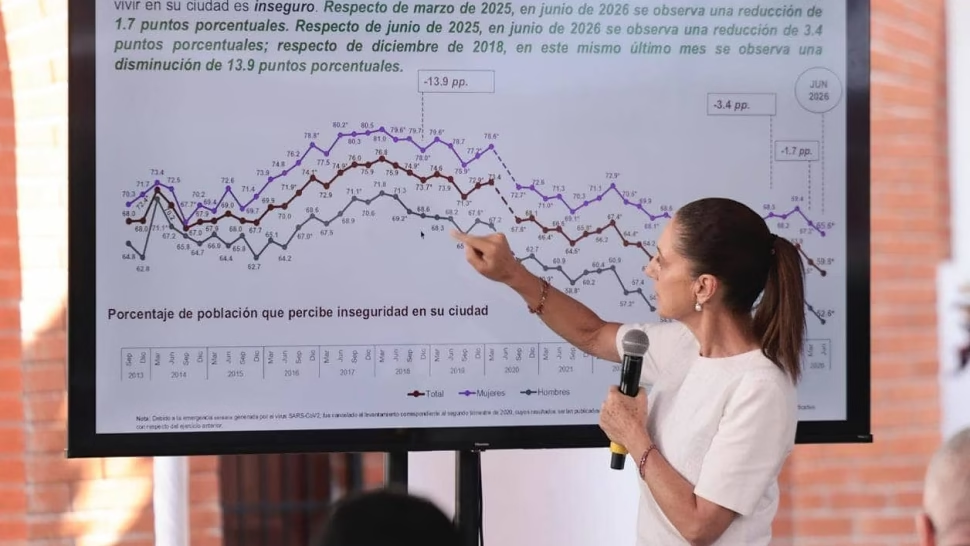
President Claudia Sheinbaum reported that the perception of insecurity in urban areas fell to 59.8% in June 2026, according to the National Urban Public Security Survey (ENSU) of the INEGI. In December 2025 it was 63.8%, which represents six consecutive months of decline.

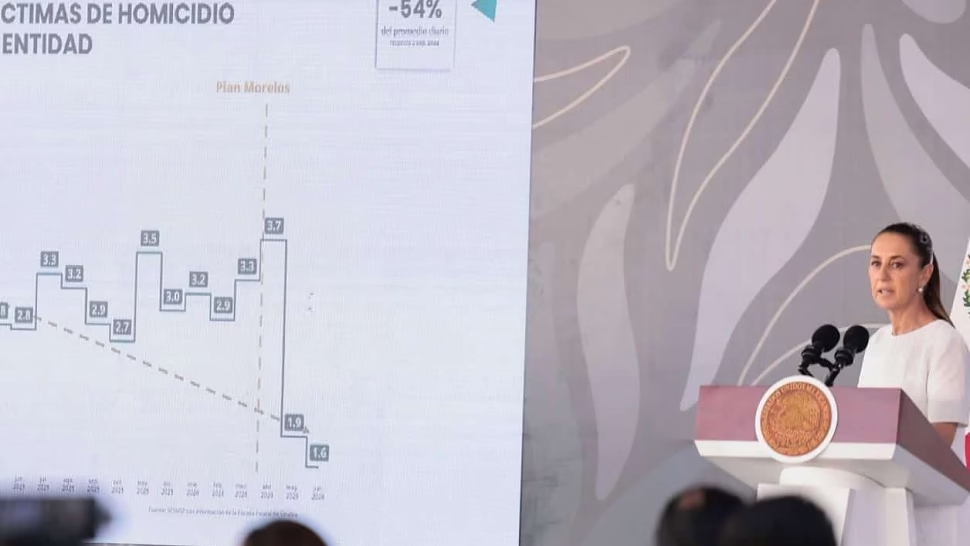
“The important thing here is that we are giving results in the security indicators and people are beginning to notice this decrease,” he said during the morning conference in Cuernavaca, Morelos.

Historical comparison

Sheinbaum recalled that in December 2018, under the government of Andrés Manuel López Obrador, the perception of insecurity was 73.7%. The previous lowest point was reached in September 2024 at 58.6%. The president attributed the improvement to the National Security Strategy.

The ENSU measures citizens’ feeling of insecurity in their environment. Recent data reflects a positive trend, although the challenge remains to maintain the reduction in crime. The authorities continue to implement actions to consolidate these results.

Continue reading