Sheinbaum supervises aid to victims in Veracruz

The president supervises on the ground the delivery of resources and the cleanup after the catastrophic floods that hit the region.

A Return That Marked the Destiny of an Affected Region

On a Thursday that seemed to decide the future of thousands, President Claudia Sheinbaum Pardo rode back to the heart of the tragedy: Veracruz. His mission was not a simple protocol visit; It was an epic inspection of the vital support for the affected families, those whose lives were devastated by the unleashed fury of the rains and floods. The atmosphere was charged with a palpable urgency, as if every minute counted in this battle against the elements.

From her social networks, the president launched a message that resonated like an oath. In the emblematic Poza Rica, a bastion of the fight against devastation, he personally supervised the progress of the titanic cleanup. It was not a mere tour; It was an immersion in the epicenter of pain, a visit to the support delivery center where hope and despair intertwined. With words that sought to heal deep wounds, he declared: “They are not alone, help and attention to needs continues.” At his side, a cohort of loyalists stood: Governor Rocío Nahle, Welfare Secretary Ariadna Montiel, and Efraín Morales, the head of the powerful National Water Commission (Conagua). Together, they formed a united front against adversity.

RelatedSheinbaum supervises federal assistance in Veracruz after rains

The Journey Continues Toward Another Critical Front

But the mission could not stop. With the determination of a heroine in an endless saga, the federal president set out towards Álamo, another of the Veracruz municipalities that had succumbed to the climate catastrophe. Every kilometer traveled was a reminder of the vast extent of the disaster. From the field, Governor Nahle, with the firm voice of one who shares the burden, proclaimed: “We continue working together for the recovery and well-being of the people of Veracruz.” It was a promise of unbreakable alliance in the midst of chaos.

The master plan had been revealed hours before, in the morning conference from the majestic National Palace. There, Sheinbaum had solemnly announced his trip to Veracruz and Puebla, a journey intended to supervise the sanitation work and the delivery of direct support to the population. This offensive was part of the strategic actions of the Government of Mexico, a forceful response to the extraordinary rainfall that, on a fateful October 9 and 10, had unleashed hell on earth.

The Answer: A Mosaic of Hope and Resources

And then, the time came for tangible action, for promised relief. The president reminded the world that, just the day before, the distribution of the first direct support of 20 thousand pesos had begun. This economic rescue was complemented by food vouchers and household goods, a lifeline thrown to the affected population in Veracruz, Puebla, Querétaro and San Luis Potosí. But the relief plan did not end there. In yet another twist to this epic, it was announced that on October 25, aid would extend to Hidalgo, bringing comfort and resources to another front of this war against nature. Each peso, each voucher, was a piece in the complex puzzle of national reconstruction.

Did you witness solidarity in your community? Share this immediate response story on your social networks and help spread the word about recovery efforts. Explore more content on government action in emergency situations.
Imports of Mexican cattle to the US resume

Following a health agreement, the US will reopen the port of Douglas, Arizona, for Mexican cattle.

President Claudia Sheinbaum reported that the United States will resume importing Mexican cattle starting the last week of August. The decision came after an official communication from the US Secretary of Agriculture, Brooke Rollins.

Reopening schedule

The reopening will begin at the border port of Agua Prieta, Sonora, linked to the Douglas crossing, Arizona. August 24 will be the first date of operation. Later, two additional points will be enabled in Chihuahua, subject to compliance with the Joint Action Plan against screwworm.

Sheinbaum instructed federal agencies to accelerate coordination with US authorities. He highlighted the work of the Secretary of Agriculture, Julio Berdegué, and the director of Senasica, Columba López, to strengthen health measures.

  • The animals will enter with complete inspections to verify that they do not show signs of the plague.
  • Later, the opening of the ports of Santa Teresa and Columbus, in New Mexico, will be evaluated.

The president described the news as positive for Mexican ranchers, who for months contained the spread of the screwworm. He appreciated Rollins’ willingness to maintain an institutional relationship.

Rollins, for his part, stated that the protection of the US livestock industry remains a priority and that the temporary closure of crossings was necessary to reduce risks. The reopening is possible thanks to binational collaboration.

Continue reading

More than eight million apocryphal cigarettes seized in Manzanillo

Joint operation in Manzanillo detected shipment of counterfeit cigarettes.

Operational in the port of Manzanillo

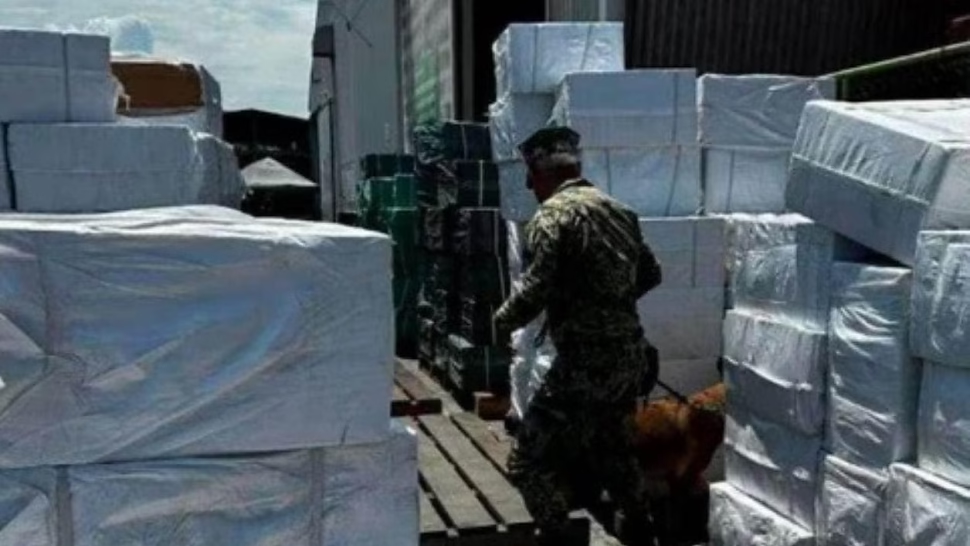
Federal authorities seized more than eight million allegedly apocryphal cigarettes in the port of Manzanillo, Colima. The operation was coordinated by agencies of the security cabinet and the National Customs Agency of Mexico (ANAM).

Personnel from the ANAM and the Administrative Unit of the Manzanillo Customs detected inconsistencies in an operation to import cigarettes from abroad. This led to a specialized review.

As a result of the inspections, the authorities located 8 million 436 presumably counterfeit cigarettes. The merchandise was insured with the support of the Secretary of the Navy (Semar).

The ANAM reported that this type of operations are part of the permanent mechanisms of operational intelligence, risk management and strategic analysis. The objective is to strengthen security in foreign trade operations and detect documentary irregularities or goods of illicit origin.

The comprehensive analysis of the operation made it possible to reinforce documentary traceability, operational review and validation of commercial profiles. The authorities maintain surveillance at entry points into the country to combat illegal trade.

Continue reading

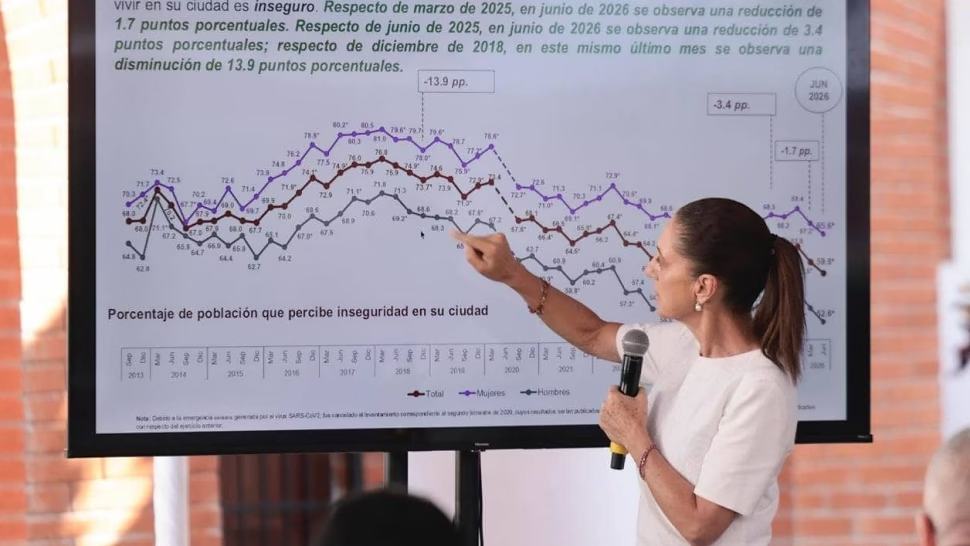
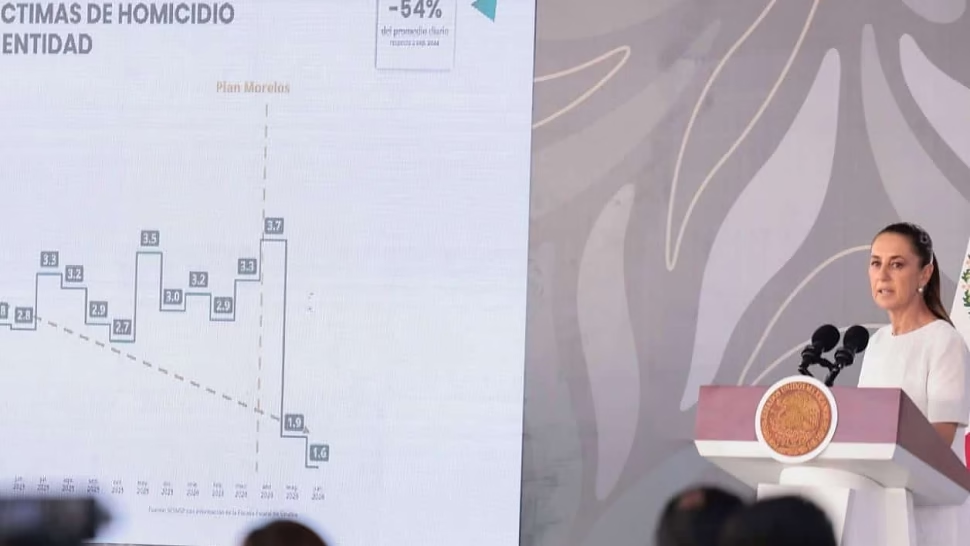
Perception of insecurity drops to 59.8%: Sheinbaum

Perception of insecurity in Mexico drops to 59.8%, the lowest figure since 2018.

ENSU results

President Claudia Sheinbaum reported that the perception of insecurity in urban areas fell to 59.8% in June 2026, according to the National Urban Public Security Survey (ENSU) of the INEGI. In December 2025 it was 63.8%, which represents six consecutive months of decline.

“The important thing here is that we are giving results in the security indicators and people are beginning to notice this decrease,” he said during the morning conference in Cuernavaca, Morelos.

Historical comparison

Sheinbaum recalled that in December 2018, under the government of Andrés Manuel López Obrador, the perception of insecurity was 73.7%. The previous lowest point was reached in September 2024 at 58.6%. The president attributed the improvement to the National Security Strategy.

The ENSU measures citizens’ feeling of insecurity in their environment. Recent data reflects a positive trend, although the challenge remains to maintain the reduction in crime. The authorities continue to implement actions to consolidate these results.

Continue reading