Sheinbaum supervises a development center in Tlaxcala with a million-dollar investment

The president highlights a public-private collaboration model that already attracts capital and promises thousands of jobs in the region.

A pole, many adjectives and a tour that starts with a bang

HUAMANTLA, Tlaxcala.- To start the year with vigor (and with headlines), President Claudia Sheinbaum Pardo chose as her first stop in 2026 to supervise the Pole of Economic Development for Well-being, or PODECOBI for friends who love acronyms. Located in the vast plains of Huamantla – more than 50 hectares, so that no one is left in doubt of its enormity – this project has already achieved the miracle of convincing seven companies, national and international, that investing here is a brilliant idea. Imagine the scene: smiling authorities, vast lands and the promise of progress floating in the air, more palpable than the dust of the road.

In statements that seem taken from a promotional brochure, Sheinbaum stressed: “It is a very efficient model that they have, that the governor has, to attract private investments.” Of course, “they” and “the governor” are separate entities in this political choreography, but the message is clear: private capital is welcomed, celebrated and photographed alongside the authorities. The federal president, with her impeccable timing, highlighted that this development center reflects the “trust that exists in Mexico.” One wonders if that trust also includes the patience to navigate bureaucratic procedures, but that is a detail that is left out of the script.

RelatedSheinbaum supervises economic development hub in Tlaxcala with seven companies

Millions, jobs and a tight delivery time

The figures, as in any good presentation, are juicy: a total investment of 540 million dollars and the generation of up to 6 thousand jobs. Six thousand. A number round and significant enough to repeat in every press release. Governor Lorena Cuéllar Cisneros, in a burst of calendar optimism, declared that the goal is to have everything completed by the end of February. February 2026, it is understood, which leaves a margin of… a couple of months. Nothing like a tight deadline to get everyone running!

The presidential tour was not exempt from its obligatory entourage. Accompanying the Chief Executive, the Secretary of Economy of Tlaxcala, Javier Marroquín Calderón, and the general coordinator of Wellbeing Programs, Carlos Torres Rosas, paraded. A perfect entourage to ensure that every step, every glance at an architectural plan and every handshake were duly recorded. Because, what good is a development pole if it is not accompanied by a pole of public figures posing?

Deep down, beyond the rhetoric and protocol photos, the PODECOBI of Huamantla stands as an interesting experiment: a hybrid model where the government offers the land and the framework, and the private sector provides the capital and, theoretically, the efficiency. A marriage of convenience where everyone promises to live happily ever after, or at least until the next financial reporting cycle. Only time will tell if those 50 hectares become a real economic driver or another well-intentioned white elephant. Meanwhile, the shovelfuls of earth continue to move to the rhythm of the speeches.

Are you intrigued to see how these regional development projects evolve?Share this note on your social networks and explore more content on economics and investment on our site.

Sheinbaum supervisa Polo de Desarrollo en Huamantla

Senate will review regulation of militarized schools after fatal cases

Senator promotes review of 1943 regulations after deaths of minors in private military-type schools.

Review of regulations after fatal cases

Given the death of a 13-year-old girl in a private militarized school, Senator Guadalupe Chavira announced that the Senate will review the Regulations for Private Military-Type Academies, in force since 1943. The legislator described the ordinance as anachronistic and incompatible with the current protection of children’s rights.

The regulations allow military instruction from primary to technical levels, including shooting classes in secondary school and the use of grades that grant authority to certain students over others. Chavira pointed out that these are not isolated cases; In 2025, another 13-year-old minor died at the Ollin Militarized Academy, in Morelos, after suffering serious abuse during a camp.

“The tragedy that occurred with Dafne, whose suffocation under water is being investigated, should call us to reflection and action. These schools do not have the power to organize summer camps or to authorize practices such as hazing, which ended in the death of a 13-year-old girl,” declared the senator.

The Ministry of Public Education (SEP) reported that the academy where the case occurred was operating with a 2022 incorporation agreement. After being closed for investigations, the school resumed online classes claiming the students’ right to continue their training. The agency faces at least eight additional complaints of mistreatment.

Chavira demanded a new legal framework that grants the SEP clear regulatory powers, since the 1943 regulation leaves responsibility to the Secretariat of National Defense. Specialists warn that in these private schools discipline is imposed through violence and hierarchical submission, unlike official schools where there are human rights areas and supervision of the CNDH.

Continue reading

Defense distances itself from the academy after death at a young age

The agency cited the Internal Regulations to justify its position

The Secretariat of National Defense (Sedena) disclaimed any responsibility for the “Marina Doenitz” Militarized Academy, in Ciudad Madero, Tamaulipas, after the death of the young Dafne Zapata.

Through a statement, the agency stated that it lacks the power to authorize, supervise, inspect or regulate educational institutions of this type.

“It is reported that the Secretariat of National Defense lacks the power to authorize, supervise, inspect or regulate the operation of educational institutions of this nature, in accordance with the Internal Regulations of this agency, issued by the Presidency of the Republic through its publication in the Official Gazette of the Federation, on December 29, 2008, where any administrative provision that contravenes this order was repealed,” the agency wrote.

He added that, in accordance with these regulations, Sedena “has no relationship with the aforementioned academy, nor with any other establishment of this type.”

No clear supervision

The case has put the operation of private militarized schools under scrutiny. In several states of the country they have proliferated without there being a federal body that explicitly regulates them.

To date, no state or federal authority has assumed the responsibility of supervising these schools. The Tamaulipas Prosecutor’s Office investigates the events.

Continue reading

Navy Special Forces celebrate 25 years of service

Elite naval units commemorate 25 years with demonstrations of capacity and the Quachic Challenge.

Elite demonstration in Veracruz

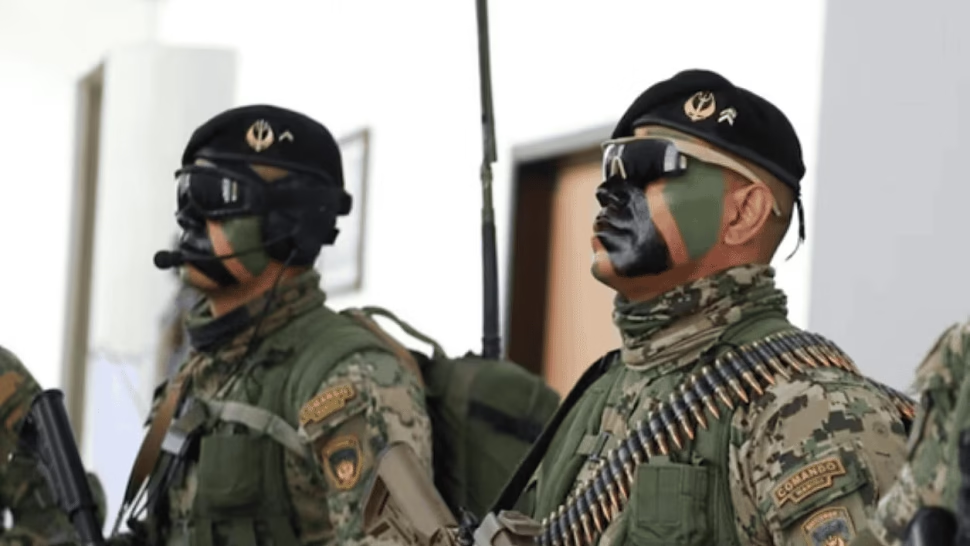
Members of the Special Forces and Amphibious Commands of the Mexican Navy commemorated their 25th Anniversary with an exhibition of their capabilities at the Heroic Naval Military School, in Veracruz. The units carried out sports activities, swimming circuits, walking with equipment, transporting the wounded, boat maneuvers and precision shooting.

Created in 2001, these units are specially organized, trained and equipped to operate in hostile or politically sensitive areas. Its staff has unique skills and competencies in their training.

Quachic Challenge and historical presentations

During the day, presentations were made on the evolution of the Special Forces and the Commandos, highlighting the quality of their preparation. A tactical gallery with specialized equipment was also set up.

The seventh edition of the national competition “Reto Quachic” was held, which included active personnel, cadets and retirees. The participants faced obstacles such as swimming 300 meters, walking 1,400 meters with 20 kilos of equipment and weapons, transporting the injured and boat, and precision shooting.

The exercises tested physical fitness, discipline and responsiveness, while fostering camaraderie and group cohesion. The commemoration not only celebrated an anniversary, but reaffirmed the importance of the continued training of these key units for national security.

Continue reading